

Why the Finance Office Deserves Your Full Attention
By the time you reach the finance and insurance (F&I) office at a dealership, you've likely already spent hours negotiating, test-driving, and discussing trade-ins. Fatigue is real - and dealerships know it. The pace of the paperwork signing process is often fast, with stacks of documents placed in front of you in quick succession. That environment is precisely why understanding what you're looking at before you arrive matters enormously.
A car loan agreement is a legally binding contract. Once signed, its terms govern every payment you'll make for the life of the loan - which might be 48, 60, or even 84 months. Errors, misrepresentations, or add-ons you didn't intend to accept become your financial responsibility the moment you sign. This is general financial education, not personalized financial or legal advice - for guidance specific to your situation, consult a qualified professional.
If you want to understand how this signing stage fits into the broader purchase process, see our step-by-step car buying guide for context on every stage from research to delivery.
The Key Sections Every Borrower Should Verify
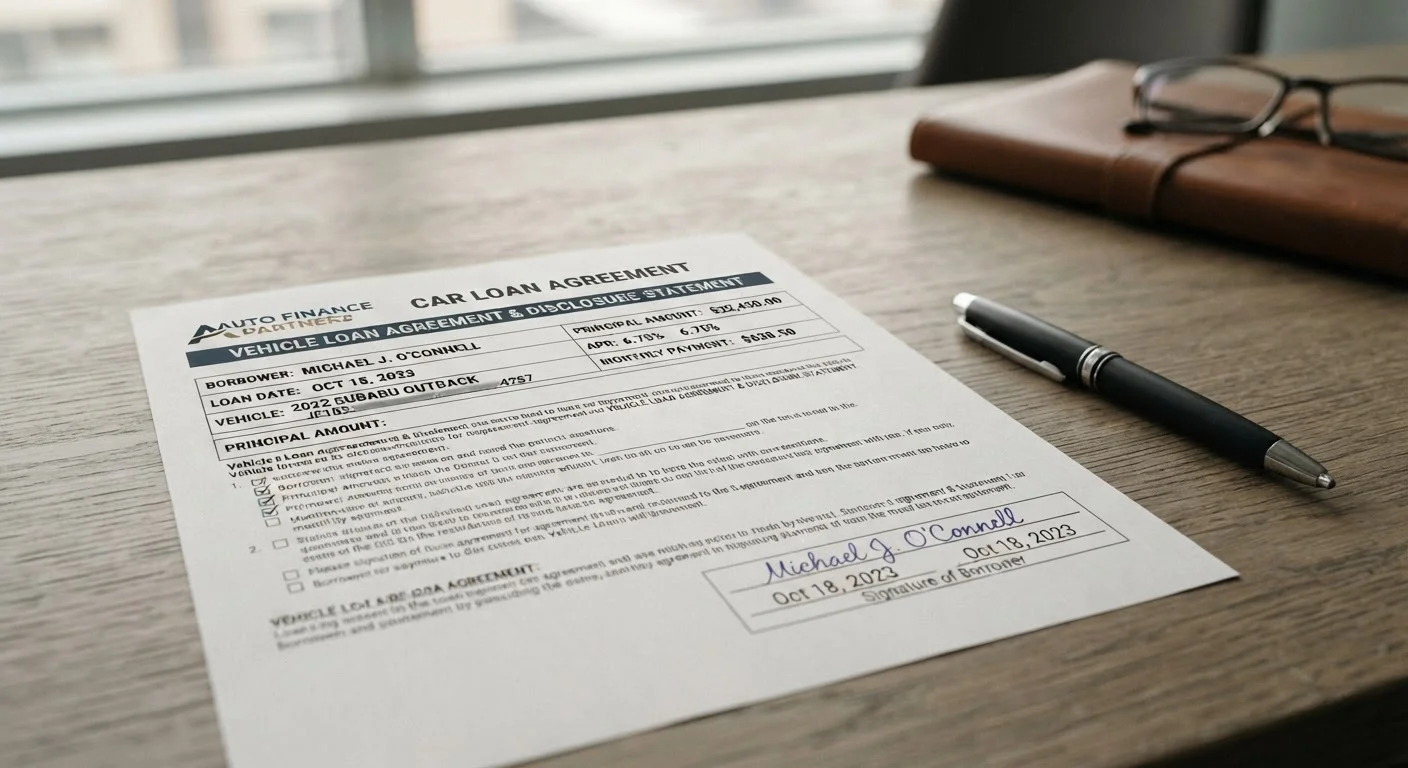
Loan agreements vary by lender and state, but most contain the same core disclosures. Here's what each one means and why it matters.
Annual Percentage Rate (APR)
The APR reflects the true annual cost of borrowing, incorporating both the nominal interest rate and any financed fees. A loan might advertise a 6% interest rate but carry a higher APR once origination fees are factored in. Always compare using APR, not just the interest rate headline.
Total Amount Financed
This is the principal you're actually borrowing. It should match the agreed vehicle price minus your down payment and trade-in credit, plus any fees or add-ons that were rolled into the loan. If this number is higher than you expected, ask for a line-by-line breakdown before proceeding.
Finance Charge
Expressed in dollars, the finance charge is the total interest you will pay over the life of the loan assuming you make every payment on schedule. It's a useful reality check: a seemingly modest monthly payment can translate to thousands of dollars in total interest over a long loan term.
Total of Payments
This figure tells you exactly how much you'll pay the lender from first payment to last, combining principal and all interest. Compare it to the vehicle's agreed purchase price - the gap is what financing costs you.
Payment Schedule
Verify the number of payments, the amount of each payment, and the due dates. If a payment amount differs from what you were quoted during negotiation, stop and ask for clarification before signing.
Numbers That Differ From What You Negotiated
If any figure in the loan document - purchase price, trade-in value, down payment credit, or interest rate - differs from what you agreed to at an earlier stage of the process, stop before signing and ask for a corrected contract. Signing a document with incorrect figures generally means accepting those figures as agreed. A dealer or lender should be willing to correct any genuine discrepancy without pressure.
Prepayment Penalties
Some loan agreements include a clause that charges a fee if you pay off the loan ahead of schedule. Not all loans carry this provision, but it's worth searching for explicitly. Paying off a loan early is generally a financially sound move - a prepayment penalty changes that calculus.
Optional Add-Ons and Insurance Products
Extended warranties, GAP insurance (which covers the difference between what you owe and what the car is worth if it's totaled), credit life insurance, and tire protection plans are commonly offered in the F&I office. These are often legitimate products, but they're also often rolled into the loan without the buyer fully registering the cost. Verify whether any add-ons in the contract were products you explicitly chose to purchase.
If you're weighing whether dealer financing is the right path, our comparison of dealer financing vs. your own bank walks through the practical tradeoffs.
How to Review the Agreement Without Getting Rushed
Reading a loan agreement isn't about distrust - it's about due diligence that any lender or dealer should respect. If a finance manager seems unwilling to give you time to read the documents, treat that as a serious caution signal.
Request all documents before the signing session begins
Ask the finance manager for a complete set of loan documents to review before anything is explained verbally. Reading the text yourself - rather than relying on a spoken summary - helps you catch discrepancies that might not surface in conversation.
Cross-reference the APR and loan amount against your prior quotes
Compare the APR and total amount financed in the contract against any pre-approval letter or written quote you received earlier. Even small differences in APR add up significantly over a multi-year loan term.
Identify every add-on included in the loan
Go line by line through the itemized list of what's included in the total amount financed. Flag any product or fee you don't recognize. Ask the finance manager to explain each item and confirm that you actively chose to include it - not that it was added as a default.
Search specifically for a prepayment penalty clause
Scan the contract language for terms like "prepayment charge," "early payoff fee," or "rule of 78s" - the latter is a calculation method that front-loads interest and can penalize early payoff. If present, understand its terms before committing.
Confirm the payment schedule matches your expectations
Verify that the monthly payment amount, number of payments, and first payment date all match what you budgeted for. A longer loan term lowers monthly payments but substantially increases total interest paid - make sure the term you're signing for is the one you chose.
Once you've confirmed every figure and clause aligns with what you agreed to, signing can proceed with confidence. Keep copies of every document for your records. If anything is unclear after you leave, don't hesitate to contact the lender directly - the contact information will be in the contract.
For a broader look at negotiation dynamics that affect what ends up in your paperwork, see our article on common car negotiation assumptions that can hurt you.
This article is for general informational and educational purposes only and does not constitute personalized financial, legal, or lending advice. Consult a qualified financial professional for guidance specific to your situation.
The content on this site is provided for informational purposes only and should not be considered a substitute for professional advice. While we strive to provide accurate and up-to-date information, we make no guarantees regarding its completeness or accuracy. Always consult a qualified professional for advice specific to your circumstances before making any decisions.