

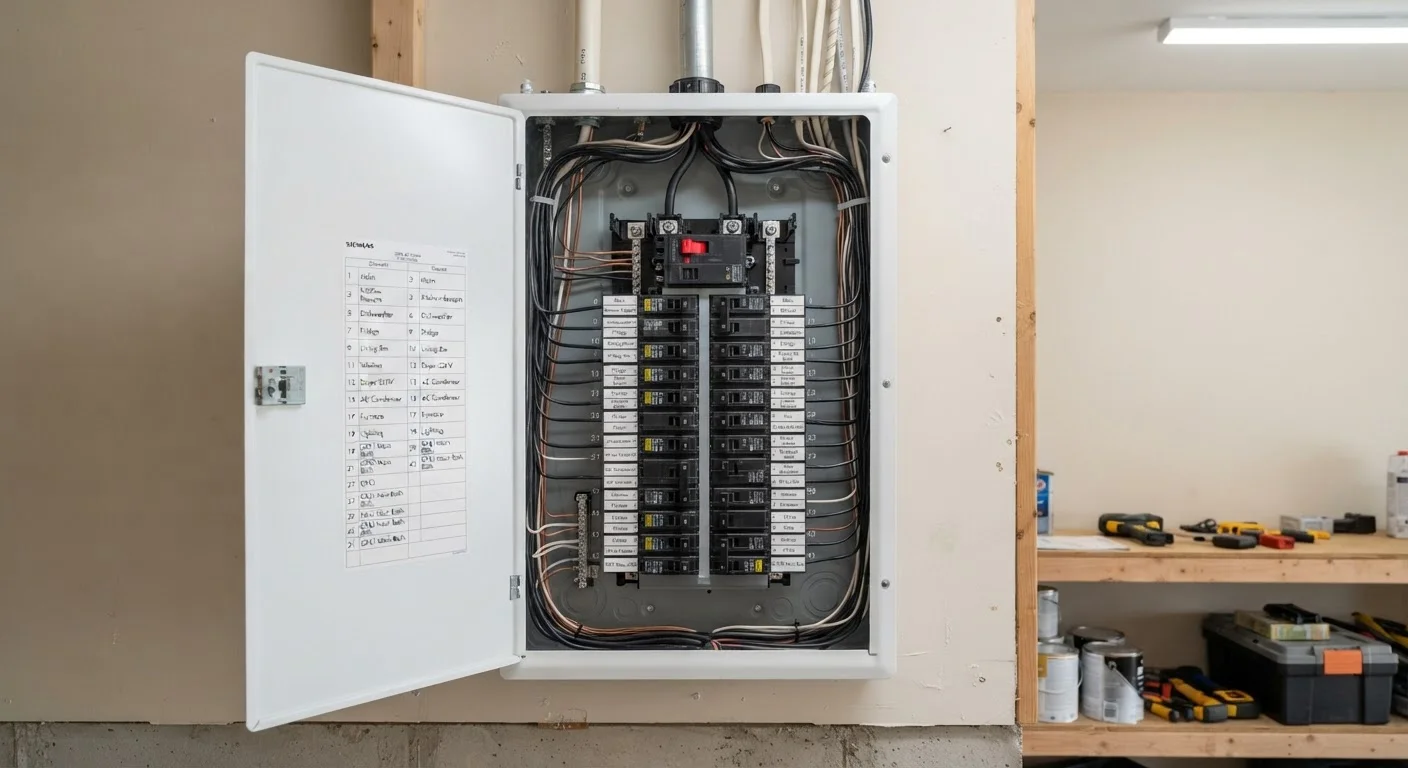
What's Actually Inside Your Panel
Open the door of your electrical panel and you'll find two main components: a main breaker at the top and a series of individual circuit breakers arranged in rows below it. The main breaker controls power to the entire panel and is rated to match your home's total service capacity - typically 100 to 200 amps in most American homes.
Each individual breaker corresponds to a specific circuit - a loop of wiring that serves a particular room, zone, or appliance. Standard breakers for lighting and outlets are usually 15- or 20-amp single-pole breakers. Larger appliances like electric dryers, central air conditioners, and electric ranges require double-pole breakers, which take up two slots and typically handle 30 to 60 amps.
On each side of the breaker rows, you'll notice two hot bus bars - metal rails carrying live electricity directly from the utility. These are always energized, even when the main breaker is off. This is a critical safety point: the wires feeding into the top of the main breaker can never be de-energized by a homeowner. That task belongs exclusively to the utility company.
The Top of the Panel Is Always Live
Even when your main breaker is switched off, the two large wires entering the top of the panel from your utility service line remain energized. Only your utility company can disconnect that power. Never open the service entrance cover or touch those wires under any circumstances - this applies to homeowners and, in most cases, to general contractors as well.
Reading Your Panel's Label Map
Every panel should have a label - usually on the inside of the door - that identifies which breaker controls which circuit. In an ideal world, that map is accurate and legible. In practice, many homeowners inherit panels with outdated, incomplete, or illegible labels.
Mapping your panel is a valuable maintenance task. The process involves turning off one breaker at a time and identifying which outlets, lights, or appliances lose power, then recording that clearly on a new label. This task is safe to do yourself because you are only toggling breakers, not touching wiring. A simple circuit tester, available at any hardware store, makes the job faster.
When labeling, be specific: write Kitchen Outlets - North Wall rather than just Kitchen. Good labels save time during outages and help any electrician you hire work more efficiently. For a broader look at home documentation habits, our seasonal home inspection guide offers a useful framework for recording and tracking your home's systems.
Why Breakers Trip - and What to Do
A circuit breaker trips - cuts power automatically - for three main reasons:
- Overload: More current is being drawn than the circuit is rated for. Common when too many appliances run on one circuit simultaneously.
- Short circuit: A hot wire touches a neutral or ground wire, creating a sudden surge of current. This can happen inside an outlet, appliance, or damaged wiring.
- Ground fault: Similar to a short circuit, but current is flowing through an unintended path to ground. GFCI outlets in bathrooms and kitchens protect against this at the outlet level.
For a simple overload, the fix is straightforward: unplug devices, reset the breaker firmly (OFF then ON), and redistribute your electrical load. For short circuits or repeated tripping without an obvious cause, the circuit needs professional diagnosis. Resetting a faulty circuit repeatedly without finding the root cause is unsafe.
Write Down the Cause Before You Reset
Before resetting a tripped breaker, take 30 seconds to note what was running on that circuit and what you were doing when it tripped. This simple habit creates a useful record. If the same breaker trips more than twice in a short period, that note gives an electrician a useful starting point for diagnosis.
Where the DIY Line Falls for Electrical Work
There is a clear and important boundary between what homeowners can safely handle and what requires a licensed electrician. Toggling breakers, mapping circuits, and replacing an outlet or light switch on a properly de-energized circuit are tasks many homeowners can learn to do safely. But any work that involves opening the panel, adding or moving circuits, upgrading service capacity, or touching service entrance wiring is strictly the domain of licensed professionals.
This isn't just about personal safety - it's also about code compliance. Most jurisdictions in the United States require permits for new electrical circuits, panel replacements, and service upgrades. Unpermitted electrical work can create problems when you sell your home or file an insurance claim. Our article on where the DIY line really falls covers this topic across a range of home systems.
If your home is older, if you're planning to add significant electrical loads (such as an EV charger or a major kitchen renovation), or if your panel shows any signs of age or damage, a licensed electrician's assessment is a sound investment - not an optional one. For a broader checklist of home systems to monitor, see our home maintenance guide for first-time owners.
51,000+
Home electrical fires reported annually in the U.S.
According to the U.S. Fire Administration, electrical fires are among the leading causes of residential structure fires each year.
40 years
Typical lifespan of a residential electrical panel
Industry guidance generally suggests panels older than 25-40 years warrant a professional inspection, particularly if capacity or safety technology has not been updated.
200 amps
Standard service capacity for new U.S. homes
Most new American home construction is wired for 200-amp service to accommodate modern appliance loads, compared to older 60- or 100-amp panels common in mid-century homes.
Frequently Asked Questions
Yes - resetting a tripped breaker is generally safe for homeowners. Turn off or unplug devices on that circuit first, then firmly push the breaker to the full OFF position before switching it back ON. If it trips again immediately or repeatedly, stop and call an electrician; something may be wrong with the circuit or a connected device.
Signs that warrant a professional evaluation include breakers that trip frequently, a panel that feels warm to the touch, a burning smell, visible corrosion, or a panel brand known for safety issues. Age alone - particularly panels over 25-30 years old - is also a valid reason to have a licensed electrician assess the system.
No. Adding a circuit requires working inside a live panel, which carries serious electrocution risk, and typically requires a permit and inspection in most U.S. jurisdictions. This work should always be done by a licensed electrician who can ensure the installation meets local code.
Multiple breakers tripping simultaneously can indicate a significant overload, a fault in the main service line, or a problem with the panel itself. This is not a routine reset situation - contact a licensed electrician to diagnose the cause before restoring power.
Persistent tripping usually signals a circuit overload (too many devices drawing power), a short circuit in wiring or an appliance, or a failing breaker. Reduce the load on that circuit first. If the problem continues, have an electrician inspect both the circuit and the breaker.
The number varies widely based on home size and age, but modern homes commonly have 20-40 circuits to serve lighting, outlets, and dedicated appliance loads. Older homes built before the 1970s may have far fewer, which can create overload issues as modern electrical demands increase.
The content on this site is provided for informational purposes only and should not be considered a substitute for professional advice. While we strive to provide accurate and up-to-date information, we make no guarantees regarding its completeness or accuracy. Always consult a qualified professional for advice specific to your circumstances before making any decisions.