

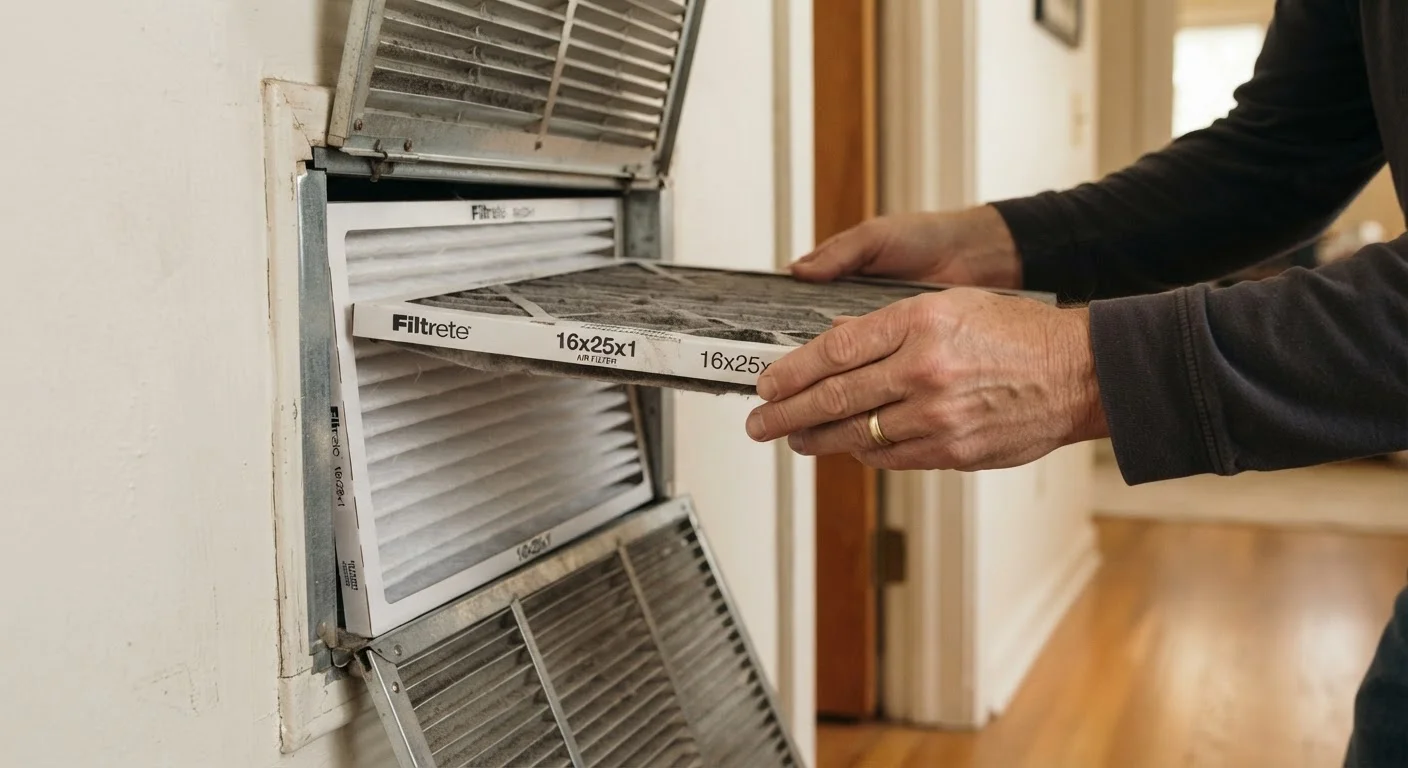
Why Your HVAC Filter Does More Than You Might Expect
Many homeowners think of the HVAC filter solely as an air quality tool - something that catches dust so the family breathes cleaner air. That's true, but it's only half the story. The filter's primary engineering purpose is to protect the mechanical components of your heating and cooling system from debris that could coat coils, clog motors, and reduce efficiency.
When air is pulled through your return vents, it carries with it dust, pet dander, pollen, mold spores, and other particles. Without a filter, all of that debris settles on the evaporator coil, heat exchanger, and blower fan - surfaces that are expensive to clean and easy to damage. A properly functioning filter intercepts these particles before they reach critical components.
As part of a broader home upkeep strategy, filter maintenance fits alongside other routine tasks covered in our Home Maintenance for First-Time Owners - simple habits that prevent larger problems down the road.
Set a Filter Change Reminder
Write the installation date directly on the filter's cardboard frame with a marker each time you install a new one. Pair this with a recurring calendar reminder on your phone so the task never slips through the cracks. Consistent timing matters more than perfection.
Understanding MERV Ratings: What the Numbers Actually Tell You
The MERV scale was developed by the American Society of Heating, Refrigerating and Air-Conditioning Engineers (ASHRAE) to give consumers a standardized way to compare filters. Here's a practical breakdown:
- MERV 1-4: Fiberglass panel filters. Catches large debris like lint and dust bunnies. Minimal protection for air quality.
- MERV 5-8: Standard pleated filters. Captures mold spores, dust mite debris, and pet dander. Suitable for most homes.
- MERV 9-12: Higher-efficiency pleated filters. Catches fine dust, auto emissions particles, and some bacteria. Good for allergy-prone households.
- MERV 13-16: Near-HEPA performance. Used in some high-end residential and commercial systems. Requires a system designed to handle reduced airflow.
For most residential systems, a filter in the MERV 8-11 range offers effective filtration without restricting the airflow your equipment relies on. Always consult your system's documentation - or an HVAC technician - before jumping to a higher rating.
How Often Filters Need Changing - And What Changes That
General guidance suggests replacing a standard 1-inch pleated filter every 60 to 90 days. But several household factors can shorten that window considerably:
- Pets: Shedding animals push more dander and hair into the air stream. Households with one or more pets often need monthly changes.
- Allergies or asthma: More frequent changes reduce the particle load recirculating through the home.
- Dusty environments: Homes near construction sites, dirt roads, or with recent renovation work collect debris faster.
- Occupancy: A vacation home that sits empty for weeks may need far less frequent changes; a busy household with children runs the system harder.
The simplest habit is to check the filter monthly. Hold it up to a light source - if you can't see light passing through, it's time to replace it regardless of how long it's been in place. Neglecting this task compounds costs over time, a pattern explored in our article on why deferred maintenance costs more.
5-15%
Energy savings from a clean HVAC filter
The U.S. Department of Energy estimates that replacing a clogged filter can reduce HVAC energy consumption by 5 to 15 percent.
~$10-$30
Typical cost of a residential pleated filter
Standard pleated filters for home HVAC systems generally fall in this price range, making regular replacement one of the most cost-effective home maintenance tasks.
25-40%
Of HVAC energy wasted by restricted airflow
According to the U.S. Environmental Protection Agency, heating and cooling accounts for roughly half of home energy use - inefficiencies from dirty filters compound that cost significantly.
What Happens When You Ignore Filter Maintenance
A clogged filter doesn't just reduce air quality - it triggers a chain of mechanical problems. Restricted airflow forces the blower motor to work harder to move the same volume of air, which increases electricity consumption and generates excess heat. Over time, this strain shortens the motor's lifespan. Meanwhile, reduced airflow across the evaporator coil can cause it to freeze, leading to water damage and a system that simply shuts down.
Dirty filters also allow more particulate matter to bypass the filter media and coat internal components. Cleaning or replacing a coated evaporator coil is a job typically requiring a licensed HVAC technician and can run into several hundred dollars - far more than the cost of a replacement filter.
Scheduling filter checks alongside your seasonal home walk-throughs is a practical approach. Our guide on seasonal home inspections outlines a reliable framework for catching issues like this before they escalate.
When to Call an HVAC Professional
If your system is running constantly, producing weak airflow, or cycling on and off more than usual even after you've replaced the filter, those are signs of a deeper issue. A licensed HVAC technician should inspect the system - don't attempt to access sealed refrigerant components, electrical panels, or heat exchangers yourself.
Frequently Asked Questions
For standard 1-inch filters, every 1 to 3 months is the typical recommendation. Thicker filters (4-5 inches) may last 6 to 12 months. Homes with pets, smokers, or allergy sufferers should change filters more frequently.
MERV stands for Minimum Efficiency Reporting Value and measures how effectively a filter captures particles of various sizes. Ratings run from 1 (very coarse) to 20 (used in hospitals). For most homes, a filter rated MERV 8 to 13 strikes a good balance between filtration and airflow.
Yes. A clogged filter restricts airflow, causing the blower motor to strain and heat exchangers to overheat. Over time this can lead to premature equipment failure and costly repairs.
Not necessarily. Very high MERV filters can restrict airflow more than many residential systems are designed to handle, reducing efficiency and potentially causing damage. Check your system's manual or consult an HVAC technician before upgrading to a MERV rating above 13.
Most residential filters are found either at the return air vent (a large louvered grate on a wall or ceiling) or inside the air handler unit itself. Your system may have one or multiple return vents, each with its own filter.
No. Portable air purifiers and HVAC filters serve different purposes. Your HVAC filter protects the mechanical components of the system in addition to improving air quality. Both can work together, but the system filter must still be maintained.
The content on this site is provided for informational purposes only and should not be considered a substitute for professional advice. While we strive to provide accurate and up-to-date information, we make no guarantees regarding its completeness or accuracy. Always consult a qualified professional for advice specific to your circumstances before making any decisions.