

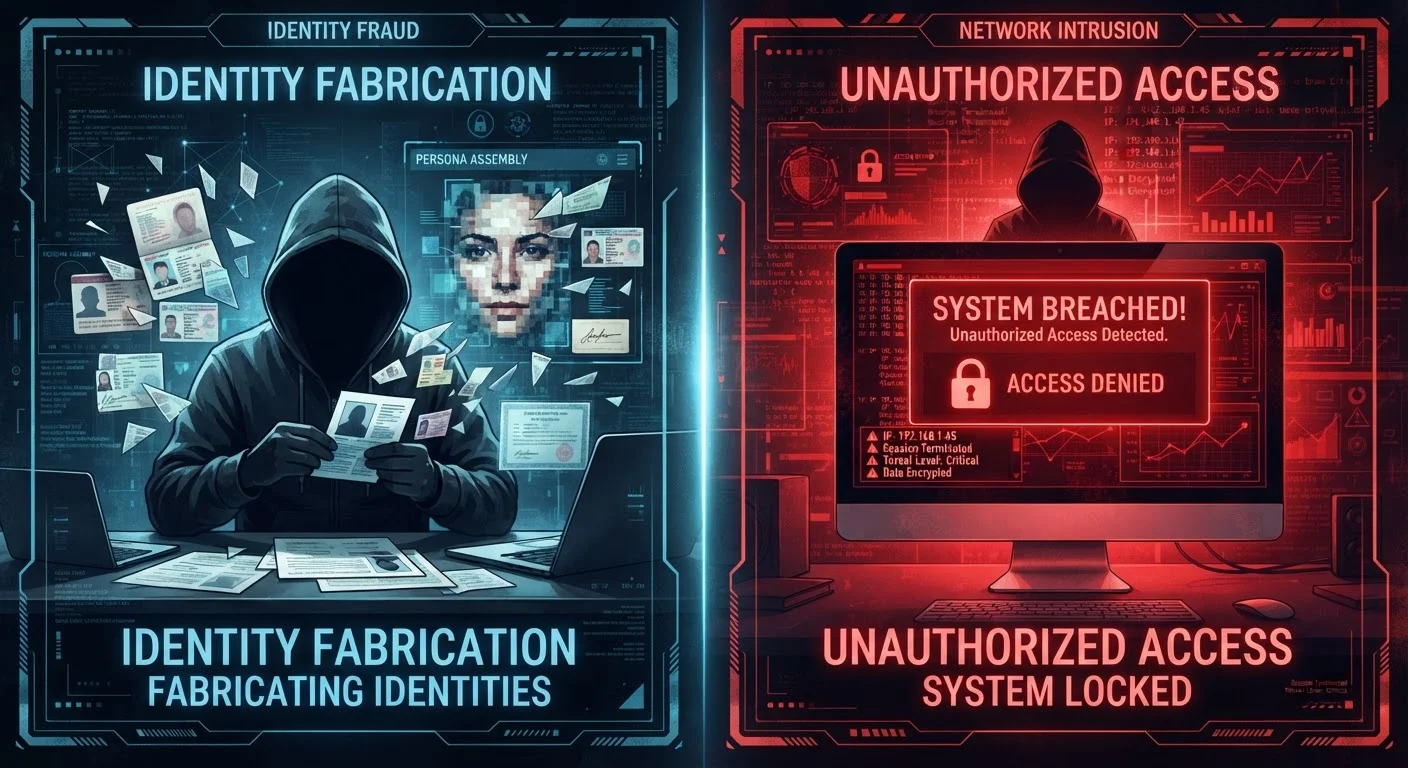
Option A
Identity Theft
The longer-game fraud that builds on your personal information.
Best for: Understanding when criminals use your data to create new fraudulent accounts, loans, or records in your name.
Option B
Account Takeover
The fast-moving attack that hijacks what you already own.
Best for: Understanding when criminals break into your existing accounts to drain funds, steal rewards, or lock you out.
What Sets These Two Threats Apart
The terms identity theft and account takeover are often used interchangeably, but they describe meaningfully different types of fraud. Conflating them can lead to the wrong response - which is costly when time matters.
Identity theft occurs when a criminal uses your personally identifiable information (PII) - such as your Social Security number, date of birth, or address - to open new accounts, apply for credit, file fraudulent tax returns, or create records under your name. The defining characteristic: the fraud involves building something new using your identity as the foundation.
Account takeover (ATO) is different. Here, the attacker gains unauthorized access to an account you already have - a bank account, email, social media profile, or retail login. Nothing new is being created; the attacker is exploiting existing infrastructure that belongs to you.
Understanding this distinction matters because the warning signs, immediate actions, and long-term recovery steps diverge significantly for each.
| Criterion | Identity Theft | Account Takeover |
|---|---|---|
| What's targeted | Your personal identity (PII) | Your existing account credentials |
| What attackers create or access | New fraudulent accounts or records | Unauthorized access to existing accounts |
| Typical detection timeline | Weeks to months | Hours to days |
| Common entry point | Data breaches, social engineering | Credential stuffing, phishing |
| Primary damage | Credit damage, fraudulent debt | Financial loss, data exposure |
| Key recovery step | Credit freeze, FTC report | Account recovery, enable 2FA |
How Each Threat Typically Unfolds
Both threats frequently trace back to the same starting point: exposed personal data, whether through a data breach or phishing. What happens next determines which category of fraud you're dealing with.
In an identity theft scenario, criminals usually acquire your PII from breaches, dark web marketplaces, or social engineering. They then use that information deliberately and sometimes patiently - opening credit cards, securing loans, filing tax returns, or even obtaining medical services in your name. The fraudulent activity may not surface for months, making early detection difficult.
Account takeover tends to move faster. Attackers use stolen login credentials - often obtained from credential-stuffing attacks, where breached username and password combinations are tested across many sites - to log into an active account. Once inside, they may drain funds, redirect shipments, harvest stored payment methods, or use your account as a launchpad for further fraud. The damage is often swift and visible.
It's worth noting that the two can overlap: an attacker who takes over your email account may then use that access to reset passwords on financial accounts, effectively escalating an ATO into broader identity-related fraud.
Warning Signs to Watch For
Recognizing the signals of each threat early is one of the most effective ways to limit harm.
Signs of Identity Theft
- Credit inquiries from lenders you never contacted
- Unfamiliar accounts appearing on your credit report
- Bills or collection notices for services you didn't sign up for
- A rejected tax return because one was already filed under your Social Security number
- Unexpected denial of credit despite a clean history
Signs of Account Takeover
- Being locked out of an account you use regularly
- Login alerts or password-reset emails you didn't request
- Transactions or transfers you don't recognize
- Changes to your account's email, phone number, or security settings
- Friends or contacts receiving unusual messages from your accounts
Many of the everyday habits that create vulnerabilities - password reuse, weak security questions, skipping two-factor authentication - make both types of attack easier to carry out.
How to Respond and Protect Yourself
The responses to each threat differ enough that it's worth treating them separately.
If You Suspect Identity Theft
Place a fraud alert or credit freeze with all three major credit bureaus (Equifax, Experian, and TransUnion). Review your full credit report for unfamiliar accounts. Report the fraud to the Federal Trade Commission (FTC) at IdentityTheft.gov, which provides a personalized recovery plan. If a Social Security number was involved, contact the Social Security Administration directly.
If You Suspect Account Takeover
Contact the account provider immediately to report unauthorized access and initiate a recovery process. Change passwords on any other accounts that share the same credentials. Enable two-factor authentication (2FA) wherever it isn't already active - this requires a second verification step, such as a code sent to your phone, making future unauthorized logins significantly harder. Monitor linked payment methods for unauthorized charges and notify your bank if financial accounts are involved.
In both cases, documentation matters. Keep records of what happened, when you noticed it, and every step you took. This supports disputes, insurance claims, and law enforcement reports if needed.
This article provides general educational information about digital security threats. It is not legal or financial advice. If you believe you are a victim of fraud, contact relevant institutions and, where appropriate, local law enforcement.
The content on this site is provided for informational purposes only and should not be considered a substitute for professional advice. While we strive to provide accurate and up-to-date information, we make no guarantees regarding its completeness or accuracy. Always consult a qualified professional for advice specific to your circumstances before making any decisions.