

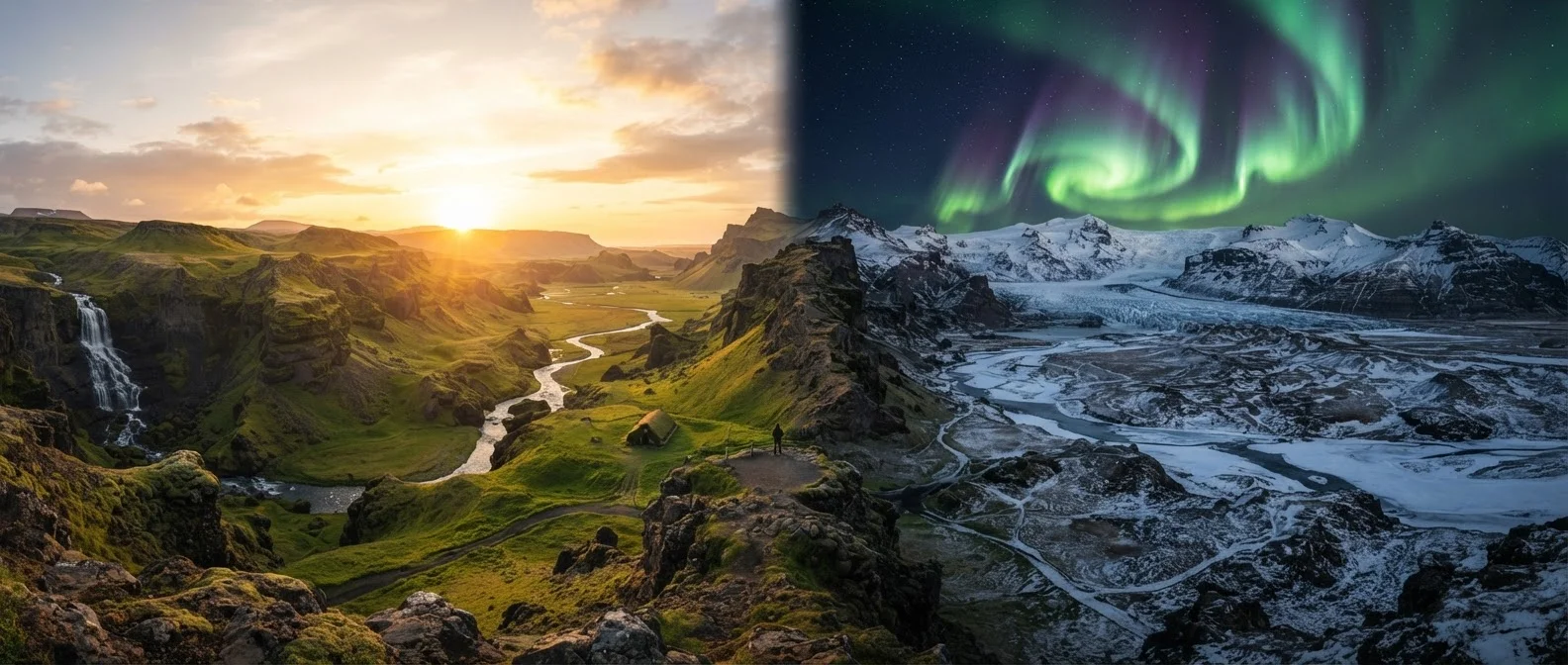
Option A
Iceland in Summer
The season of endless daylight and open roads.
Best for: Travelers who want accessible hiking, road trips, and dramatic green landscapes under the midnight sun.
Option B
Iceland in Winter
The season of darkness, aurora, and raw solitude.
Best for: Travelers chasing the northern lights, ice cave tours, and an atmospheric, crowd-free Iceland experience.
What Summer in Iceland Actually Looks Like
Iceland's summer season - roughly June through August - is defined by the midnight sun. Near the summer solstice, Reykjavík sees around 22 hours of daylight, and true darkness never arrives. This phenomenon is disorienting for first-timers but profoundly useful for travelers: you can hike until 11 p.m., pull over for a waterfall at midnight, and drive for hours without worrying about navigating in the dark.
The Highland interior opens up in summer, unlocking some of Iceland's most remote and stunning terrain. The F-roads - gravel tracks requiring a four-wheel-drive vehicle - lead to places like Landmannalaugar's rhyolite mountains and the Þórsmörk valley, which are completely off-limits the rest of the year. Waterfalls run at full volume, puffins arrive on the Westfjords cliffs, and the Laugavegur trail becomes one of the world's premier multi-day hiking routes.
The tradeoff is real, though. Summer is Iceland's peak tourist season. Iconic stops like Geysir and Seljalandsfoss can feel crowded by mid-morning, accommodation books up months in advance, and prices - for lodging, rental cars, and tours - are at their highest. As seasonality shapes every layer of trip planning, summer demands earlier booking and a higher budget to avoid disappointment.
What Winter in Iceland Actually Looks Like
Iceland in winter - typically November through February - is a fundamentally different country. Reykjavík sees only four to five hours of usable daylight near the December solstice. Roads in the interior are closed. Coastal routes can be affected by storms. And yet, winter draws a devoted following of travelers for reasons that no other season can provide.
The northern lights (Aurora Borealis) are Iceland's most iconic winter attraction. Visibility requires darkness, clear skies, and solar activity - none of which are guaranteed on any given night. But the long winter nights maximize your chances compared to anywhere else in Europe. Guided glacier walks and natural ice cave tours inside Vatnajökull also operate primarily in winter, when ice formations are stable enough to safely enter.
| Criterion | Summer (June-August) | Winter (Nov-Feb) |
|---|---|---|
| Daylight hours | 20-24 hours near solstice | 4-5 hours near solstice |
| Northern lights visibility | Not possible (too bright) | Best chance (long dark nights) |
| Highland F-road access | Open (4WD required) | Closed entirely |
| Natural ice cave tours | Not available | Seasonally available |
| Crowd levels | High - peak tourist season | Lower (except holidays) |
| Accommodation cost | Higher, books up early | Generally lower off-peak |
| Road conditions | Mostly reliable | Storm and ice risk; verify daily |
| Wildlife (puffins, whales) | Peak puffin season | Limited wildlife activity |
Weather in winter is Iceland's biggest variable. Storms can ground flights, close roads, and make driving the Ring Road genuinely hazardous. Renting a larger 4WD vehicle, checking safetravel.is before every drive, and building flexibility into your itinerary are practical necessities, not optional extras. The crowds thin considerably, especially outside holiday periods, and the dramatic, moody landscapes - black lava fields under pewter skies, geothermal steam rising from snow - have their own stark appeal that summer simply can't replicate.
Side-by-Side: Key Differences at a Glance
Understanding the concrete differences between seasons helps you align your expectations with the reality on the ground. The table above captures the most decision-relevant contrasts between Iceland's summer and winter experiences.
Shoulder Seasons Are Worth Considering
May and September-October offer a genuine middle path between Iceland's two extremes. May brings extended daylight, blooming landscapes, and notably fewer visitors than June through August. Autumn months introduce aurora potential alongside autumn color and dramatic moody skies. Pricing in both windows is generally more moderate than peak summer. If neither primary season fits your goals perfectly, researching a shoulder-month trip is time well spent.
One factor worth weighing independently is shoulder season - specifically May and September/October. These months offer a middle ground: partial daylight, smaller crowds than peak summer, some aurora potential in autumn, and generally more moderate pricing. If either primary season feels like a compromise, a shoulder-month visit may actually serve you better.
Planning Considerations Before You Book
Whichever season you choose, a few practical points apply to both. Iceland's weather is famously unpredictable regardless of month - the local saying goes that if you don't like the weather, wait five minutes. Layers, waterproof outerwear, and sturdy footwear are non-negotiable year-round.
Entry requirements, visa rules, and any health or travel advisories should always be confirmed through official Icelandic government sources and your country's foreign affairs department before booking - these details change and are outside the scope of general travel guidance. Similarly, verify road conditions through the Icelandic Road and Coastal Administration (Vegagerðin) and check safetravel.is for real-time alerts during your trip.
Budget planning should account for Iceland's generally high cost of living regardless of season. Winter softens that somewhat on accommodation, but not on food or fuel. Finally, consider what kind of traveler you are - not just what you want to see. A traveler who struggles with darkness and cold will not enjoy winter regardless of the northern lights. A traveler who hates crowds and heat may find Icelandic summer less magical than they imagined. Honest self-assessment before booking makes for a far better trip.
The content on this site is provided for informational purposes only and should not be considered a substitute for professional advice. While we strive to provide accurate and up-to-date information, we make no guarantees regarding its completeness or accuracy. Always consult a qualified professional for advice specific to your circumstances before making any decisions.