

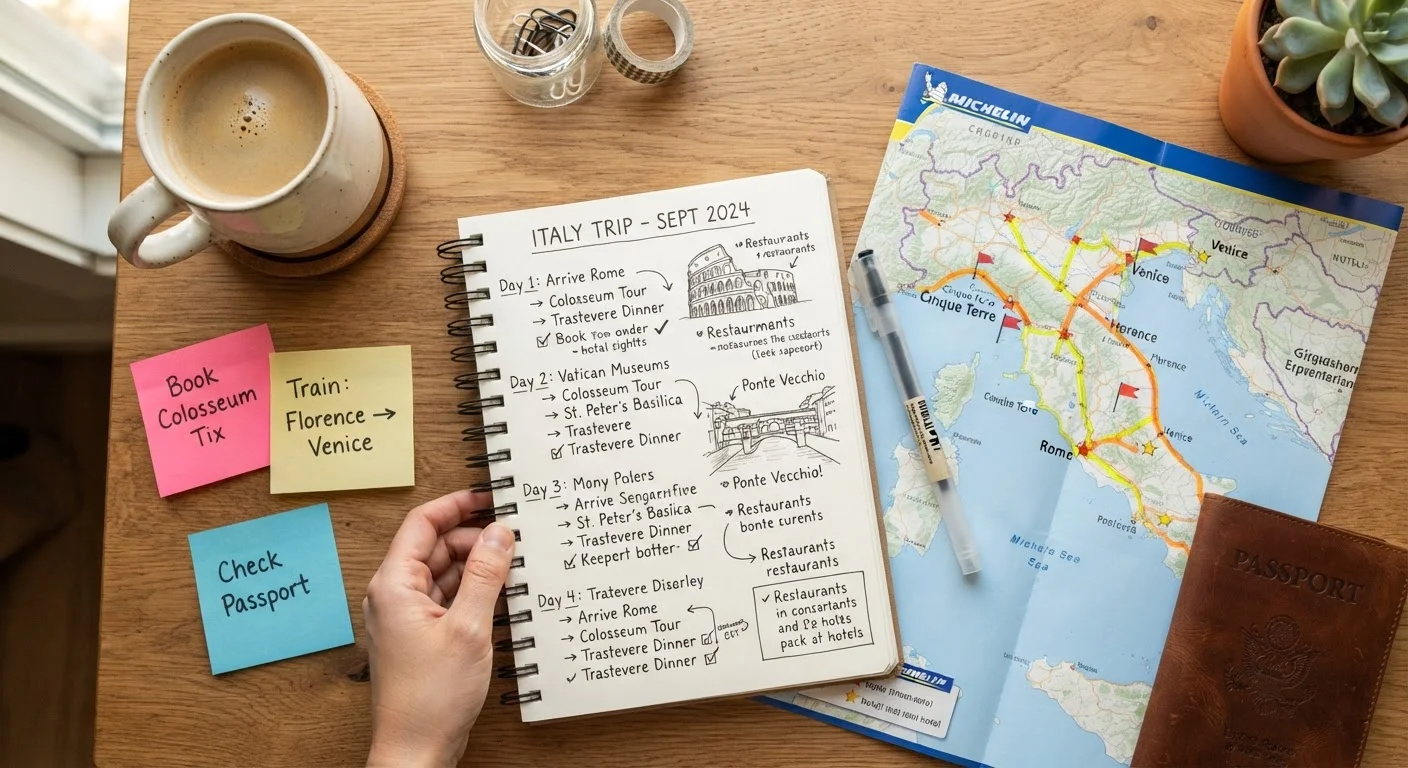
What a Travel Itinerary Actually Does
Most travelers think of an itinerary as a list of things to do. In reality, a functional itinerary is a coordination tool - it aligns your time, money, energy, and logistics into a plan you can actually execute. Without that alignment, even well-researched trips unravel: missed connections, decision fatigue, wasted hours backtracking across a city.
Understanding the anatomy of a well-built itinerary means recognizing what each component contributes. It's not just about filling days with activities. It's about creating a framework that keeps your trip moving forward without requiring constant improvisation.
For a broader foundation, our ground-up planning primer walks through how to get to the itinerary-building stage in the first place.
The Core Components Every Itinerary Needs
A well-constructed itinerary contains several layers of information working together:
- Transportation segments: Every leg of travel - flights, trains, rental cars, ferry crossings - documented with times, confirmation numbers, and terminal or station details.
- Accommodation details: Property name, address, check-in and check-out times, and reservation reference for each night. Include the phone number for each property.
- Day-by-day activity blocks: Organized by morning, afternoon, and evening rather than by the hour, with each day anchored to one primary goal or attraction.
- Buffer time: Explicitly scheduled gaps between activities to absorb delays, rest, or unexpected discoveries. This is the component most travelers cut first - and regret most.
- Emergency and contingency notes: Local emergency numbers, nearest hospital or clinic, travel insurance contact, and embassy or consulate information for international trips.
Why travel plans fall apart is often traced directly to missing one of these layers - particularly buffer time and contingency information.
Anchor Each Day to One Priority
Before building out any day's schedule, identify the single most important experience for that day. Everything else - meals, secondary sites, transit - should support that anchor rather than compete with it. This simple habit prevents overscheduling and keeps daily decision-making manageable when you're actually on the road.
Pacing: The Invisible Architecture of a Good Itinerary
How much you schedule per day matters as much as what you schedule. Overloaded itineraries are the single most common reason trips feel exhausting rather than restorative. A general benchmark for leisure travel: two to three meaningful activities per day, not six.
Pacing also depends on destination type. A city-focused trip involves more transit time between sites than a beach or nature destination. Seasonality affects pacing too - summer heat in certain climates makes midday exploration impractical, effectively restructuring your usable hours.
Road trip itineraries operate by their own pacing logic. Drive times need to be realistic, not map-app minimums. For that format, the road trip planning playbook covers route-building in practical depth.
2-3
Meaningful activities recommended per day for leisure travel
Travel planning research and experienced itinerary designers consistently point to this range as the threshold between enjoyable pacing and over-scheduling.
60-90 min
Recommended daily buffer time per itinerary day
Travel logistics experts generally suggest building at least one unscheduled block of 60 to 90 minutes into each travel day to absorb delays and fatigue.
3-6 months
Ideal advance planning window for international trips
Planning this far ahead gives travelers access to broader accommodation options, tour availability, and more competitive transport pricing.
Format and Accessibility: Making Your Plan Usable
An itinerary only works if you can access and read it under real travel conditions - tired, possibly in a different time zone, navigating an unfamiliar place. Format decisions matter:
- Digital + offline: Store your itinerary in a cloud document, but always download an offline copy or print a backup. Connectivity is not guaranteed, and international data roaming isn't always reliable.
- Chronological structure: Organize by date, then by time block. Avoid organizing by category (all restaurants in one section, all museums in another) - it forces constant cross-referencing when you're on the move.
- Confirmation numbers visible: Don't bury them. Put them immediately adjacent to each booking entry so you can produce them quickly at a check-in desk or border crossing.
Travelers choosing between a fly-and-explore versus a road trip format will find that the itinerary structure itself shifts significantly - comparing those two approaches clarifies what changes and why.
For broader travel advice beyond logistics, our travel tips hub covers safety, packing, and on-the-road decision-making in one place.
Frequently Asked Questions
An itinerary should capture confirmed bookings, planned activities, travel segments, and accommodation details for each day. Beyond that, granularity is a personal preference. Overly minute-by-minute schedules often create stress rather than reduce it; block-style planning by morning, afternoon, and evening works well for most travelers.
For international trips or travel during peak seasons, starting the framework three to six months out gives you time to secure popular accommodations and tours. Domestic or off-season travel can often be planned within four to eight weeks. The earlier you plan, the more options you'll have.
A packing list is a separate inventory document covering what you'll bring. An itinerary is a schedule and logistics document covering where you'll be and what you'll do. Both are useful, but they serve different planning functions and should be kept distinct.
Yes - sharing a copy with a trusted contact at home is a basic safety practice. If something goes wrong or contact is lost, someone who knows your planned route and accommodation details can coordinate help efficiently.
Absolutely. A light itinerary that confirms only accommodation and major transport leaves plenty of room for spontaneous decisions day to day. Think of it as scaffolding - it holds the structure up without filling in every wall.
The content on this site is provided for informational purposes only and should not be considered a substitute for professional advice. While we strive to provide accurate and up-to-date information, we make no guarantees regarding its completeness or accuracy. Always consult a qualified professional for advice specific to your circumstances before making any decisions.