

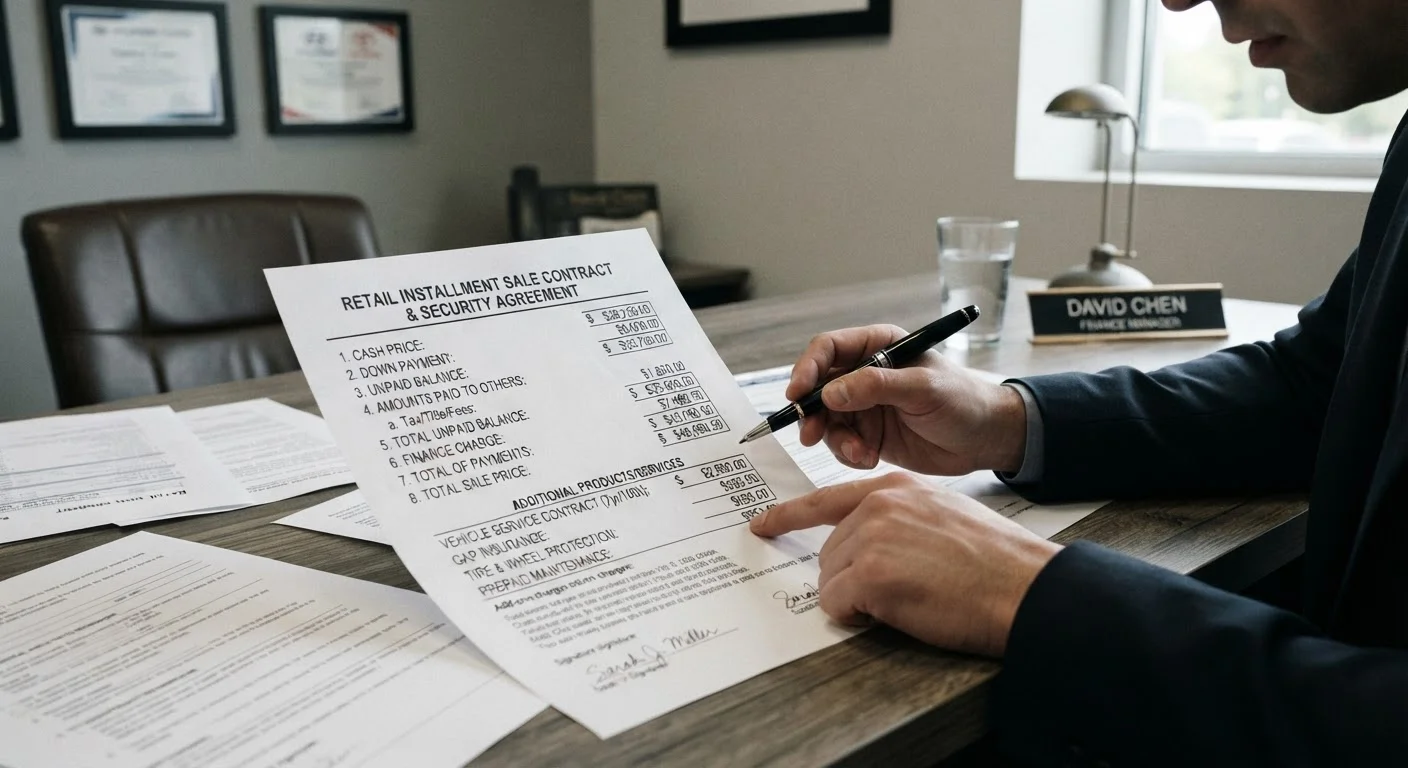
What Happens in the Finance Office
After agreeing on a vehicle price, most buyers are guided into a finance office where a finance and insurance (F&I) manager presents the final contract. This is where dealerships often introduce a menu of optional products - some genuinely useful, many significantly overpriced, and a few that duplicate protections buyers already have.
These add-ons can collectively add hundreds or even thousands of dollars to the total cost of a vehicle. Because they're presented at signing - when buyers are fatigued and eager to close - they're easy to accept without scrutiny. As the sticker price alone doesn't reveal, the real cost of a vehicle often emerges in this final stage. Understanding what each product actually covers - and where alternatives exist - puts you in a much stronger position before you pick up a pen.
Ask for the Add-On List in Advance
Before your signing appointment, contact the dealership and request a written list of all F&I products they plan to present. Reviewing them ahead of time - rather than in the moment - lets you research each item calmly and arrive prepared to ask specific questions or decline clearly. This simple step removes the time pressure that makes add-on acceptance more likely.
Add-Ons That Rarely Justify the Cost
Paint Protection Film or Sealant
Dealerships commonly offer paint sealants or polymer coatings applied before delivery, priced anywhere from $200 to $1,000 or more. The pitch is that they protect your finish from oxidation, UV damage, and environmental contaminants.
In practice, modern factory paint already carries a clear coat designed for durability. Many of these dealer-applied sealants offer minimal benefit beyond what a quality consumer wax or ceramic coating product - available at a fraction of the cost - provides. If paint protection film (PPF) genuinely interests you, independent detailers typically offer higher-quality installation at more competitive prices than dealership packages.
Independent detailers typically offer higher-quality paint protection at far lower prices than dealer packages.
Fabric and Interior Protection
Presented as a spray-on guard against stains and spills, fabric protection packages at dealerships often run $100-$300. This is frequently one of the lowest-value add-ons on the menu.
Consumer-grade fabric protectants - the same category of product - are widely available for under $20 and can be applied at home in minutes. Some new vehicles already ship with factory-treated upholstery. Before agreeing to this charge, check your vehicle's window sticker and owner's manual to see if treatment was already applied at the factory.
Consumer-grade fabric protectants cost under $20 and achieve similar results to dealer-applied treatments.
VIN Etching
VIN etching involves engraving the vehicle identification number onto the windows, theoretically deterring theft because etched glass is harder to resell. Dealers frequently charge $200-$400 for this service.
While VIN etching has some merit as a theft deterrent concept, do-it-yourself etching kits are available for under $30. Some auto insurance policies also offer a modest discount for etched vehicles - worth confirming with your insurer - but the dealership markup on this service is typically very high relative to what it actually involves.
DIY VIN etching kits achieve the same result for under $30 - a fraction of the dealership charge.
Nitrogen-Filled Tires
Some dealerships charge $50-$200 to inflate tires with nitrogen rather than standard compressed air, claiming it maintains pressure more consistently and extends tire life.
Nitrogen does seep through tire walls slightly more slowly than regular air, and it's used in specialized settings like racing and commercial aviation. For everyday passenger vehicles, however, the practical difference in handling or tire longevity is negligible under normal driving conditions. Standard air - which is already about 78% nitrogen - works well, and you can top off for free at most gas stations. If you accept nitrogen fill and later add regular air, the benefit disappears anyway.
For everyday driving, the real-world difference between nitrogen and standard air in tires is negligible.
Dealer-Sold Extended Warranties (Service Contracts)
Extended warranties - more accurately called vehicle service contracts - are among the highest-margin products sold in the F&I office. Prices vary widely, from $1,000 to over $3,500 depending on term length and coverage.
Whether one makes sense depends on the vehicle's reliability history, how long you plan to keep it, and what's already covered by the factory warranty. Key cautions: many service contracts exclude a long list of components in the fine print, require repairs only at authorized facilities, and may not transfer if you sell the vehicle. If you're considering one, you're not obligated to buy it from the dealer - third-party administrators sell comparable contracts, sometimes at lower prices. Read the exclusions list carefully before any decision. This is also worth weighing alongside how dealer financing compares to outside options, since rolling add-ons into a loan increases the total interest paid.
Extended warranties from dealers carry high margins - third-party contracts may offer comparable coverage at lower cost.
Credit Life and Disability Insurance
Credit life insurance pays off your auto loan balance if you die before the loan is paid off; credit disability insurance makes payments if you become unable to work. Dealerships often present these as straightforward protections, but they tend to be expensive relative to what they offer.
If income protection or life coverage is important to you, standalone term life and disability insurance policies purchased independently typically provide broader coverage at lower premiums. These dealer-sold policies are generally tied specifically to the loan balance and offer no flexibility beyond that narrow purpose.
Standalone term life and disability policies usually provide broader protection at lower cost than dealer credit insurance.
How to Handle Add-On Pressure at the Dealership
The most important thing to remember: every single add-on is optional. No federal or state law requires you to purchase any F&I product to complete a vehicle sale. If a finance manager implies otherwise, that is inaccurate. You are entitled to decline any item, and doing so should not affect your agreed-upon vehicle price or financing rate.
Ask for the itemized list of add-ons in writing before the signing appointment if possible. Review each line carefully, ask what it covers, and check whether that coverage overlaps with your existing auto insurance, homeowner's policy, or the manufacturer's warranty. For context on the broader financial picture of vehicle ownership, see the real costs of car ownership beyond the purchase price. Being informed is always your strongest negotiating tool - common negotiation assumptions can actually weaken your position if left unexamined.
The content on this site is provided for informational purposes only and should not be considered a substitute for professional advice. While we strive to provide accurate and up-to-date information, we make no guarantees regarding its completeness or accuracy. Always consult a qualified professional for advice specific to your circumstances before making any decisions.