

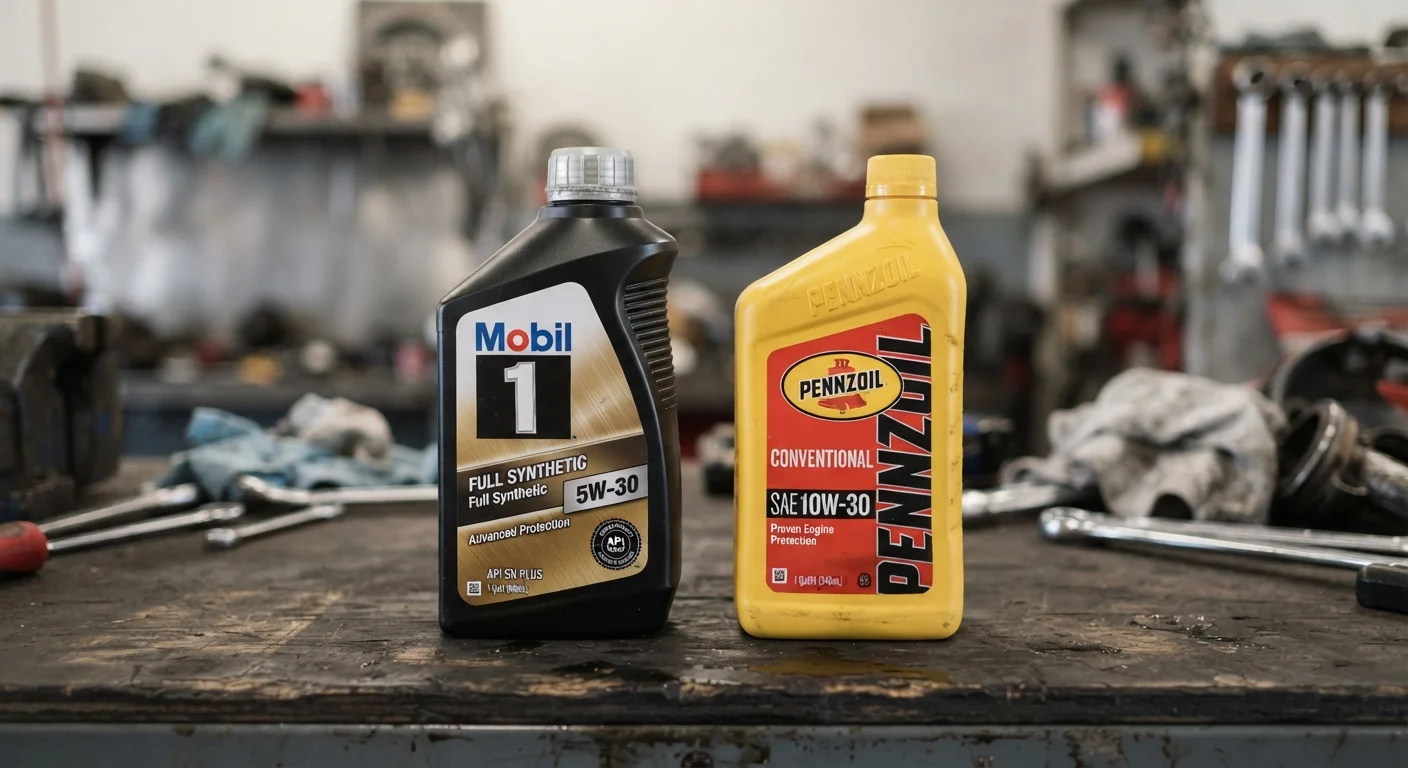
Option A
Synthetic Motor Oil
The engineered, long-lasting performer.
Best for: Drivers who want longer intervals between oil changes, operate in extreme temperatures, or own modern vehicles with tight engine tolerances.
Option B
Conventional Motor Oil
The familiar, budget-friendly standard.
Best for: Owners of older, simpler engines with straightforward driving patterns who change their oil on a consistent, frequent schedule.
What Makes These Oils Different
Motor oil serves one essential purpose: reducing friction between the moving metal parts inside your engine. But not all oil is made the same way, and that difference matters.
Conventional motor oil is refined directly from crude petroleum. The refining process removes many impurities, but some irregular molecules remain. This gives the oil less consistency at the molecular level, which affects how it performs under stress and temperature swings.
Synthetic motor oil, by contrast, is chemically engineered. Starting from a base stock - sometimes refined crude, sometimes other compounds - chemists build uniform molecular chains designed for specific performance characteristics. The result is an oil that flows more reliably in cold temperatures, holds up better under heat, and resists oxidation (breakdown) for longer.
There are also synthetic blend oils, which mix both types. These offer a middle ground: better performance than straight conventional oil at a lower cost than full synthetic.
| Criterion | Synthetic Motor Oil | Conventional Motor Oil |
|---|---|---|
| Base material | Chemically engineered molecules | Refined crude petroleum |
| Typical change interval | 7,500-10,000+ miles | 3,000-5,000 miles |
| Cost per quart | Higher (roughly 2-4x more) | Lower |
| Cold-weather performance | Flows faster at startup | Thickens more in cold |
| Heat and stress resistance | Breaks down more slowly | Degrades faster under load |
| Best suited for | Modern, high-tolerance engines | Older, simpler engines |
| Availability | Widely available | Universally available |
The Cost Equation: More Per Quart, Less Per Year?
Synthetic oil typically costs two to four times more per quart than conventional oil. That sounds like a clear argument for conventional - until you factor in change frequency.
Conventional oil generally requires changes every 3,000 to 5,000 miles. Full synthetic oil can often go 7,500 to 10,000 miles or longer, depending on the vehicle and driving conditions. For a driver covering 15,000 miles annually, that could mean three or four conventional changes versus one or two synthetic changes per year. Over time, the gap in total cost narrows considerably.
Understanding your actual service interval is important. See our guide on oil change intervals for a detailed breakdown of how mileage recommendations are set and what drives the difference between schedules.
There's also an indirect cost to consider: engine wear. Synthetic oil's superior film strength can reduce long-term wear, potentially extending engine life. Quantifying that precisely is difficult, but it's a factor worth weighing - especially on a vehicle you plan to keep for many years.
What Your Owner's Manual Actually Says
The single most reliable guide for oil selection is your vehicle's owner's manual. Manufacturers specify not just the oil type but the viscosity grade - expressed as something like 5W-30 or 0W-20. The numbers describe how the oil flows at cold temperatures (the first number) and at operating temperature (the second).
Many drivers assume conventional oil is fine because it worked for decades. But automotive engineering has changed significantly. Modern engines - particularly those with turbochargers, variable valve timing systems, or direct injection - often have tighter tolerances and operate at higher temperatures. These engines are typically designed around synthetic oil, and using conventional in them can increase wear or even void warranty coverage in some cases.
It's worth noting that many common beliefs about motor oil don't hold up under scrutiny. Our look at car maintenance myths examines why the "change oil every 3,000 miles" rule, for instance, is outdated for most drivers today.
If your manual calls for synthetic, use synthetic. If it permits conventional, that's a reasonable option - provided you maintain the recommended change schedule consistently.
Switching Oils and What to Watch For
One persistent question: can you switch between synthetic and conventional? In most cases, switching from conventional to synthetic is safe and may actually benefit an older engine by cleaning out accumulated sludge deposits more effectively. However, this cleaning effect can occasionally reveal pre-existing seal wear, so it's worth monitoring for leaks after a switch on high-mileage vehicles.
Switching back from synthetic to conventional is generally not recommended without a specific reason, since you'd be trading a higher-performance product for a lesser one without a clear benefit.
Maintaining any oil change schedule is more important than the type of oil you use. Skipping or delaying changes - regardless of oil type - allows oil to degrade, build up contaminants, and lose its protective properties. Our article on why deferred maintenance costs more than you think outlines what actually happens inside an engine when changes are overdue.
For most drivers today, synthetic oil is the straightforward choice: it's what most modern vehicles need, it requires fewer changes, and it provides more consistent protection. The additional upfront cost is a reasonable tradeoff for what it delivers.
The content on this site is provided for informational purposes only and should not be considered a substitute for professional advice. While we strive to provide accurate and up-to-date information, we make no guarantees regarding its completeness or accuracy. Always consult a qualified professional for advice specific to your circumstances before making any decisions.