

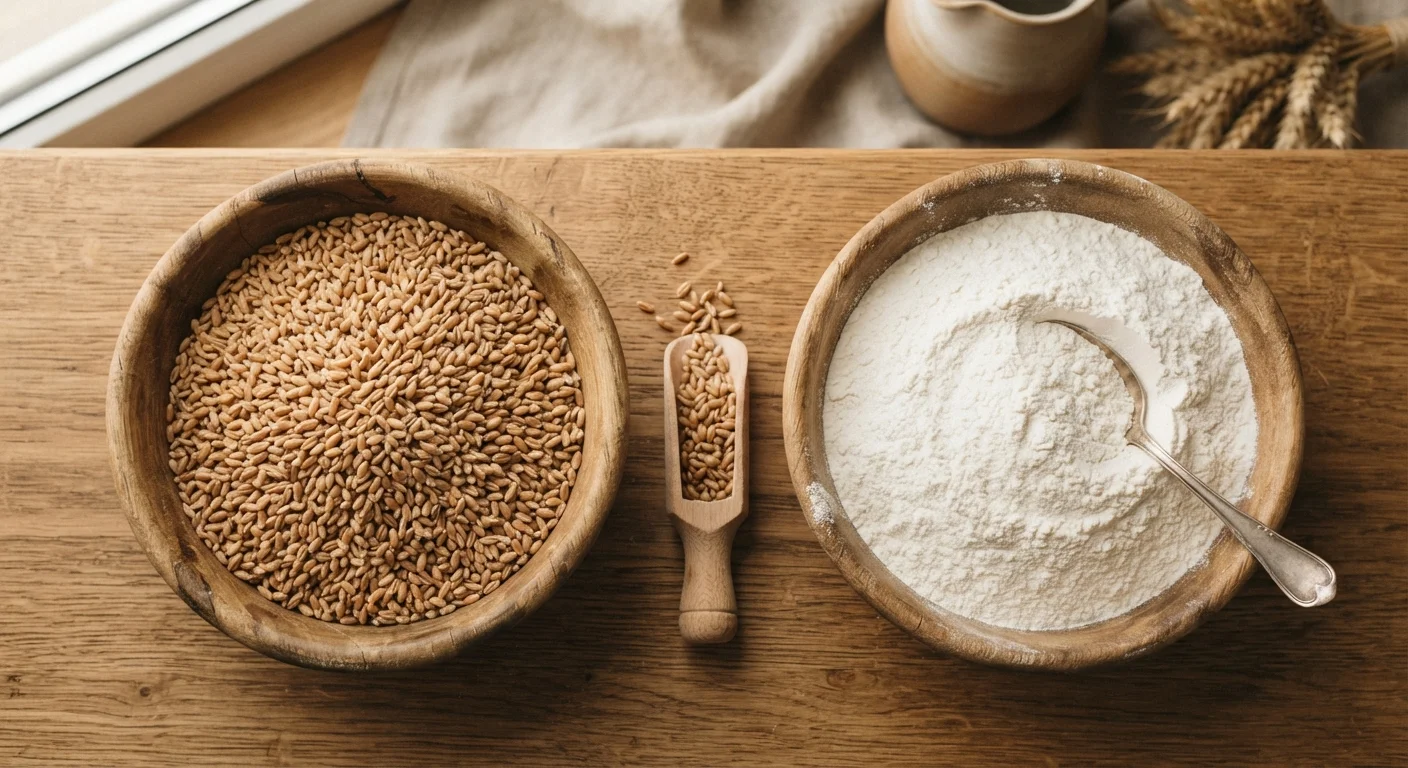
Option A
Whole Grains
The nutritionally complete, minimally processed option.
Best for: People seeking more fiber, vitamins, and sustained energy from their carbohydrate choices.
Option B
Refined Grains
The lighter, longer-lasting processed alternative.
Best for: Situations where texture, shelf life, or digestibility for sensitive individuals is the priority.
What Happens Inside the Mill
Every grain of wheat - and most other cereal grains - is made up of three layers: the bran (the fibrous outer layer), the germ (the nutrient-dense embryo), and the endosperm (the starchy inner core). When you eat a whole grain, you eat all three.
Refining strips that down to just the endosperm. The bran and germ are mechanically removed during milling to produce the smooth, white flour most people recognize. This process extends shelf life and creates a lighter texture - but it also removes the majority of the grain's nutritional value in a single step.
What disappears with the bran and germ is significant: most of the dietary fiber, B vitamins including thiamine, riboflavin, niacin, and folate, vitamin E, iron, magnesium, zinc, and beneficial plant compounds called phytochemicals. The endosperm that remains is primarily starch with relatively little nutritional complexity.
| Criterion | Whole Grains | Refined Grains |
|---|---|---|
| Kernel parts retained | Bran, germ, and endosperm | Endosperm only |
| Dietary fiber | High (e.g., ~3g per slice whole wheat bread) | Low (e.g., ~0.6g per slice white bread) |
| B vitamins | Naturally rich | Mostly removed; some added back via enrichment |
| Minerals (iron, magnesium, zinc) | Higher amounts naturally present | Significantly reduced; partial restoration via enrichment |
| Blood glucose impact | Slower, more gradual rise | Faster, more pronounced rise |
| Shelf life | Shorter (germ oils can go rancid) | Longer (germ removed) |
| Texture and taste | Denser, nuttier flavor | Lighter, milder flavor |
Enrichment: Partial Restoration, Not Full Recovery
After milling, many refined grain products - particularly white bread, pasta, and white rice - are labeled "enriched." This means manufacturers have added back a handful of nutrients lost during processing, typically iron and four B vitamins. The FDA mandates enrichment of refined wheat flour sold in the US for this reason.
But enrichment does not restore everything. Dietary fiber - arguably the most important nutritional casualty of refining - is almost never added back in meaningful amounts. Neither are many of the trace minerals, vitamin E, or the full spectrum of phytochemicals originally present. Think of it as returning a fraction of what was taken.
This distinction matters when you are reading food labels. As our guide to reading a nutrition label explains, the fiber line is one of the most telling numbers on the panel - and it exposes the gap between enriched refined products and their whole grain counterparts quickly.
25%
Lower heart disease risk with whole grain intake
A large review in the BMJ found people eating about 3 servings of whole grains daily had roughly 25% lower risk of cardiovascular disease compared to low consumers.
70-80%
Of fiber lost during milling
Refining wheat into white flour removes an estimated 70-80% of the grain's original dietary fiber content, according to nutrition research on grain processing.
3 servings
Daily whole grain goal per US dietary guidelines
The Dietary Guidelines for Americans recommend making at least half of all grain servings whole grains, equating to roughly 3 or more servings daily for most adults.
How the Two Compare Nutritionally
The nutritional difference between whole and refined grains plays out clearly when you look at specific outcomes. Whole grains digest more slowly due to their fiber content, producing a gentler rise in blood glucose compared to refined carbohydrates. This slower digestion also promotes a greater sense of fullness after eating.
Over the long term, research published by institutions such as the Harvard T.H. Chan School of Public Health and reviewed in major nutrition journals consistently finds that higher whole grain intake is associated with reduced risk of cardiovascular disease, type 2 diabetes, and colorectal cancer. These are associations observed in population studies, not guaranteed individual outcomes - but the evidence base is substantial and reflects mainstream dietary guidance from organizations like the Dietary Guidelines for Americans.
It is worth noting that replacing refined grains with whole grains does not require eliminating entire food categories. As explored in our piece on why cutting out entire food groups backfires, the goal is substitution and balance, not restriction.
Decoding Labels: What 'Whole Grain' Actually Means
Grain labeling is one of the more misleading areas of food packaging. Here is what to know:
- "Whole grain" on the ingredient list means the product contains at least some whole grain flour - but it may still be mostly refined. Check that a whole grain is listed as the first ingredient.
- "Multigrain" only means multiple types of grain were used. It says nothing about whether any of them are whole.
- "Wheat bread" or "made with wheat flour" almost always refers to refined white wheat flour, not whole wheat.
- "100% whole grain" or "100% whole wheat" is the clearest language - it indicates all grain ingredients are whole grain.
In the US, the Whole Grains Council's stamp can also help: a product bearing the "100% Whole Grain" stamp must have at least 16 grams of whole grain per serving. Checking the fiber content alongside this label gives you a more complete picture.
This article is for general informational and educational purposes only and is not a substitute for professional medical or dietary advice. Consult a qualified healthcare provider or registered dietitian before making significant changes to your diet, especially if you have a health condition.
The content on this site is provided for informational purposes only and should not be considered a substitute for professional advice. While we strive to provide accurate and up-to-date information, we make no guarantees regarding its completeness or accuracy. Always consult a qualified professional for advice specific to your circumstances before making any decisions.