

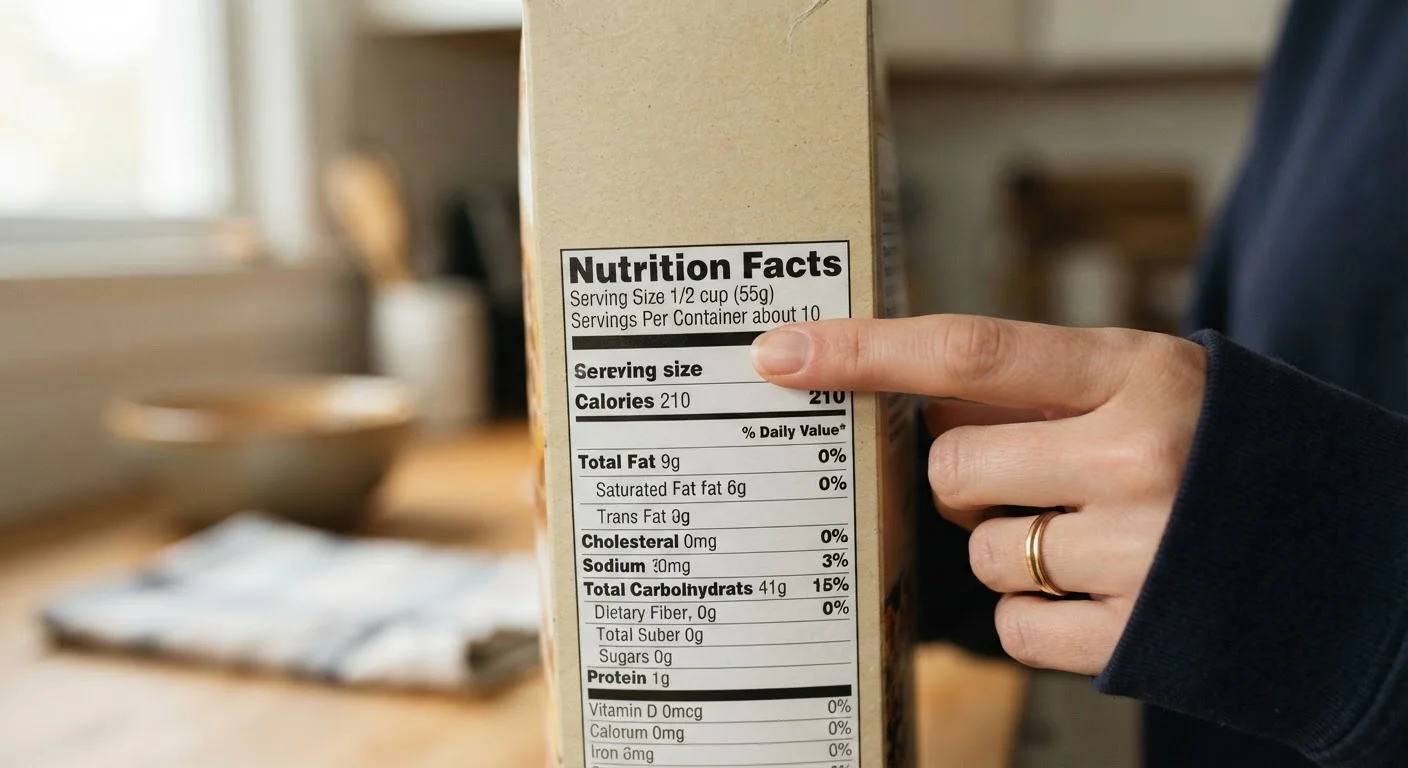
Why Nutrition Labels Feel Confusing - and How to Cut Through the Noise
The Nutrition Facts panel was designed to help consumers make informed choices, but its dense grid of numbers, percentages, and terms can feel like a pop quiz you never studied for. The good news: you don't need to decode every line. Understanding a handful of key sections gives you most of what you need to make smarter decisions at the grocery store.
Labels in the U.S. follow a standardized format regulated by the FDA, which updated the design in 2016 to make calories more prominent and to add a dedicated line for added sugars. Knowing the layout means the same skills apply to nearly any packaged food you pick up. For a deeper look at the vitamins and minerals listed near the bottom of the panel, see our plain-language guide to micronutrients.
Front-of-Pack Claims Are Marketing, Not Regulation
Terms like 'natural,' 'wholesome,' or 'light' on the front of a package aren't always defined by strict FDA standards. The Nutrition Facts panel and ingredients list on the back are the regulated, standardized sources of truth. When in doubt, flip the package over.
Step-by-Step: Reading the Label from Top to Bottom
Work through the label in order - each section builds on the one above it. The steps below follow the standard FDA Nutrition Facts layout.
Start with serving size
The very first line after "Nutrition Facts" is the serving size, followed by the number of servings per container. Every number on the label - calories, fat, sodium, everything - refers to one serving, not the entire package. If a bag of chips lists 7 servings and you eat the whole bag, multiply every value by 7.
Check calories
Calories measure the total energy provided by one serving. The updated FDA label displays this number in large, bold type. Calories alone don't determine whether a food is nutritious - a food can be calorie-dense and nutrient-rich (like nuts) or calorie-light and nutrient-poor. Use calories as one data point, not the whole picture.
Read the macronutrients: fat, carbohydrates, and protein
The next section breaks down the three macronutrients - the main sources of energy in food:
- Total Fat includes all fat types. The sub-lines for saturated fat and trans fat matter most - these are the types most associated with cardiovascular risk at high intake levels. Unsaturated fats (found in fish, nuts, and oils) are not broken out separately on most labels but contribute to the total.
- Total Carbohydrate includes dietary fiber, total sugars, and added sugars as sub-lines. Fiber is worth seeking out; added sugars - those put in during processing - are worth watching.
- Protein shows grams per serving. No % DV is required for protein on most labels.
Use the % Daily Value column as your quick guide
To the right of each nutrient is its % Daily Value (% DV) - the percentage of the recommended daily amount that one serving provides, based on a 2,000-calorie reference diet. This column is one of the most useful tools on the label because it removes the need to memorize gram targets. A quick rule of thumb: 5% DV or less is low; 20% DV or more is high.
Scan the micronutrients at the bottom
The bottom section lists Vitamin D, Calcium, Iron, and Potassium - four nutrients identified by the FDA as commonly under-consumed in the U.S. Higher % DV values here are generally favorable. Other vitamins and minerals may appear voluntarily. For a full breakdown of what each micronutrient does, consult our micronutrient reference guide.
Read the ingredients list
Ingredients are listed in descending order by weight - whatever appears first is present in the largest amount. A long list isn't automatically a red flag, but it's worth noting where sugar, sodium, or saturated-fat sources appear. If multiple forms of sugar (e.g., corn syrup, cane sugar, dextrose) appear early or frequently, the product's added sugar content may be higher than the label's single sugar line suggests.
What to Watch For: Sodium, Sugar, and Saturated Fat
Three nutrients appear repeatedly in public health guidance about packaged foods: sodium, added sugars, and saturated fat. A % DV of 20% or more is considered high for any nutrient; 5% or less is considered low. For sodium, saturated fat, and added sugars, you generally want to stay on the lower end. For fiber, vitamins, and minerals, higher is typically better.
Many packaged foods contain more of these three than their front-of-pack marketing suggests. Our companion article how to spot excess sodium, sugar, and saturated fat walks through specific red flags in detail. If you're curious about fiber specifically - a nutrient most Americans fall short on - our fiber guide explains what it does and where to find it.
Keep in mind that no single food defines your overall diet. Cutting entire food groups based on one nutrient on a label usually isn't necessary or helpful. Context - across your whole day of eating - matters more than any individual product's panel. For practical help putting meals together, see building a balanced plate.
This article provides general nutrition education and is not a substitute for personalized advice from a registered dietitian or qualified healthcare professional.
The content on this site is provided for informational purposes only and should not be considered a substitute for professional advice. While we strive to provide accurate and up-to-date information, we make no guarantees regarding its completeness or accuracy. Always consult a qualified professional for advice specific to your circumstances before making any decisions.