

Our Verdict
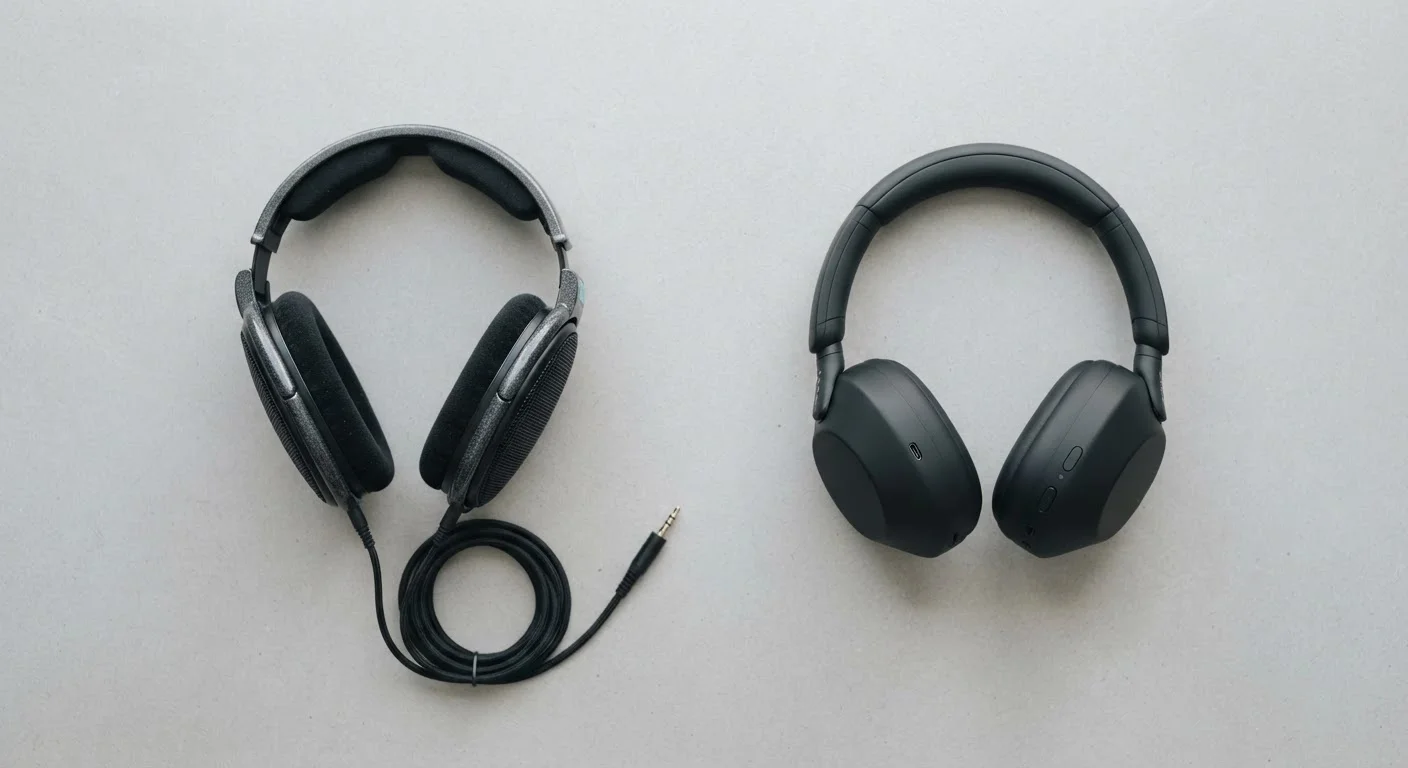
Neither wired nor wireless headphones is universally superior - each format makes real trade-offs. Wireless wins on convenience and portability, especially for active users and commuters. Wired wins on consistent audio fidelity, zero latency, and simplicity for home listening or professional use.
Wireless headphones suit commuters, gym-goers, and casual listeners who prioritize freedom of movement; wired headphones are the stronger choice for home listeners, gamers who need low latency, and anyone doing serious audio work.
The Core Trade-Off: Convenience vs. Consistency
The debate between wired and wireless headphones isn't really about which sounds better in a lab - it's about what matters most in your daily life. Wireless headphones, primarily using BT technology, have surged in popularity because they eliminate the cable entirely. Wired headphones, meanwhile, have stayed relevant because they offer a direct, uninterrupted signal path that wireless simply can't replicate by design.
When a wired headphone is plugged in, audio travels as an analog electrical signal from your device to your ears. There's no compression, no transmission step, and no latency introduced by wireless protocols. Bluetooth, even in its modern high-quality codecs like aptX HD or LDAC, still compresses and transmits audio digitally - a process that can introduce subtle artifacts and a slight delay. For most casual listeners, this difference is imperceptible. For gamers or audio professionals, it can matter significantly.
Bluetooth Codecs: What the Jargon Means
Bluetooth audio quality depends heavily on which codec - a compression format - your headphones and device both support. SBC is the universal baseline; AAC is common on Apple devices; aptX, aptX HD, and LDAC offer higher-fidelity transmission on compatible Android devices. If your headphones support LDAC but your phone only outputs SBC, you'll get the lower-quality connection. Check both device specs before assuming you're getting high-resolution wireless audio.
What You Gain With Wireless
The appeal of wireless headphones is easy to understand. Without a cable tethering you to a device, you can move freely - whether you're commuting, working out, or simply walking between rooms. Most modern wireless headphones connect within seconds using Bluetooth pairing and maintain a stable connection across typical listening distances of 30 feet or more.
No charging required - always ready to use
Wired headphones draw power from the connected device, so there's no battery to manage or run flat at an inconvenient moment.
Freedom of movement without a cable
Wireless headphones let you move around your home, gym, or commute without being tethered to a device, reducing snag and pull on your ears.
Zero signal latency for uninterrupted audio
A wired connection delivers audio with no detectable delay, which matters for video sync and real-time gaming where Bluetooth lag can be noticeable.
Active noise cancellation built into most models
Modern wireless headphones commonly feature ANC that actively reduces ambient noise - a significant advantage in loud environments like offices or public transit.
No compatibility issues or compression artifacts
Wired audio bypasses codec selection entirely, meaning the signal your device outputs is what reaches your ears without additional processing.
Multi-device connectivity on many wireless models
Many wireless headphones support simultaneous pairing with two devices, letting users switch between a phone and a laptop without re-pairing.
Active noise cancellation (ANC), a feature now common in wireless models, can dramatically reduce environmental noise on planes, in offices, or on public transit. This is a genuine quality-of-life improvement that wired headphones rarely offer at the same level of integration.
What You Give Up With Wireless
Battery dependency is the most significant downside of wireless headphones. A pair that runs out of charge mid-flight or during a long session simply stops working. Most flagship wireless models offer between 20 and 40 hours of playback, but battery capacity degrades over time - a two-year-old pair may deliver noticeably less runtime than when it was new.
Battery life is finite and degrades over time
Wireless headphones must be charged regularly, and lithium battery capacity typically diminishes after 300-500 charge cycles, reducing runtime on older pairs.
Requires headphone jack or adapter for wired use
Many smartphones have removed the 3.5mm jack, forcing wired headphone users to carry and manage an additional adapter that can be lost or break.
Bluetooth interference in crowded environments
Dense wireless environments - airports, offices, apartment buildings - can cause audio dropouts or instability on Bluetooth headphones due to signal congestion.
Higher cost for equivalent audio performance
Wireless headphones include battery, Bluetooth hardware, and often ANC components, meaning a larger share of the price goes to electronics rather than acoustic drivers.
Cables restrict movement and can snag
A physical cable limits how far you can move from your device and can catch on clothing, furniture, or objects - a genuine nuisance during physical activity.
Codec compatibility can limit audio quality
High-quality Bluetooth codecs like LDAC or aptX HD require both the headphone and source device to support them; mismatches default to lower-quality SBC transmission.
Wireless headphones also introduce more points of failure: firmware bugs, Bluetooth interference in crowded environments, and codec compatibility issues between devices. Pairing problems, while infrequent, are a reality of the wireless ecosystem that wired users never encounter.
The Headphone Jack Problem - and Why It Still Matters
One underappreciated friction point for wired headphones is hardware compatibility. Many modern smartphones - particularly flagship Android devices and all recent iPhones - no longer include a 3.5mm headphone jack. Users who prefer wired headphones often need a USB-C or Lightning adapter, adding a small but real inconvenience and another potential point of failure.
That said, wired headphones remain fully plug-and-play on laptops, desktop computers, gaming consoles, and most audio equipment. For home listening setups or desktop workstations, the headphone jack is alive and well. This is a similar dynamic to the wired vs. wireless debate in home networking - just as a direct cable connection often outperforms wireless for reliability, as explored in our look at wired vs. Wi-Fi connections at home, the direct audio connection offers consistency that wireless cannot always match.
~57%
Global headphone market share held by wireless
Industry analysts have consistently tracked wireless headphones surpassing wired in unit sales volume over the past several years, reflecting a broad consumer shift.
~300ms
Typical Bluetooth audio latency on older codecs
Standard SBC Bluetooth can introduce latency of up to 300 milliseconds; modern low-latency codecs have reduced this significantly, though wired connections remain near zero.
20-40 hrs
Typical wireless headphone battery life range
Most current flagship wireless over-ear headphones advertise 20 to 40 hours of playback, though real-world use with ANC enabled reduces these figures.
Which Format Fits Your Life?
The honest answer is that most listeners will be happy with either format if they choose a well-built pair suited to their habits. If you listen primarily at a desk, at home, or while gaming, a wired pair delivers reliable quality without the overhead of charging or pairing. If your listening happens on the move - commuting, exercising, traveling - wireless headphones solve real problems that wired models create.
Budget also plays a role. At equivalent price points, wired headphones tend to deliver more acoustic performance because there's no cost allocated to wireless hardware, batteries, or ANC circuitry. If pure audio fidelity per dollar is the goal, wired often wins. If versatility and cable-free convenience are the priority, wireless justifies its premium.
The content on this site is provided for informational purposes only and should not be considered a substitute for professional advice. While we strive to provide accurate and up-to-date information, we make no guarantees regarding its completeness or accuracy. Always consult a qualified professional for advice specific to your circumstances before making any decisions.