

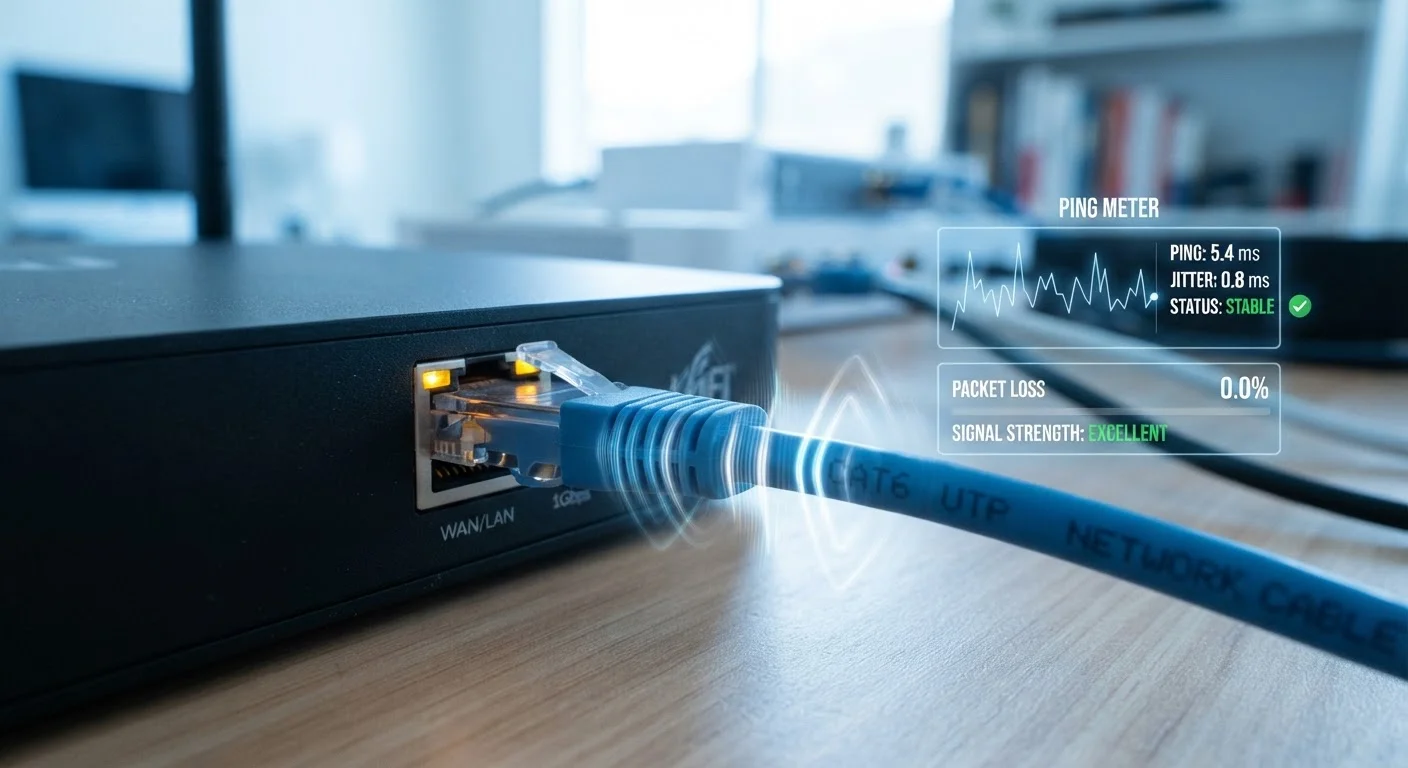
Speed vs. Latency: Two Different Things
When most people evaluate an internet plan, they focus on one number: download speed in megabits per second (Mbps). It is an important metric, but it tells only part of the story. A connection can be fast in the sense of moving large amounts of data quickly while still feeling sluggish during a video call or online game.
That sluggishness is a latency problem, not a speed problem. Think of download speed like the width of a pipe - it controls how much water flows through at once. Latency is how long it takes a drop of water to actually travel from one end of that pipe to the other. Both dimensions affect your experience, but for different reasons and different activities. See our guide to download and upload speeds for a closer look at how bandwidth metrics work.
What Causes High Latency?
Several factors influence how much latency you experience on any given connection:
- Physical distance: Data must travel between your device, your router, your ISP's network, and the destination server. Greater physical distance means more time in transit.
- Connection technology: Geostationary satellite internet signals travel roughly 22,000 miles to a satellite and back - a round trip that alone adds several hundred milliseconds of latency, regardless of the plan's advertised speed. Fiber and cable connections keep signals closer to the ground and deliver substantially lower latency.
- Network congestion: During peak hours, shared network infrastructure handles more simultaneous traffic. Routers and switches have to queue packets, adding delay.
- Router and hardware quality: Outdated or overloaded home routers can introduce their own latency, particularly on busy home networks.
- Wi-Fi interference: Wireless signals can experience interference from neighboring networks, walls, and household devices - each adding small but cumulative delays.
600ms+
Typical latency for geostationary satellite internet
Geostationary satellites orbit at roughly 22,000 miles altitude, making round-trip signal travel time inherently high regardless of plan speed.
~10-20ms
Typical latency for fiber-optic connections
Fiber-optic networks transmit data as light through glass cables close to the ground, minimizing signal travel time significantly.
50ms
Common threshold for acceptable residential latency
Many networking guidelines cite 50ms round-trip time as the upper boundary of comfortable performance for video calls and casual gaming.
When Latency Matters Most
Not every online activity is equally affected by latency. Streaming a movie, for instance, buffers content ahead of playback - so moderate latency rarely causes visible issues if bandwidth is sufficient. However, several common use cases are highly sensitive to response time:
- Online gaming: Multiplayer games require constant, real-time communication between your device and game servers. Even 80-100ms of latency can cause missed actions or visible lag, and competitive players often target under 20ms.
- Video and voice calls: Platforms like video conferencing tools relay audio and video in near-real time. High latency creates the awkward overlap where two people talk simultaneously, or causes lip-sync issues.
- Remote desktop and cloud computing: Any application where your keystrokes or clicks must reach a remote server before you see results is sensitive to round-trip time.
- Financial transactions and trading: Real-time data feeds used in trading environments are extraordinarily sensitive to latency, though this is rarely a concern for general home users.
For household activities like browsing, email, and standard streaming, latency above 100ms may still be perfectly acceptable. Knowing your use case helps you weigh whether latency should factor into your plan choice. Our article on what internet speed your household actually needs can help you map activities to the right specs.
How to Check and Interpret Your Latency
Testing your latency is straightforward. Free speed-test tools will display a ping value in milliseconds alongside your download and upload results. For the most reliable reading, connect your device directly to your router with an Ethernet cable and close other applications before running the test.
General reference ranges for residential internet:
- Under 20ms: Excellent - suitable for competitive gaming and latency-critical tasks.
- 20-50ms: Good - comfortable for video calls, casual gaming, and general use.
- 50-100ms: Acceptable - most everyday tasks will work without obvious issues.
- Over 100ms: Noticeable lag likely in real-time applications; investigate causes or consider connection alternatives.
If your latency is consistently high, try rebooting your router, connecting via Ethernet, or testing at different times of day to isolate whether congestion is the cause. Understanding the full picture of your connection - including latency alongside speed - helps you evaluate whether what you're paying for is actually being delivered. For additional context, see our explainer on why internet performance often falls short of advertised specs.
“Bandwidth is about capacity; latency is about responsiveness. For anything interactive - a game, a call, a remote session - responsiveness is often what you actually feel.”
— Network Performance Research Group, Academic working group on internet quality metrics
Frequently Asked Questions
For general browsing, streaming, and video calls, latency under 50ms is considered good. Competitive online gaming benefits from latency below 20ms. Latency above 100ms will often produce noticeable lag in real-time applications.
Not necessarily. Latency depends on the type of connection technology and network routing, not just the plan tier you purchase. A high-speed satellite plan, for example, can have higher latency than a slower cable connection due to the physical distance signals must travel.
Video calls are highly sensitive to latency and packet loss, not just download speed. Even with adequate bandwidth, high latency causes audio and video to fall out of sync, producing choppiness or delay. Network congestion and Wi-Fi interference can also contribute.
Free tools like Speedtest.net or Fast.com will display your ping alongside upload and download results. Run the test on a wired connection close to your router for the most accurate reading.
Fiber-optic connections generally offer the lowest and most consistent latency. Cable broadband is a close second. Satellite internet - particularly traditional geostationary satellite - tends to have the highest latency due to the vast distances signals travel.
Yes, to a degree. Connecting your device via Ethernet instead of Wi-Fi, reducing the number of active devices on the network, and restarting your router can all help lower latency. However, if high latency is caused by your connection type or ISP routing, equipment changes alone will not fully resolve it.
The content on this site is provided for informational purposes only and should not be considered a substitute for professional advice. While we strive to provide accurate and up-to-date information, we make no guarantees regarding its completeness or accuracy. Always consult a qualified professional for advice specific to your circumstances before making any decisions.