

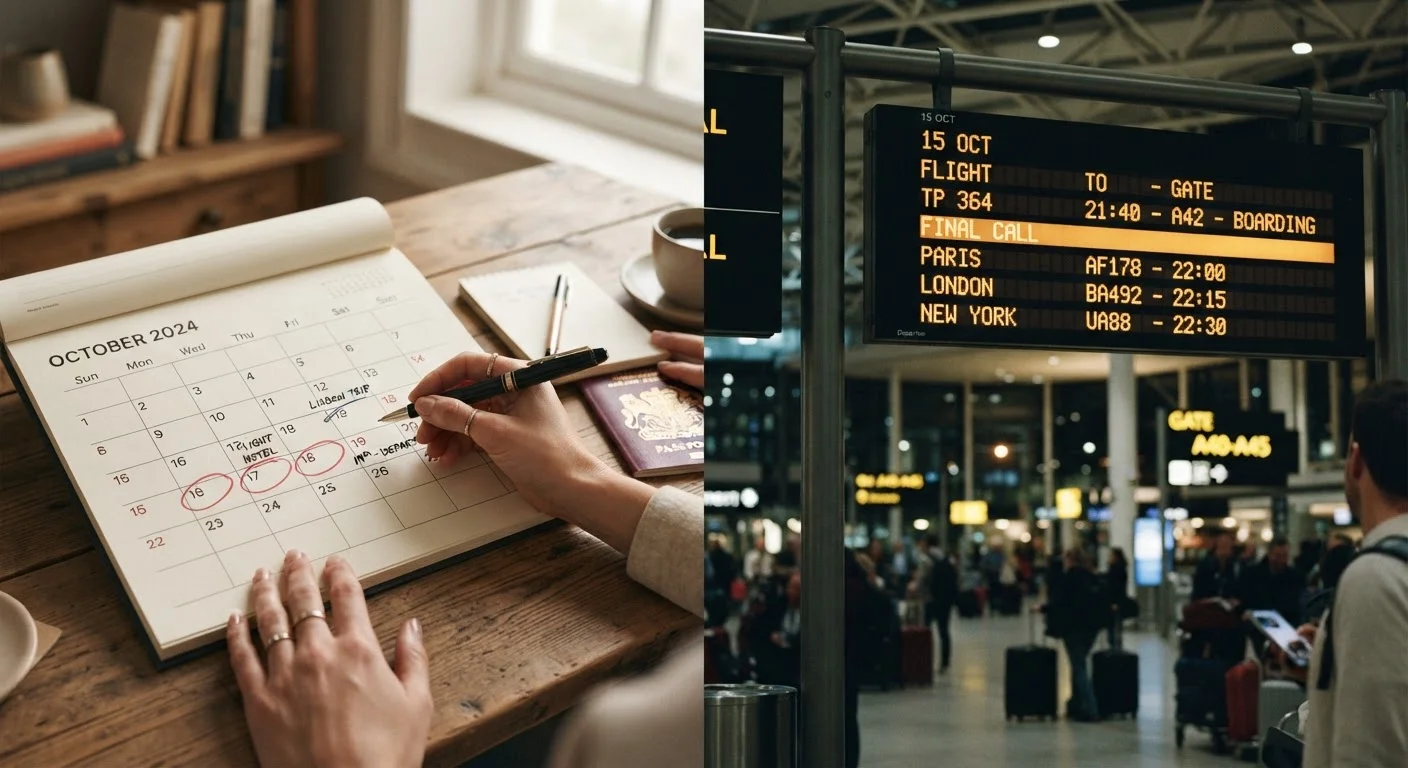
Option A
Booking Far in Advance
The certainty-first approach for planners who want guaranteed access.
Best for: Travelers with fixed dates, popular destinations, accessibility needs, or large groups who can't afford to miss a specific departure or property.
Option B
Waiting It Out
The flexible approach for travelers who prioritize savings or spontaneity.
Best for: Solo travelers or couples with schedule flexibility who are willing to accept some uncertainty in exchange for potentially lower prices or last-minute deals.
What Each Approach Actually Promises
The debate between booking early and waiting for a deal is one of travel's most persistent puzzles - and it resists a clean answer because the outcome depends heavily on what kind of trip you're planning. Before comparing timing strategies, it helps to clarify what each one genuinely delivers versus what it merely promises.
Booking far in advance primarily buys you certainty: a confirmed seat, a specific room type, a place on a limited tour. That certainty has real value, especially when the cost of a missed trip - nonrefundable time off, group logistics, visa appointments - is high. What it doesn't reliably guarantee is the lowest price. Airlines and hotels use dynamic pricing, and fares fluctuate based on demand signals, not a fixed schedule of discounts for early bookers.
Waiting it out buys you information: you'll know closer to departure whether demand is soft, whether prices have moved, and whether your plans have changed. In genuinely low-demand windows, unsold inventory sometimes does get discounted. But the core risk is real - supply contracts as the travel date nears, and what's available may be neither the price nor the product you wanted. As common trip planning myths illustrate, the idea that waiting always produces savings is one of the most persistent misconceptions in travel.
When the Calendar Actually Matters
Timing strategy isn't separable from seasonality. Peak-demand periods - major holidays, school breaks, festival dates, summer in Europe - compress available inventory fast. During these windows, waiting is a losing strategy for most travelers: inventory shrinks and prices move upward as departure approaches, not downward. Seasonality shapes trip planning at every level, from what's available to what's affordable.
Shoulder and off-season travel behaves differently. When overall demand is moderate, airlines and hotels have more unsold capacity, and prices can soften closer to the date. But even here, specific routes or properties with limited supply can sell out regardless of season.
| Criterion | Booking Far in Advance | Waiting It Out |
|---|---|---|
| Availability guarantee | High - secures specific inventory | Low - options shrink over time |
| Price predictability | Moderate - locks in a known rate | Variable - can rise or fall |
| Flexibility if plans change | Lower - depends on fare rules | Higher - no commitment yet |
| Works best for peak season | Yes - essential | No - high risk |
| Works best for off-peak travel | Useful but less critical | More viable |
| Group travel suitability | Strongly recommended | Difficult to coordinate |
| Accessible accommodations | Essential - limited supply | Very risky - often unavailable |
| Stress level | Lower - decisions made early | Higher - compressed decisions |
Group travel adds another layer. Booking a single flight seat or one hotel room last-minute is logistically feasible; booking eight matching seats or a block of adjacent rooms is far harder. Groups almost always benefit from locking in arrangements months ahead.
The Hidden Costs of Each Strategy
Early booking carries its own risks. Nonrefundable fares and prepaid hotel rates that don't allow changes mean that a plan that shifts - a job conflict, a family situation, an illness - can result in lost money. Travelers who book far ahead should carefully evaluate cancellation policies and consider whether travel protection (such as travel insurance) makes sense for their trip. Always verify coverage details with the insurer before purchasing.
Waiting, meanwhile, carries a different kind of cost: cognitive and logistical stress. Travelers who defer decisions often find themselves making rushed choices under pressure, accepting whatever remains rather than what they wanted. For travelers with accessibility needs, this is especially consequential - accessible rooms, wheelchair spaces on tours, and adapted transportation options are among the first to be claimed and among the hardest to secure at the last minute.
1-3 months
Typical advance window for domestic flight savings
Industry analysts and fare-tracking services generally find domestic airfare tends to be most competitive roughly one to three months before departure, though this varies by route and season.
6+ months
Recommended lead time for international peak-season travel
Travel industry guidance commonly suggests booking international trips during high-demand periods at least six months ahead to secure preferred flights and lodging.
~10%
Share of hotel rooms designated accessible in many U.S. properties
Under ADA guidelines, hotels are required to provide a percentage of accessible rooms, but that supply is limited and books out earlier than standard rooms.
There's also a planning-time consideration. Early booking spreads decisions across months, allowing for research and comparison. Last-minute booking compresses everything into a short window, which typically means less thorough evaluation of options.
A Practical Framework for Deciding
Rather than picking one approach as a universal rule, most experienced travelers use a hybrid: lock in the hard-to-replace, high-stakes elements early, and leave room for flexibility on the rest. Flights on popular routes, accommodations in high-demand destinations, and any booking that requires a visa or confirmed reservation as documentation should be secured well ahead. Secondary choices - a restaurant reservation, a day trip, a rental car for a less-traveled region - can often wait without meaningful downside.
The broader principles of smart travel planning consistently reinforce one point: the higher the cost of being wrong (missing a nonrefundable flight, losing a deposit, being unable to enter a country), the more early booking earns its place. When the stakes of a change are low, flexibility has genuine value.
This dynamic, interestingly, mirrors reasoning that applies well beyond travel. Research on delayed gratification suggests that the ability to wait for a better outcome is a real advantage - but only when the conditions actually favor waiting. Waiting for its own sake, in contexts where supply is finite and demand is known to be high, is a different calculation entirely.
Travel conditions, prices, and availability change frequently. Always verify booking terms, cancellation policies, visa requirements, and entry rules directly with airlines, accommodations, and relevant government sources before making any travel arrangements.
The content on this site is provided for informational purposes only and should not be considered a substitute for professional advice. While we strive to provide accurate and up-to-date information, we make no guarantees regarding its completeness or accuracy. Always consult a qualified professional for advice specific to your circumstances before making any decisions.