

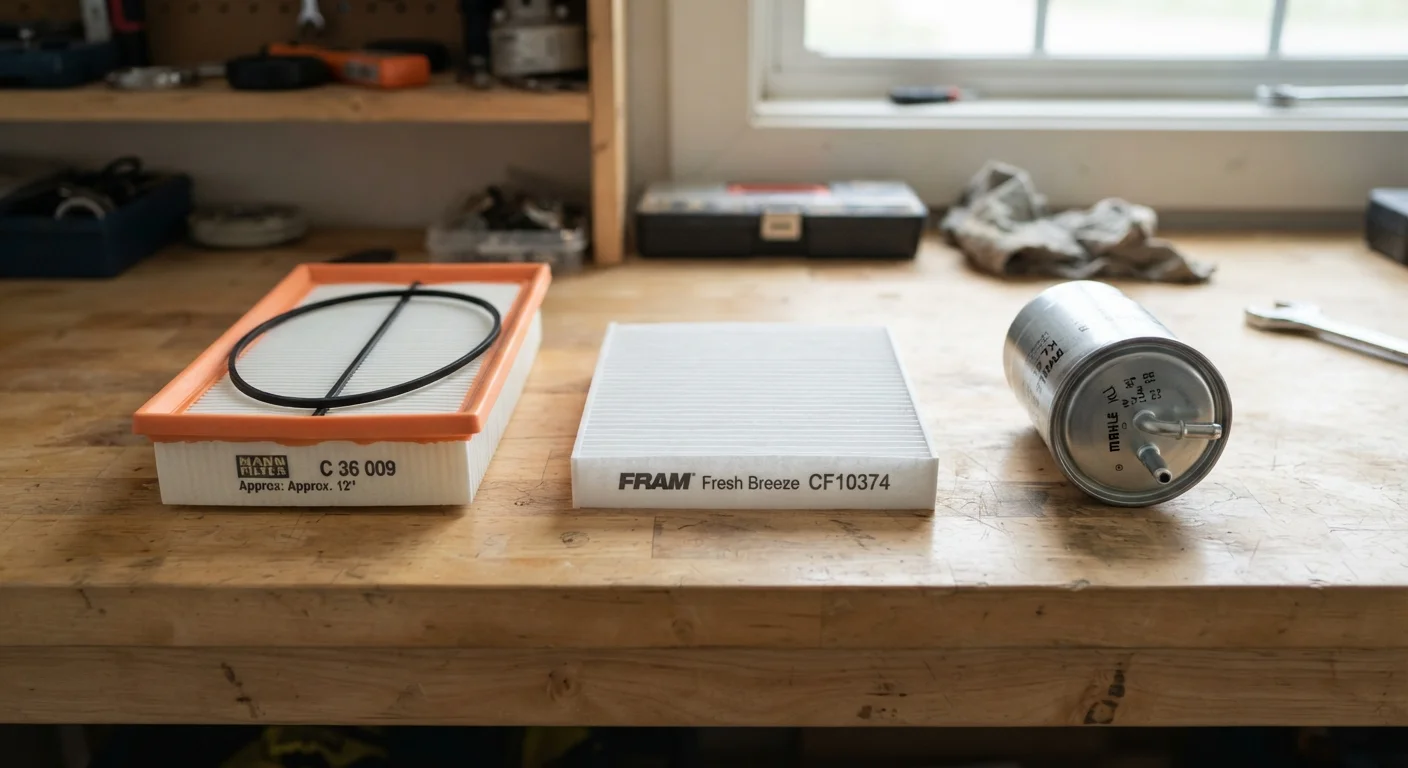
The Engine Air Filter: Protecting Combustion
Your engine needs a precise mixture of air and fuel to run. The engine air filter is the gatekeeper for that air - it sits between the outside atmosphere and your engine's intake, catching dust, pollen, insects, and debris before they can reach internal components.
Over time, the filter media becomes saturated with trapped particles. A mildly dirty filter is still functional, but a heavily clogged one restricts airflow enough to disrupt the air-fuel balance your engine depends on. Symptoms of a neglected engine air filter include reduced acceleration response, slightly decreased fuel economy, rough idling, or in serious cases, a check-engine light triggered by airflow sensor readings.
Replacement intervals typically fall between 15,000 and 30,000 miles, though drivers in dusty, unpaved, or high-pollution environments should inspect theirs more frequently. The filter is usually accessible under the hood in a black plastic housing - often one of the easier inspections any driver can perform. If it looks gray, packed with debris, or visibly deformed, it is ready to be replaced. For a broader picture of how maintenance neglect compounds over time, see why skipping routine maintenance costs more than you think.
The Cabin Air Filter: Protecting You
While the engine air filter protects mechanical components, the cabin air filter protects the people inside the vehicle. It filters the air pulled into the passenger compartment through the heating, ventilation, and air conditioning (HVAC) system, capturing dust, pollen, mold spores, and other airborne particles.
Most cabin filters are located behind the glove box, under the dashboard, or beneath the hood near the windshield base - check your owner's manual for exact placement. Replacement intervals are generally every 15,000-25,000 miles, but drivers with allergies or those who regularly travel in high-pollen or dusty areas may benefit from more frequent changes.
Signs of a cabin filter that needs attention include weak airflow from the vents even at high fan speeds, musty or stale odors when the HVAC is running, and increased interior dust accumulation. Unlike the engine air filter, this one is easy to overlook because a degraded cabin filter doesn't typically trigger dashboard warnings - it just quietly reduces air quality and HVAC efficiency.
Check Cabin Filter Before Allergy Season
If you or your passengers are sensitive to pollen or air quality, inspecting the cabin filter before spring arrives is a worthwhile habit. A fresh filter ensures your HVAC system is not recirculating trapped allergens through the vents. Combining this check with seasonal vehicle preparation makes it easier to remember.
Cabin filter condition is especially worth checking before allergy season or before a long road trip. See seasonal car care tips for a complete weather-readiness checklist.
The Fuel Filter: Protecting Your Injectors and Pump
Fuel is not perfectly clean as it travels from refinery to gas station to your tank. The fuel filter removes microscopic contaminants - rust particles, sediment, and other debris - before fuel reaches your injectors and fuel pump. Clean fuel delivery is critical for consistent combustion and long injector life.
Service intervals vary more for fuel filters than the other two. Some older vehicles recommend replacement every 20,000-30,000 miles; others specify longer intervals or design the filter as a sealed, lifetime component integrated into the fuel pump assembly. Because of this variability, your owner's manual is the authoritative source for your specific vehicle's schedule.
Symptoms of a failing or clogged fuel filter include hard starting, engine hesitation under acceleration, stalling at low speeds, or a noticeable loss of power under load. Left unaddressed, a blocked fuel filter forces the fuel pump to work harder, shortening its lifespan and potentially leading to an expensive pump replacement. Fuel system work - especially on vehicles where the filter is inside the tank - is generally best handled by a qualified mechanic due to the safety considerations involved with fuel system components.
Understanding how filters relate to the broader picture of what flows through your car is easier with context - car fluids and what each one does covers the liquid side of the equation in the same plain-language way.
Making Filter Maintenance Part of Your Routine
Each of these three filters performs a distinct job, but they share one common trait: they degrade gradually and silently. There is rarely a dramatic failure moment - just a slow decline in performance or protection that is easy to ignore until it becomes a problem.
15K-30K
Miles between engine air filter changes
General manufacturer guidance; actual interval depends on vehicle model and driving environment.
15K-25K
Miles between cabin air filter changes
Industry-standard recommendation, with more frequent changes advised in dusty or high-pollen conditions.
3 filters
Distinct filter types protecting different systems
Engine air, cabin air, and fuel filters each serve a unique protective role and have independent service schedules.
The practical approach is to build filter checks into your regular maintenance rhythm. When you get an oil change, ask for a visual inspection of the engine air filter. Every other oil change, check the cabin filter condition. And whenever you consult your owner's manual for scheduled service, confirm the fuel filter recommendation for your specific make and model.
Driving conditions matter as much as mileage. Stop-and-go urban commuting, construction zones, dirt roads, and high-pollen environments all accelerate filter wear. If your driving fits any of those patterns, lean toward the shorter end of any recommended interval. Be cautious about blanket rules - common car maintenance myths covers how one-size-fits-all advice can mislead well-intentioned drivers.
Filters are among the least expensive maintenance items on any vehicle. The cost of replacing all three is modest compared to the repairs that can result from ignoring them - whether that is a damaged fuel pump, a failing mass airflow sensor, or simply an HVAC system working overtime against a choked cabin filter.
Frequently Asked Questions
Most manufacturers recommend replacing the engine air filter every 15,000-30,000 miles, but this varies by vehicle and driving environment. If you frequently drive on unpaved roads or in dusty conditions, you may need to replace it more often. Always check your owner's manual for the interval specific to your car.
Common signs include reduced airflow from your vents, musty or unpleasant odors when running the HVAC system, and increased dust buildup inside the car. In some vehicles, a visibly dirty filter is easy to inspect yourself when accessing the glove box or dashboard panel.
Engine air filters and cabin air filters are among the most DIY-friendly maintenance tasks - they typically require no special tools. Fuel filter replacement is more involved and varies by vehicle; in many modern cars, the fuel filter is integrated with the fuel pump assembly, making it a job best left to a qualified mechanic.
Yes. A severely restricted air filter can reduce engine efficiency by limiting the air-fuel ratio needed for proper combustion. Fuel economy losses, rough idling, and sluggish acceleration are all potential symptoms of a long-overdue air filter change.
A clogged fuel filter restricts fuel flow to the engine, which can cause hard starts, engine misfires, stalling, or even fuel pump failure over time. Because the fuel pump works harder to push fuel through a blocked filter, neglect can escalate into a much more expensive repair.
Most vehicles made after the late 1990s include a cabin air filter, but not all do. Check your owner's manual or ask a mechanic if you are unsure whether your car is equipped with one. Older or more basic vehicle trims may omit this component entirely.
The content on this site is provided for informational purposes only and should not be considered a substitute for professional advice. While we strive to provide accurate and up-to-date information, we make no guarantees regarding its completeness or accuracy. Always consult a qualified professional for advice specific to your circumstances before making any decisions.