

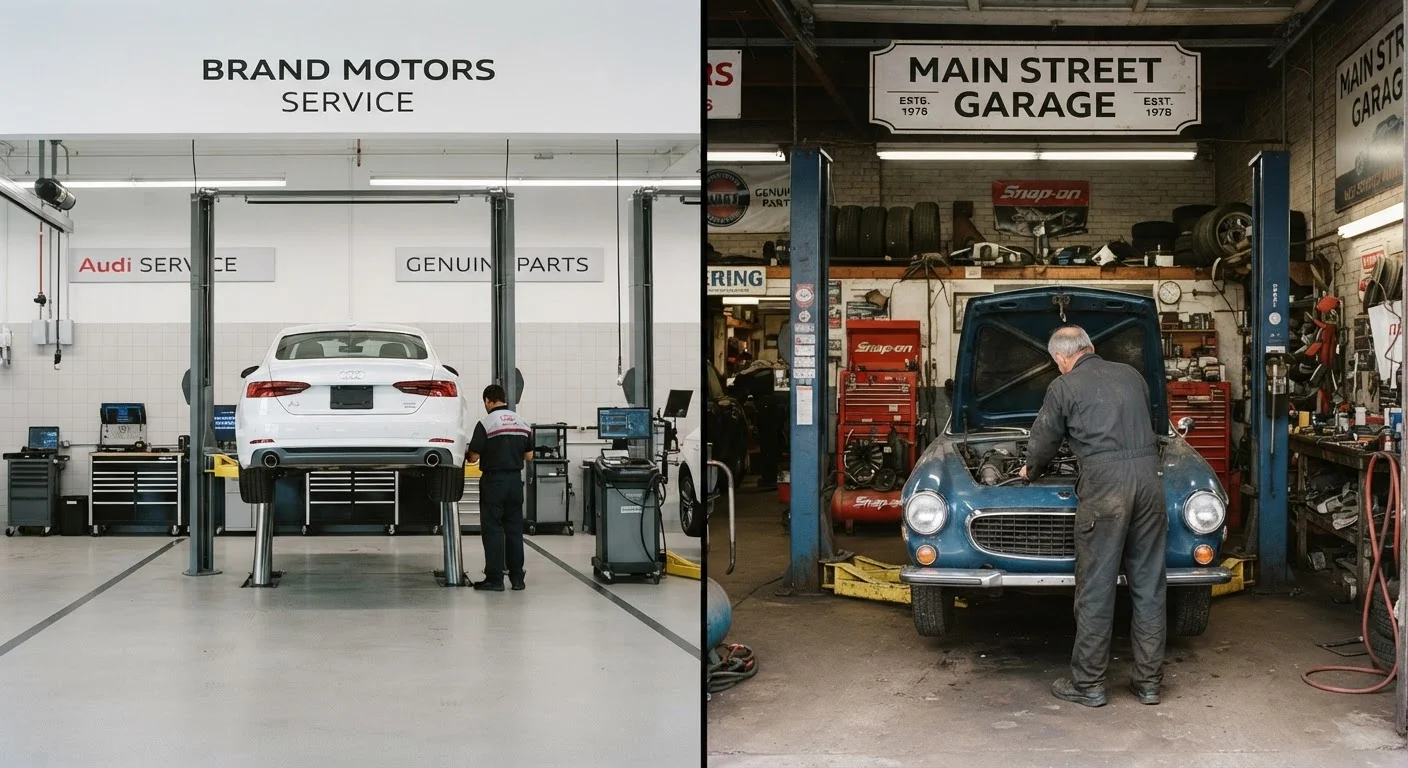
Our Verdict
Neither a dealer service center nor an independent mechanic is universally the better choice - the right answer depends on your vehicle, its warranty status, and the nature of the repair. Dealers excel at brand-specific diagnostics and warranty work; independents often deliver comparable quality on routine jobs at a lower cost. Building a relationship with a trusted provider on either side is ultimately more valuable than the label on the door.
Drivers with newer, in-warranty vehicles or those facing complex, model-specific repairs will get the most from a dealer service center; owners of older, out-of-warranty cars seeking cost-effective routine maintenance are often better served by a reputable independent mechanic.
What Actually Sets These Two Options Apart
When your car needs service, you face a choice that has real financial and practical consequences: take it to the dealership's service department or hand it to an independent mechanic. Both can perform the same basic tasks - oil changes, brake replacements, tire rotations - but the experience, pricing structure, and depth of expertise can differ significantly depending on the situation.
A dealer service center is operated by a franchised dealership and employs technicians who receive manufacturer-specific training and certifications. They have access to OEM (original equipment manufacturer) parts, proprietary diagnostic software, and the latest technical service bulletins issued directly by the automaker.
An independent mechanic operates outside the manufacturer's network. Many are highly experienced generalists who work across multiple makes and models, using aftermarket or third-party parts and commercial diagnostic tools. Some specialize in particular brands or vehicle types.
Understanding the difference between scheduled maintenance and as-needed repairs can help you frame which type of service provider makes more sense for a given situation.
Pros and Cons at a Glance
Before diving deeper, it helps to see the core advantages and disadvantages of both options laid out clearly. The pros and cons below apply primarily to dealer service centers as the subject being evaluated against the independent alternative.
Manufacturer-trained, brand-certified technicians on staff
Dealer technicians complete automaker-specific training programs and have access to the latest factory service information, which matters for complex, model-specific diagnostics.
Access to OEM parts and proprietary diagnostic tools
Original equipment parts are built to the exact factory specification, and manufacturer-issued software can read deeper system data than most aftermarket scanners.
Warranty work and recall repairs handled in one place
Only franchised dealers can perform recall repairs at no cost to the owner, and warranty claims are processed directly through the manufacturer's systems.
Detailed vehicle history integrated into manufacturer database
Service records are logged against your VIN, which can be useful when selling the vehicle or addressing recurring issues across visits.
Higher labor rates than most independent shops
Dealership overhead - facilities, training programs, manufacturer fees - is typically reflected in higher hourly labor charges, which can add up significantly on multi-hour jobs.
Less flexibility on parts sourcing and pricing
Dealers generally default to OEM parts, which carry a premium over quality aftermarket alternatives that may perform comparably for many repairs.
Can feel impersonal and transactional
Large service departments rotate staff and handle high volumes, which can make it harder to build an ongoing relationship with a technician who knows your specific car.
Longer wait times during peak periods
High-volume dealership service departments may have appointment backlogs of several days, and loaner car availability is not guaranteed at every location.
When the Dealer Is the Smarter Call
Dealer service centers earn their place in specific, well-defined scenarios. If your vehicle is still under the factory warranty or a certified pre-owned warranty, having service performed at a franchised dealership is often required - or at minimum, strongly advisable - to keep that warranty intact. Recall repairs and technical service bulletin updates must typically be performed at a dealer at no charge to you.
Complex, model-specific problems - unusual electrical faults, transmission issues, advanced driver-assistance system calibrations - are situations where manufacturer-trained technicians and proprietary software deliver a clear advantage. An independent shop's commercial scanner may not access the same depth of data.
The Magnuson-Moss Warranty Act and Your Rights
Federal law generally prohibits manufacturers from voiding a vehicle warranty solely because the owner used a non-dealer shop for routine maintenance. However, you should retain documentation - receipts, service records, and proof that manufacturer-specified fluids and parts were used. If a warranty dispute arises, consult a qualified legal or consumer protection professional for guidance specific to your situation.
Your vehicle's owner's manual will specify whether any maintenance tasks require dealer service to preserve warranty coverage. Reading those sections carefully before booking an appointment can save you from an avoidable dispute.
When an Independent Mechanic Makes More Sense
For most drivers with vehicles out of the factory warranty period, a reputable independent mechanic handles the vast majority of service needs competently and at a lower price point. Labor rates at independent shops are generally lower than at dealerships, and the use of quality aftermarket parts - which meet or exceed OEM specifications in many cases - can reduce the total bill further.
Independent shops often offer a more personal relationship. A mechanic who knows your car's history can flag patterns and make proactive recommendations. If you maintain a car service log, bringing that record to an independent shop helps them understand your vehicle's full picture without relying solely on a dealer database.
~30%
Typical labor rate difference, dealer vs. independent
Industry surveys have consistently found that dealer service labor rates run roughly 20-40% higher on average than comparable independent shops, though this varies by region and repair type.
70%+
Car owners who switch to independent shops post-warranty
Consumer research from AAA has found that the majority of drivers move away from dealer service once their factory warranty expires, citing cost as the primary driver.
Not all maintenance requires a professional at all. Several routine checks - tire pressure, fluid levels, windshield wipers - are straightforward for any driver. See our guide to DIY car checks for a practical starting point.
How to Evaluate Either Option Before You Commit
Regardless of which type of shop you use, the quality of the individual business matters more than the category it belongs to. When evaluating a service provider, look for:
- Certifications: ASE (Automotive Service Excellence) certification indicates a technician has passed standardized competency exams. Dealers require manufacturer certifications; good independent shops carry ASE credentials.
- Transparency: A trustworthy shop provides a written estimate before starting work and explains what was done afterward. Avoid any shop that resists doing so.
- Warranty on repairs: Many reputable independent shops offer a parts-and-labor warranty on their work. Ask about it upfront.
- Reviews and referrals: Word-of-mouth from neighbors or colleagues who own similar vehicles is one of the most reliable indicators of service quality.
It's also worth knowing that the Magnuson-Moss Warranty Act generally protects consumers from having a factory warranty voided simply because they used a non-dealer shop for routine maintenance - provided the correct service specifications were followed and documented. Consulting a qualified professional or reviewing official guidance is advisable if warranty coverage is a concern in your specific case.
The content on this site is provided for informational purposes only and should not be considered a substitute for professional advice. While we strive to provide accurate and up-to-date information, we make no guarantees regarding its completeness or accuracy. Always consult a qualified professional for advice specific to your circumstances before making any decisions.