

Our Verdict
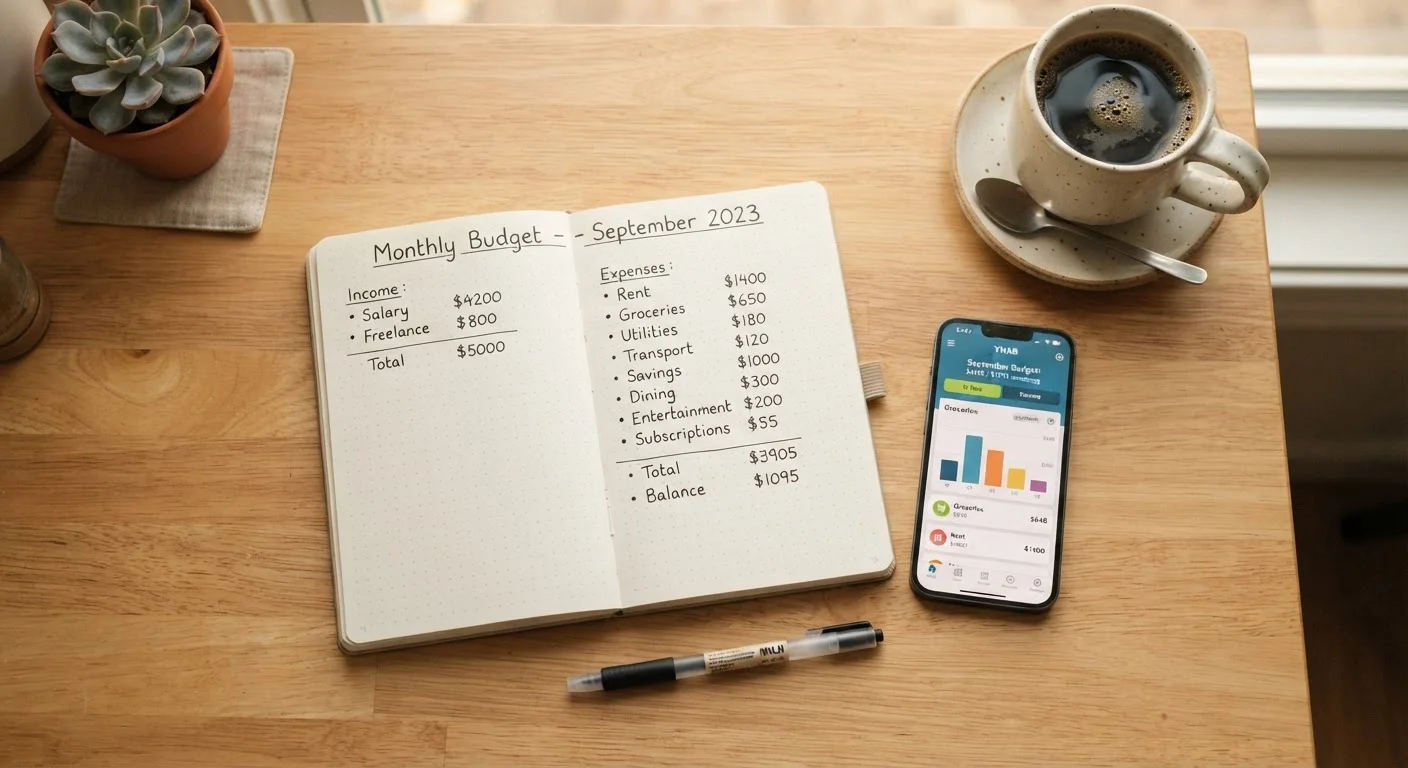
Pen-and-paper budgeting suits people who benefit from slowing down and engaging manually with their finances, or who prefer a low-tech routine. Digital budgeting is the stronger choice for anyone juggling multiple accounts, wanting automation, or needing real-time visibility into spending. For many people, the most practical answer is a hybrid - plan on paper, track digitally.
| Best for | Recommended |
|---|---|
| Those who want deliberate, distraction-free engagement with their money | Pen-and-paper budgeting |
| People managing multiple accounts, income sources, or shared household finances | Digital budgeting |
| Beginners building their first budget from scratch | Pen-and-paper budgeting |
| Those with variable income who need frequent adjustments and trend data | Digital budgeting |
Why the Format of Your Budget Actually Matters
Budgeting isn't just arithmetic - it's a habit. And habits are shaped by the tools that support them. The format you use affects how often you check your budget, how clearly you understand your spending, and whether you stick with it past the first month.
Research in cognitive science suggests that writing by hand engages the brain differently than typing. A commonly cited finding from studies on note-taking indicates that handwriting tends to promote deeper processing and better retention of information. That may translate to more mindful engagement when you're writing out categories and dollar amounts on paper.
Digital tools, on the other hand, reduce friction in a different way - they handle the math, sync with bank accounts, and surface trends you might miss in a notebook. Neither advantage cancels the other out. The question is which type of friction actually helps you.
If you haven't built a budget before, see our step-by-step starting guide before deciding which format to use.
The Case for Pen-and-Paper Budgeting
A handwritten budget has no subscription fee, no app updates, and no account syncing errors. You pick up a notebook, write down your income, list your expenses, and subtract. That simplicity is genuinely valuable for people who feel overwhelmed by technology or prefer a tactile routine.
Users who favor paper often report that the physical act of writing forces them to slow down and think through each category intentionally. There's also no app notification to ignore, no dashboard cluttered with suggested upgrades. Just the numbers in front of you.
Paper budgeting pairs naturally with cash-based systems. If you're already using physical envelopes to manage spending categories, a written ledger keeps everything in the same analog ecosystem. For more on that approach, see how the envelope method works.
Key advantages:
- No cost, no tech required
- Encourages deliberate, manual engagement with spending
- Works offline and without account access
- Low barrier to entry for beginners
Real limitations: Updating mid-month is cumbersome. Tracking irregular or variable income requires more discipline. And if you lose the notebook, the record is gone.
Start Simple, Then Add Complexity
If you're unsure which format to try, start with paper for your first monthly budget. Write out your income and every spending category you can think of. After 30 days, evaluate: did you check it regularly? Did you update it mid-month? Your answers will tell you whether to stay analog or move to a digital tool - or combine both.
The Case for Digital Budgeting
Spreadsheets and budgeting apps solve problems that paper can't. They calculate automatically, flag overspending in real time, and can pull transactions directly from linked accounts - removing the need to manually log every coffee or grocery run.
For households with multiple bank accounts, credit cards, or shared finances, a digital system provides a single consolidated view that would take significant effort to replicate on paper. Apps with bank-linking features can categorize spending automatically, although it's worth reviewing those categories periodically since automated systems make mistakes.
Spreadsheets occupy a useful middle ground: more flexible than an app, more powerful than paper. A well-built spreadsheet can track spending by category over months, calculate savings rates, and model different income scenarios - particularly useful for anyone budgeting on a variable income.
Key advantages:
- Automated calculations eliminate math errors
- Real-time visibility into spending across accounts
- Easier to update, adjust, and maintain over months
- Can generate trends and reports for longer-term planning
Real limitations: Apps require ongoing access to financial account credentials, which raises security considerations. Free tools often have limited features; paid apps add a recurring cost. And for some users, the ease of digital entry reduces the sense of weight that each spending decision deserves.
Head-to-Head: How They Stack Up
The table below summarizes how pen-and-paper and digital budgeting compare across the criteria most people actually care about. Note that individual experience will vary - treat this as a general framework, not a verdict on your specific situation.
| Criterion | Pen-and-Paper | Digital (App or Spreadsheet) | |
|---|---|---|---|
| Cost | Near zero (notebook and pen) | Free to paid subscription | |
| Ease of setup | Immediate, no accounts needed | Moderate; may require account linking | |
| Accuracy over time | Prone to math and entry errors | Automated calculations, fewer errors | |
| Mindfulness / engagement | High - deliberate manual entry | Lower - automation reduces attention | |
| Updating mid-month | Cumbersome, manual | Easy, often real-time | |
| Trend tracking | Difficult across multiple months | Built-in charts and history | |
| Security risk | Physical loss only | Account credential exposure possible | |
| Best for beginners | Yes - low barrier to start | Moderate - depends on tool chosen |
For a broader look at how spending tracking methods compare - including hybrid options - see methods that actually stick.
What Real Users and Research Suggest
Personal finance communities consistently surface the same pattern: the method people stick with is almost always the one that matches their natural habits, not the one that's theoretically optimal. Someone who enjoys journaling tends to maintain a paper budget longer. Someone who lives on their phone tends to actually check a budgeting app.
Research supports the idea that friction can be both helpful and harmful depending on context. Writing by hand adds productive friction - it slows decision-making in a way that can increase financial mindfulness. But too much friction (losing track of receipts, tedious mid-month updates) leads to abandonment.
A hybrid approach addresses both: some users plan their monthly budget on paper during a dedicated session, then track actual spending digitally throughout the month. This preserves the intentionality of handwriting while using technology's strengths for real-time accuracy.
Whichever format you choose, the underlying budgeting method matters too. See zero-based budgeting vs. the 50/30/20 rule to compare two popular frameworks that work with either format. For a comprehensive reference covering the full budgeting process, this end-to-end guide covers income tracking, expense categories, and long-term planning in one place.
This article is for general informational and educational purposes only and does not constitute personalized financial advice. Consult a qualified financial professional for guidance tailored to your individual circumstances.
The content on this site is provided for informational purposes only and should not be considered a substitute for professional advice. While we strive to provide accurate and up-to-date information, we make no guarantees regarding its completeness or accuracy. Always consult a qualified professional for advice specific to your circumstances before making any decisions.