

Our Verdict
The envelope method is a proven, low-tech budgeting tool that works because it makes spending limits tangible. It isn't a perfect fit for every lifestyle - particularly those who rely heavily on online payments or travel frequently - but for anyone struggling with overspending in specific categories, few methods create accountability as quickly or as clearly.
Best for people who consistently overspend on discretionary categories like dining, groceries, or entertainment, especially those new to budgeting or recovering from debt.
What the Envelope Method Actually Is
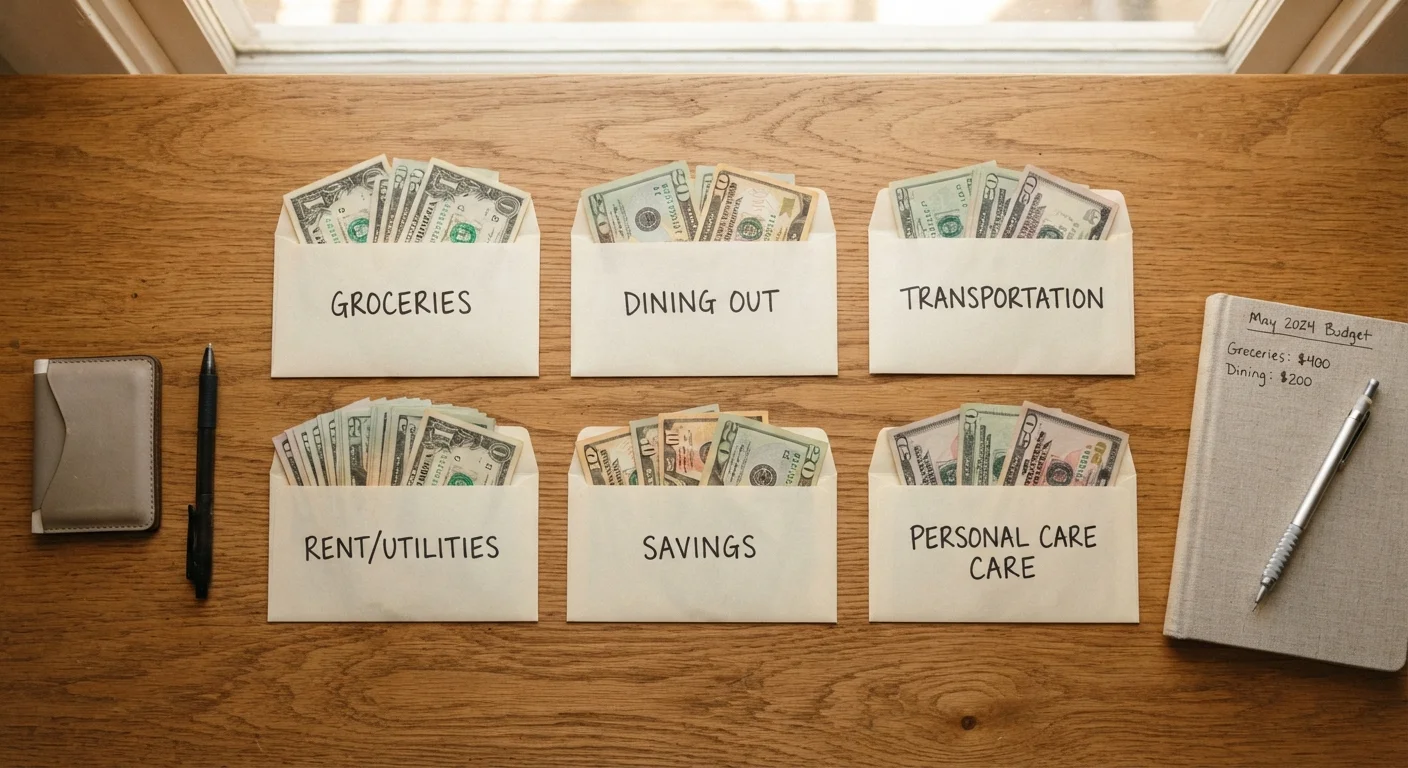
The envelope method - sometimes called the envelope system - is a cash-based budgeting technique. At the start of each pay period, you withdraw your discretionary spending money in cash, divide it into labeled envelopes by category (groceries, dining out, gas, entertainment, and so on), and spend only what's in each envelope. When the envelope is empty, spending in that category stops until next month.
That's essentially it. No app subscription, no spreadsheet formulas. The mechanic is simple by design: physical cash creates a hard limit that a debit card swipe does not.
The method doesn't typically apply to fixed expenses like rent, insurance, or loan payments - those are usually paid by check, transfer, or autopay. The system targets the variable, discretionary categories where most budget leakage actually occurs. If you're unfamiliar with terms like discretionary income or fixed expenses, the budgeting glossary covers the vocabulary worth knowing before you start.
The Real Advantages of Paying With Cash
Creates a hard spending limit per category
Once an envelope is empty, spending stops - no overdraft risk, no budget math required. The limit enforces itself.
Cash spending feels more psychologically real
Consumer behavior research suggests people spend less with physical money than with cards, a phenomenon sometimes called the 'pain of paying.'
Zero cost and no technology required
All you need is cash and envelopes. There's no app to learn, no subscription fee, and no risk of a software glitch derailing your budget.
Instant visibility into remaining funds
At any moment, you can open an envelope and see exactly how much is left - no login, no transaction delay, no reconciliation needed.
Builds habitual awareness of spending patterns
Regularly handling and allocating cash forces a conscious engagement with spending that automatic card payments don't encourage.
The psychological case for cash is backed by consumer behavior research. Studies have consistently found that people spend less when paying with physical money compared to cards - sometimes called the "pain of paying." Handing over bills creates a moment of friction that a tap-to-pay transaction simply doesn't.
For anyone who has ever checked their bank statement and genuinely not remembered where $200 went, that friction is valuable. The envelope method makes overspending an active, visible choice rather than a passive one. It also pairs naturally with spending tracking strategies - because you can literally count what's left at any point in the month.
Where the System Falls Short
Incompatible with most online purchases
A large portion of everyday spending - subscriptions, e-commerce, bill payments - happens digitally, where cash envelopes simply can't be used.
Cash can be lost or stolen with no recourse
Unlike debit or credit cards, cash carries no fraud protection. If your envelopes are lost or stolen, that money is gone with no way to recover it.
Requires regular trips to the ATM or bank
Maintaining a cash-based system means withdrawing and sorting money each pay period, which takes time and may involve ATM fees depending on your bank.
Difficult to manage shared or variable household expenses
When multiple people contribute to household spending, coordinating physical envelopes becomes logistically awkward and prone to miscommunication.
Digital workarounds reduce the core benefit
Using prepaid cards to mimic envelopes reintroduces the abstraction of digital spending, weakening the psychological accountability the system is built on.
The envelope method is not a frictionless system - which is part of its value, but also its biggest limitation in a digital economy. Most Americans make a significant portion of purchases online, and you can't stuff a website checkout with a $20 bill. That forces workarounds: some people use prepaid cards loaded with envelope amounts, but this dilutes the behavioral benefit of actual cash.
Security is a legitimate concern too. Carrying multiple envelopes of cash, or storing them at home, creates real risk of loss or theft. Unlike a debit or credit card, cash has no fraud protection and no way to recover it if it goes missing.
Finally, the system demands consistent effort: weekly cash withdrawals, remembering to bring the right envelopes, reconciling what's left. For people with unpredictable schedules or income, that operational overhead adds up. If the envelope method sounds too rigid, it's worth comparing it with more flexible frameworks - the zero-based budgeting vs. 50/30/20 comparison lays out two popular alternatives.
Who Gets the Most Out of This Approach
The envelope method tends to deliver the strongest results for a specific type of spender: someone who knows where their money should go but consistently fails to stick to the plan. If you've set a grocery budget three months in a row and blown past it every time, cash envelopes solve the accountability problem structurally rather than relying on willpower alone.
It's also well-suited to people who are new to budgeting, working through debt repayment, or rebuilding financial habits after a setback. The simplicity is a feature, not a flaw - there's almost nothing to learn and no technology to depend on.
Using Envelopes for Just One Category
You don't have to convert your entire financial life to cash to benefit from the envelope method. Many people find success applying it to just one or two problem spending categories - like dining out or impulse shopping - while keeping everything else digital. This hybrid approach reduces the logistical friction while preserving the core accountability benefit where it matters most.
On the other hand, frequent travelers, remote workers, and households that manage most finances digitally will likely find the system cumbersome. For those readers, a pen-and-paper vs. digital budgeting comparison may surface a better fit. The envelope method doesn't have to be all-or-nothing either - some households use it only for one or two problem categories while managing everything else digitally.
This article provides general financial information for educational purposes only and is not personalised financial advice. Consider consulting a qualified financial professional for guidance specific to your situation.
The content on this site is provided for informational purposes only and should not be considered a substitute for professional advice. While we strive to provide accurate and up-to-date information, we make no guarantees regarding its completeness or accuracy. Always consult a qualified professional for advice specific to your circumstances before making any decisions.