

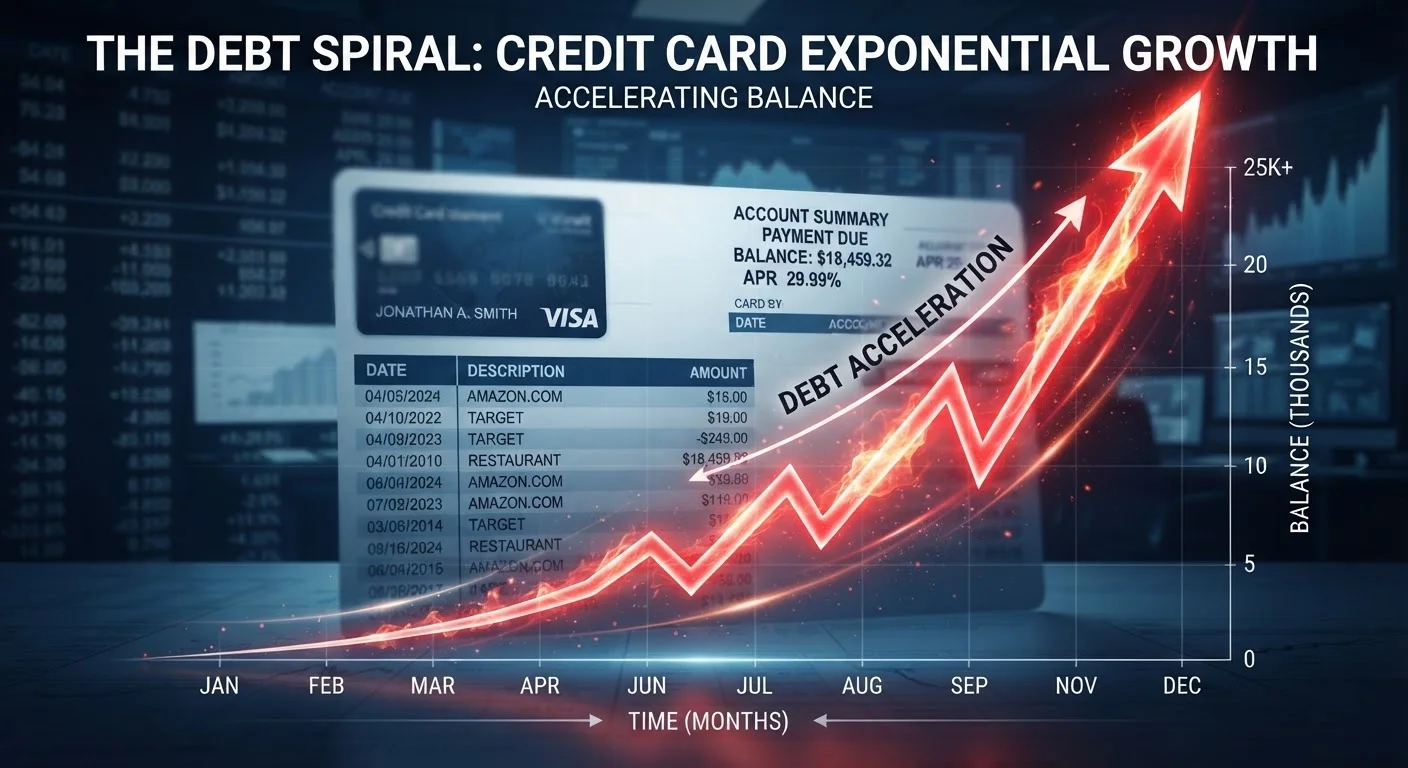
How Compounding Works Against You
Most people understand that borrowing money costs something. What's less intuitive is how that cost grows. With simple interest, you'd owe a fixed charge on your original balance. Compound interest works differently: every period, unpaid interest gets folded into your balance, and next period's interest is calculated on that larger number.
Think of it as interest earning interest. At a 20% APR, a $3,000 balance doesn't just grow by $600 a year - it grows by more each successive year because each month's unpaid interest raises the base. The longer the balance sits, the more aggressively it compounds.
This is why the math on credit card debt so often surprises people. It's not a straight line. It curves upward.
20%+
Average credit card APR in recent years
The Federal Reserve tracks average credit card interest rates; rates have remained elevated, making compounding effects particularly significant for revolving balances.
~47%
U.S. cardholders carrying a balance monthly
According to Federal Reserve consumer finance surveys, roughly half of credit card holders carry a balance from month to month, directly exposing them to compounding interest charges.
Daily
How often most credit cards compound interest
Credit card agreements typically specify daily compounding using a daily periodic rate derived from the APR, meaning interest accrues every single day a balance remains unpaid.
The Minimum Payment Trap
Credit card issuers set minimum payments low - often 1-2% of the balance or a small fixed dollar amount. This keeps debt manageable month-to-month, but it's structured in a way that maximizes the time your balance stays active, which maximizes interest collected.
When your payment barely covers the month's interest charge, the principal barely moves. The next month's interest is calculated on nearly the same balance. Over years, you can pay thousands of dollars and still owe a substantial amount - because compounding has been quietly inflating the balance the entire time.
For a concrete illustration: a $5,000 balance at 20% APR, paid at the minimum each month, can take well over a decade to clear and cost more in total interest than the original balance itself. Exact figures vary by minimum payment formula and rate, but the pattern is consistent across high-rate revolving debt.
If you're working through how to prioritize what you owe, the debt avalanche and snowball methods offer structured approaches to tackling multiple balances efficiently.
Why Acting Early Matters More Than Most People Think
Compounding is time-sensitive. The longer a balance runs, the more of your payments go toward interest rather than principal - and the more your total repayment grows beyond what you originally borrowed. Cutting a balance early, even by a few hundred dollars, removes that amount from the compounding base permanently.
That's the core logic behind accelerating debt repayment: you're not just paying down what you owe today, you're preventing future interest from compounding on a larger number. Every dollar of principal you eliminate now is a dollar that won't generate interest charges next month, or the month after, or the year after that.
This also reshapes how you might think about the broader question of debt versus savings. The trade-offs between paying off debt and building savings often hinge on exactly this: the compounding rate on your debt versus the return on your savings.
Compounding Can Work For You, Too
The mechanics that make debt expensive in a savings or investment context work in your favor. Interest earned on a savings account compounds, meaning your returns generate their own returns over time. This symmetry matters: high-rate debt that compounds against you and low-yield savings that compound slowly for you is a losing combination. That's why financial guidance consistently points toward paying down high-interest debt before directing extra money toward lower-yield savings.
Once high-rate debt is cleared, the same compounding logic that hurt you starts working for you. Contributions to savings grow more efficiently, and you're no longer losing ground to interest charges each month.
For readers weighing options to restructure what they owe, debt consolidation is one mechanism worth understanding - it can reduce the rate at which your balance compounds, though it carries its own trade-offs.
For a broader look at how debt accumulates and how to build a plan around it, see Getting Out of Debt: A Start-to-Finish Overview.
This article is for general informational and educational purposes only and does not constitute personalized financial advice. Consult a qualified financial professional for guidance specific to your situation.
Frequently Asked Questions
Yes - especially at higher interest rates. On a $5,000 credit card balance at 20% APR, minimum payments can result in paying thousands of dollars in interest over many years. The compounding effect is what keeps the balance stubbornly high even as you pay each month.
Most credit cards compound interest daily. The daily periodic rate - your APR divided by 365 - is applied to your balance each day. That daily interest then becomes part of the balance subject to the next day's calculation.
Pay more than the minimum whenever possible, and prioritize balances with the highest interest rates first. Even small additional payments reduce the principal, which shrinks the base that interest compounds on.
No. The same principle works in your favor in savings and investment accounts. The goal is to minimize compound interest on debt while maximizing it on assets.
APR (Annual Percentage Rate) is the stated yearly rate, but because credit cards compound daily, the effective rate you actually pay is slightly higher. Lenders are required to disclose APR, but understanding how it compounds gives you a clearer picture of real costs.
Yes, meaningfully so. Every extra dollar applied to principal reduces the base on which interest compounds. On high-rate debt, even an additional $50 or $100 per month can cut months - sometimes years - off repayment time and reduce total interest paid.
The content on this site is provided for informational purposes only and should not be considered a substitute for professional advice. While we strive to provide accurate and up-to-date information, we make no guarantees regarding its completeness or accuracy. Always consult a qualified professional for advice specific to your circumstances before making any decisions.