

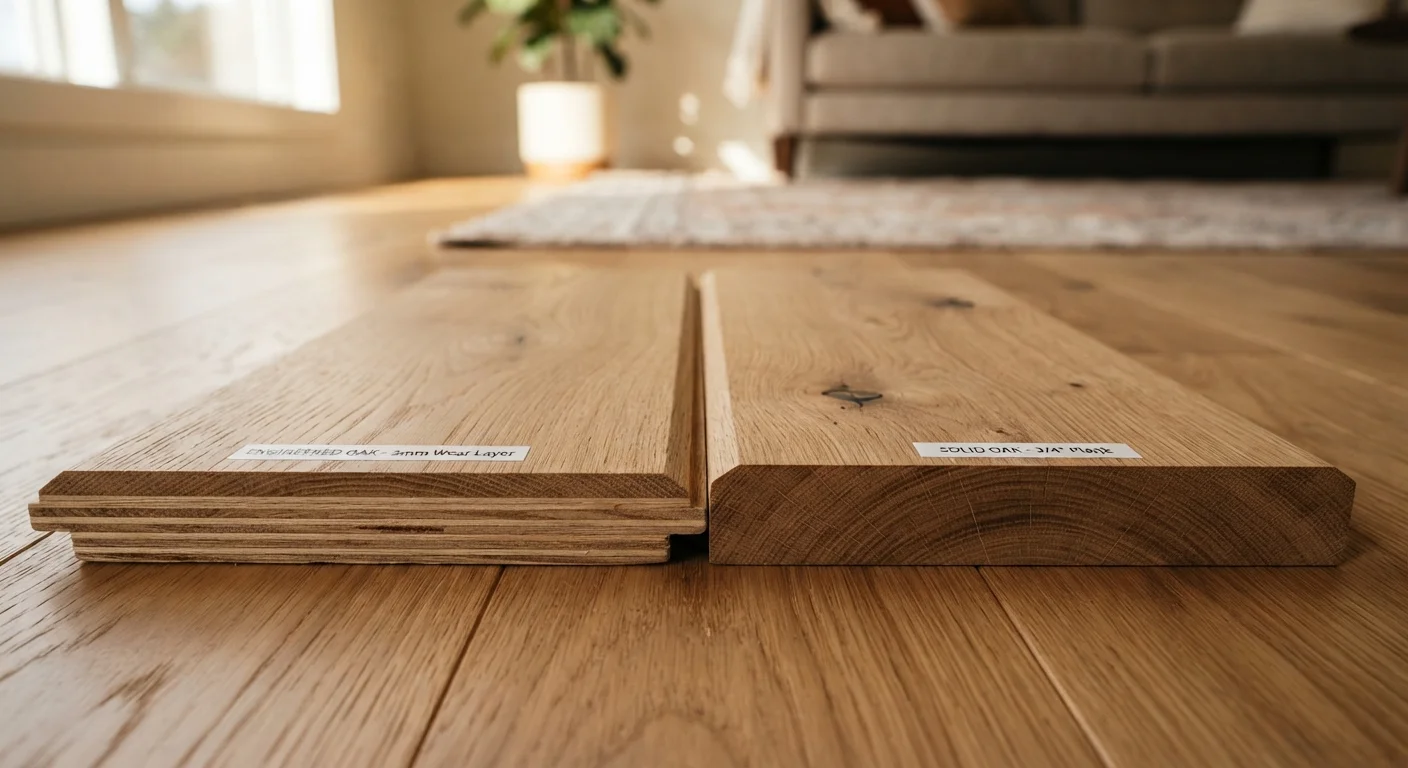
Option A
Engineered Hardwood
The dimensionally stable, moisture-tolerant option.
Best for: Basements, kitchens, and rooms with temperature or humidity swings where solid wood is prone to warping.
Option B
Solid Hardwood
The classic, refinishable, long-lasting choice.
Best for: Above-grade living rooms, bedrooms, and dining rooms in climate-controlled homes where longevity is the priority.
How Each Floor Is Made
Solid hardwood is exactly what it sounds like: a single, solid piece of wood milled from one timber species - typically 3/4 inch thick - from top to bottom. Species like oak, maple, and hickory are common in American homes. Because there's no composite core, the wood responds directly to its environment, expanding in humid conditions and contracting when the air dries out.
Engineered hardwood is a layered product. A genuine hardwood veneer - typically 2 to 6 millimeters thick - is bonded over a core of cross-layered plywood. This construction counteracts the natural movement of wood; the grain directions in each layer work against each other, giving the floor much greater dimensional stability. The surface still looks and feels like real wood because it is real wood - just not all the way through.
Where Each Type Can Be Installed
Installation location is one of the clearest deciding factors between these two options.
Solid hardwood should only be installed above grade - meaning above ground level, such as main floors and upper floors. It is not recommended for basements or directly over concrete slabs, where moisture vapor transmission can cause cupping, buckling, or mold over time.
Engineered hardwood is rated for above, on, and below grade installation. It can go over concrete slabs, in basements (provided moisture levels are within manufacturer guidelines), and on radiant heat systems where solid wood could crack. Always verify the specific product's moisture tolerance and subfloor requirements before installation.
| Criterion | Engineered Hardwood | Solid Hardwood |
|---|---|---|
| Construction | Hardwood veneer over plywood core | Single solid wood plank |
| Moisture resistance | Good - suitable over concrete | Poor - avoid below grade |
| Installation grade | Above, on, and below grade | Above grade only |
| Refinishing potential | 1-4 times (veneer dependent) | 6-8 times typically |
| Typical lifespan | 25-50+ years | 50-100+ years |
| DIY-friendly installation | Yes - floating options available | Limited - usually nail-down |
| Radiant heat compatible | Often yes - check specs | Rarely recommended |
Just as you'd match a paint finish to a room's conditions - as explored in our guide to interior paint finishes - matching your flooring type to your room's environment is essential for long-term performance.
Durability, Refinishing, and Lifespan
Solid hardwood has a compelling long-game advantage: because it is 3/4 inch of solid wood, it can typically be sanded and refinished six to eight times across its lifespan. That means scratches, stains, and worn finishes can be erased every decade or so, and the floor can even be re-stained in a new color. A well-maintained solid floor can last well over 100 years.
Engineered hardwood's refinishability depends on the thickness of its veneer layer. Thinner veneers (2-3 mm) may allow only one or two light sandings, while thicker veneers (4-6 mm) can support two to four. This is an important spec to check when evaluating any engineered product. Engineered floors typically carry warranties of 25 to 50 years under normal residential use, which covers most homeowners' needs comfortably.
Both floor types are susceptible to scratching from pet claws, furniture, and heavy foot traffic. Hardness is measured on the Janka scale; choose a harder species - such as hickory or white oak - if your household is active.
Installation and Cost Considerations
Solid hardwood is almost always installed by nailing or stapling to a wood subfloor. This limits its use over concrete and makes it less DIY-friendly for many homeowners. Professional installation is the norm, and acclimation time before installation - typically 3 to 5 days in the room's conditions - is essential to prevent post-installation movement.
Engineered hardwood offers more flexibility: it can be nailed, glued, or floated using a click-lock system depending on the product. Floating installations, in particular, are more accessible for capable DIYers. Acclimation is still recommended, though engineered products generally require less time than solid.
Material costs vary widely for both types based on species, grade, and board width. As a general range, engineered hardwood materials often run comparable to or slightly less than solid hardwood of the same species - though premium engineered products with thick veneers can match solid pricing. Labor costs for professional installation are similar between the two. For outdoor wood decisions using similar logic, see our deck materials comparison.
Note: Material and installation costs vary significantly by region, wood species, and contractor. Always obtain multiple quotes and verify current pricing before budgeting for a flooring project.
The content on this site is provided for informational purposes only and should not be considered a substitute for professional advice. While we strive to provide accurate and up-to-date information, we make no guarantees regarding its completeness or accuracy. Always consult a qualified professional for advice specific to your circumstances before making any decisions.