

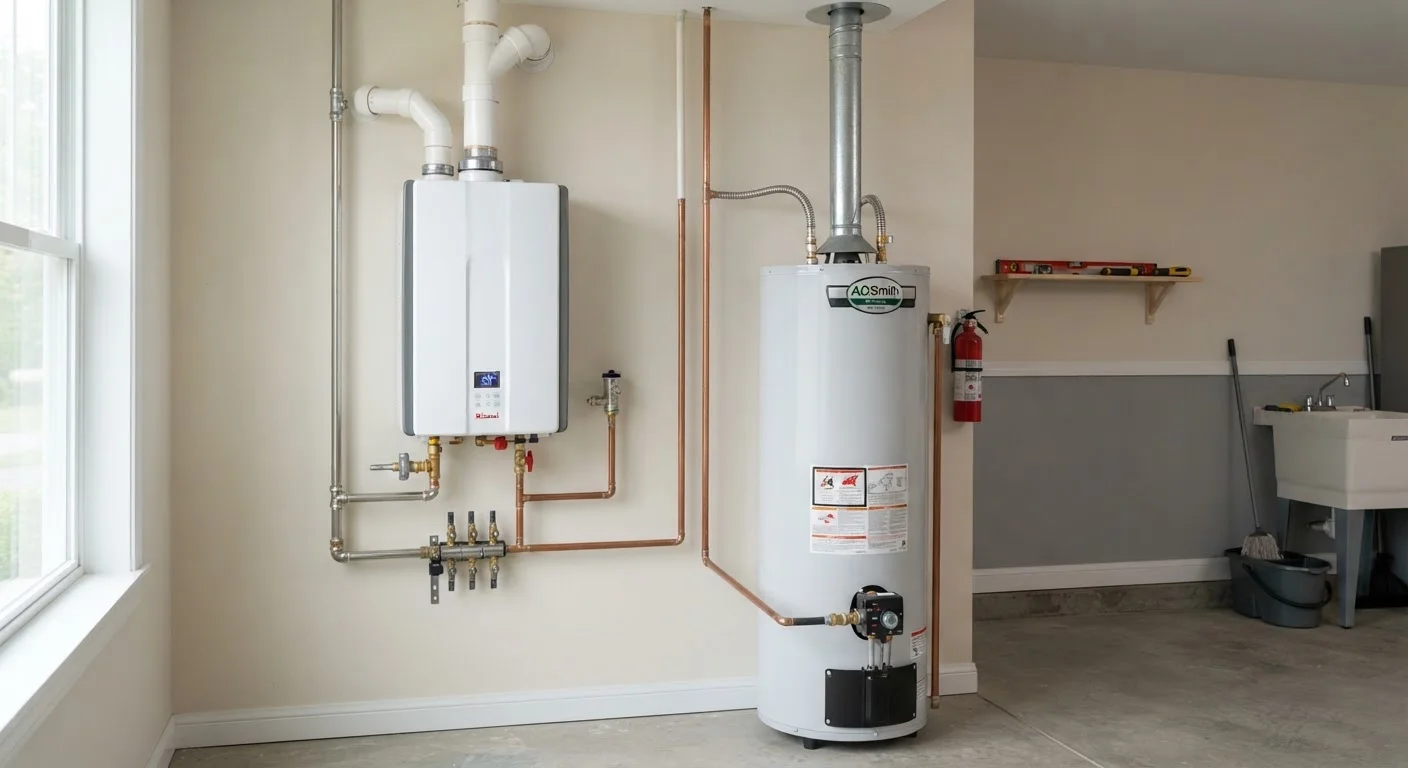
Option A
Tankless Water Heater
The on-demand, energy-efficient modern option.
Best for: Households with consistent but moderate hot water demand and a priority on long-term energy savings.
Option B
Traditional Storage-Tank Water Heater
The reliable, lower-upfront-cost classic.
Best for: Homeowners seeking straightforward installation and lower initial investment with predictable performance.
How Each System Works
Understanding the fundamental difference between these two systems makes every other comparison easier to follow.
A traditional storage-tank water heater maintains a reservoir of hot water - typically 30 to 80 gallons - kept at a set temperature around the clock. Whenever you turn on a hot tap, pre-heated water flows out and cold water enters the tank to be heated for the next use. The ongoing energy needed to keep that standing supply hot is called standby heat loss, and it represents a constant, quiet energy cost.
A tankless water heater (also called an on-demand or instantaneous heater) has no storage tank. When a hot tap opens, cold water travels through the unit and is heated instantly by a gas burner or electric element. Hot water flows as long as the tap is open, then heating stops completely. There is no standby heat loss - energy is used only when hot water is actually needed.
Both systems are available in natural gas, propane, and electric configurations. Your home's existing fuel supply and utility infrastructure will influence which options are practical for your situation.
Cost: Upfront vs. Long-Term
Cost is usually the first factor homeowners weigh, and it breaks into two distinct layers: what you pay today and what you pay over time.
Upfront costs favor the traditional tank. A storage-tank unit and its installation generally run significantly less than a tankless system. Tankless heaters - particularly whole-house gas models - require a larger unit, specialized venting, and sometimes an upgraded gas line, which adds labor and materials to the project.
According to the U.S. Department of Energy, tankless water heaters can be 24-34% more energy-efficient than conventional storage models for homes that use 41 gallons or less of hot water daily. For high-usage households (around 86 gallons per day), the efficiency advantage narrows to approximately 8-14%. Over a 10- to 15-year span, those savings can offset the higher initial investment - but the math depends heavily on your local utility rates and actual usage patterns.
| Criterion | Tankless Water Heater | Traditional Storage-Tank Heater |
|---|---|---|
| Upfront Cost | Higher (unit + installation) | Lower (unit + installation) |
| Energy Efficiency | 24-34% more efficient (moderate use) | Baseline; standby heat loss occurs |
| Typical Lifespan | 20+ years | 10-15 years |
| Hot Water Supply | Unlimited (flow-rate dependent) | Limited to tank capacity |
| Space Required | Minimal (wall-mounted) | Dedicated floor space needed |
| Installation Complexity | Higher; may need gas/electrical upgrades | Lower; typically a direct swap |
| Works During Power Outage | No (gas models need electricity for controls) | Yes (delivers stored hot water) |
| Maintenance | Descaling, filter cleaning | Annual flush, anode rod check |
If you're renting your home rather than owning it, the calculus shifts considerably - a landlord's choice of water heater affects your energy bills but not your capital outlay. For more on the financial dimensions of home ownership, see Renting vs. Buying a Home: Weighing the Real Trade-Offs.
Lifespan, Maintenance, and Reliability
Longevity is a genuine differentiator between these two technologies.
Traditional storage-tank heaters typically last 10-15 years with routine maintenance - primarily annual flushing to remove sediment buildup and occasional anode rod inspection. When a tank fails, replacement is usually straightforward because the units are standardized and widely stocked.
Tankless units have an expected lifespan of 20 years or more when properly maintained. They require periodic descaling (especially in areas with hard water) and filter cleaning, but there's no tank to corrode or rupture. However, when a tankless unit does need repair, parts can be more specialized and service calls may cost more.
One reliability note: tankless heaters depend on electricity to operate their controls even when gas-powered. During a power outage, a gas tankless unit will not function unless it has a battery backup - whereas a traditional tank will continue to supply the hot water already stored.
Performance and Household Fit
Neither system is universally superior - the right choice depends on how your household actually uses hot water.
Tankless heaters have a flow rate limit, measured in gallons per minute (GPM). A single whole-house unit may struggle to supply a shower, dishwasher, and washing machine running simultaneously. In large households with overlapping peak demand, multiple units or a hybrid approach may be needed, which increases cost and complexity.
Storage-tank heaters deliver their full stored volume at once with no flow restrictions - an advantage during high-demand periods. The trade-off is the risk of running out of hot water if demand exceeds tank capacity, followed by a recovery wait of 20-30 minutes or more depending on the unit's first-hour rating.
For smaller households, vacation homes, or spaces with limited demand, point-of-use tankless units can be an efficient supplemental option installed under a sink or near a remote bathroom.
Whatever water heater type you have, it's a core home system worth factoring into broader decisions about your property. If you're thinking through those bigger questions, Renting vs. Buying a Home: What the Decision Really Comes Down To offers a useful framework.
The content on this site is provided for informational purposes only and should not be considered a substitute for professional advice. While we strive to provide accurate and up-to-date information, we make no guarantees regarding its completeness or accuracy. Always consult a qualified professional for advice specific to your circumstances before making any decisions.