

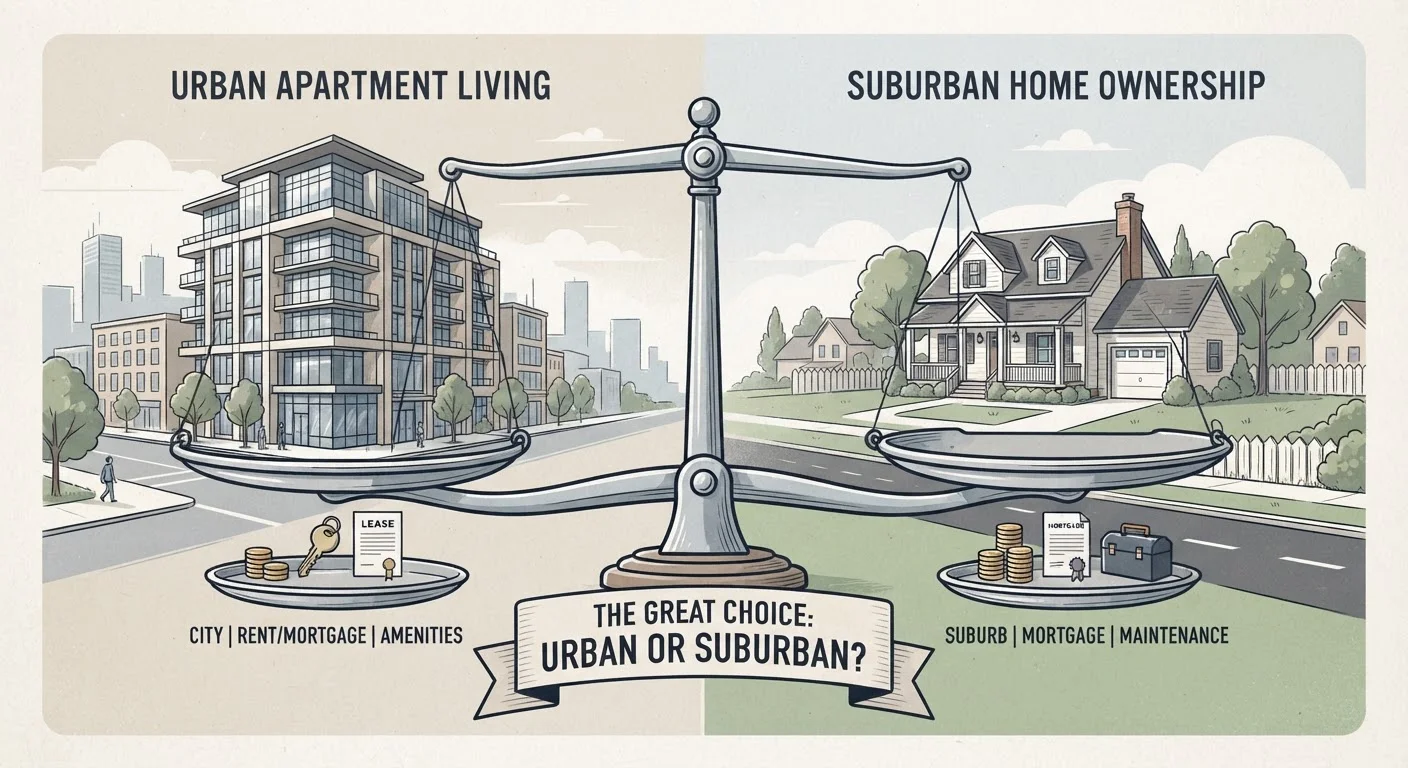
Our Verdict
Buying makes the most financial sense when you plan to stay in one place for at least five to seven years, have a stable income, and can absorb the full cost of ownership beyond the mortgage. Renting is a genuinely sound choice - not just a fallback - for people who value flexibility, live in high-cost markets, or aren't yet in a position to take on the risks of ownership.
Buyers who have a solid down payment, a stable long-term horizon, and an understanding of total ownership costs; renters who prioritize mobility or operate in markets where buying is cost-prohibitive.
The Financial Case for Buying
Homeownership is often framed as the default path to financial security in the US - and for many households, it does deliver measurable benefits. When you purchase a home with a fixed-rate mortgage, your monthly principal and interest payments stay constant, providing protection against the rent increases that renters face in competitive markets.
The most cited financial benefit is equity accumulation. Each mortgage payment chips away at your loan balance, and if your home appreciates in value over time, that equity can become a significant asset. Historically, residential real estate in the US has appreciated over long holding periods, though past performance doesn't predict future results and local markets vary considerably.
Tax treatment can also favor owners. Mortgage interest and property taxes may be deductible for some filers, though the 2017 tax law changes - including the cap on state and local tax (SALT) deductions - reduced the benefit for many households. Consulting a tax professional about your specific situation is advisable before factoring deductions into your housing math.
Builds equity with every mortgage payment
A portion of each mortgage payment reduces your loan balance, gradually increasing your ownership stake in the property - an asset that may grow in value over time.
Protection against rent increases with fixed-rate loans
A fixed-rate mortgage locks in your principal and interest payment for the loan's life, shielding you from the rent hikes that can significantly disrupt a renter's budget.
Freedom to modify and personalize your space
Owners can renovate, paint, landscape, or make structural changes without a landlord's approval, allowing the home to adapt to their needs over time.
Potential tax advantages for qualifying filers
Mortgage interest and property tax payments may offer deductions for some homeowners, though the tax benefit depends on individual filing circumstances and applicable law.
Stability and community rootedness
Owning a home typically encourages longer-term residency, which can foster neighborhood ties, school stability for children, and a stronger sense of community belonging.
For a broader framework on how this decision plays out across different scenarios, see our guide to thinking through the rent-vs.-buy decision honestly.
The Hidden Costs of Ownership
The sticker price of a home understates its true cost significantly. Buyers typically pay 2-5% of the purchase price in closing costs alone before moving in. Once in the home, annual maintenance and repair expenses are commonly estimated at 1-2% of the home's value per year - a figure that rises with older properties. Property taxes, homeowner's insurance, and in many communities, homeowner association (HOA) fees add further to the monthly burden.
Substantial upfront and ongoing costs
Down payments, closing costs, and immediate maintenance can require tens of thousands of dollars at purchase, with recurring ownership costs of 1-2% of home value annually thereafter.
Illiquidity and market exposure
Home equity cannot be quickly converted to cash, and market downturns can leave owners underwater - owing more than the home is worth - making a sale financially damaging.
Reduced mobility and geographic flexibility
Selling a home takes time and costs money; owners who need to relocate quickly for work or personal reasons face real friction that renters largely avoid.
Full responsibility for maintenance and repairs
Unlike renters who can call a landlord, homeowners absorb every repair cost - from a leaking roof to a failed HVAC system - which can be unpredictable and expensive.
Market risk can erode expected wealth gains
Home values are not guaranteed to appreciate, and in some regions or periods, real home prices have declined or stagnated for years, undermining the investment rationale for buying.
There is also liquidity risk. Unlike a savings account, home equity isn't easily accessed without refinancing, taking a home equity loan, or selling the property. If your local market softens and you need to move quickly, you may sell at a loss or face a prolonged sale process. Anyone considering homeownership should also understand how factors like layout and infrastructure choices affect long-term livability; our look at open floor plan trade-offs illustrates how home design decisions carry real costs that aren't always obvious upfront.
What Renting Actually Offers
Renting is frequently cast as "throwing money away" - a framing that doesn't hold up to scrutiny. Renters exchange a monthly payment for housing, just as homeowners exchange mortgage payments, taxes, insurance, and maintenance costs for the same. The key difference is that renters aren't building equity, but they also aren't exposed to the same financial risks.
Flexibility is the most underrated benefit. Renters can relocate for a new job, a relationship change, or simply a preferred neighborhood without the friction and cost of selling a property. In high-cost metros where home prices are far outpacing income growth, renting can also free up capital that would otherwise be tied up in a down payment - capital that can be invested elsewhere.
Price-to-Rent Ratio: A Quick Calibration Tool
The price-to-rent ratio compares median home prices to annual rents in a given market. A high ratio (above 20) typically signals that renting is more cost-competitive locally; a low ratio (below 15) often favors buying. This metric is a starting point, not a definitive answer - personal finances, career stability, and long-term goals all factor into the real calculation. You can find price-to-rent data for US metro areas through sources like the US Census Bureau and real estate research organizations.
The complete walkthrough for first-time renters covers the practical steps of finding and securing a rental, from application to lease signing.
Using Local Market Data to Ground Your Decision
One concrete tool is the price-to-rent ratio - calculated by dividing the median home price in an area by the annual median rent for a comparable property. A ratio above 20 generally suggests renting is relatively more cost-efficient; below 15, buying tends to pencil out more favorably. This metric won't make the decision for you, but it anchors the comparison in real local numbers rather than national averages that may not apply to your market.
5-7 years
Minimum ownership horizon to recoup transaction costs
Most housing economists and financial planners cite this threshold as the point at which buying begins to outperform renting financially, factoring in closing costs and agent fees.
2-5%
Typical closing costs as a share of home price
The Consumer Financial Protection Bureau notes that buyers generally pay between 2% and 5% of the purchase price in closing costs, a significant cash outlay before the mortgage begins.
1-2%
Annual home maintenance cost estimate
A commonly cited industry rule of thumb suggests budgeting 1-2% of a home's value each year for maintenance and repairs, rising for older or larger properties.
Your time horizon matters enormously here. Real estate transaction costs - agent commissions, closing costs, moving expenses - mean that buyers who sell within a few years often lose ground financially compared to renters. Most housing economists suggest a minimum five-to-seven-year ownership horizon to recover those transaction costs, though this varies by market appreciation and mortgage terms.
For renters weighing their lease structure, month-to-month versus fixed-term leases each carry distinct trade-offs worth understanding before committing. And if you're already renting and facing a move, breaking a lease early has real financial consequences that are worth understanding in advance.
The content on this site is provided for informational purposes only and should not be considered a substitute for professional advice. While we strive to provide accurate and up-to-date information, we make no guarantees regarding its completeness or accuracy. Always consult a qualified professional for advice specific to your circumstances before making any decisions.