

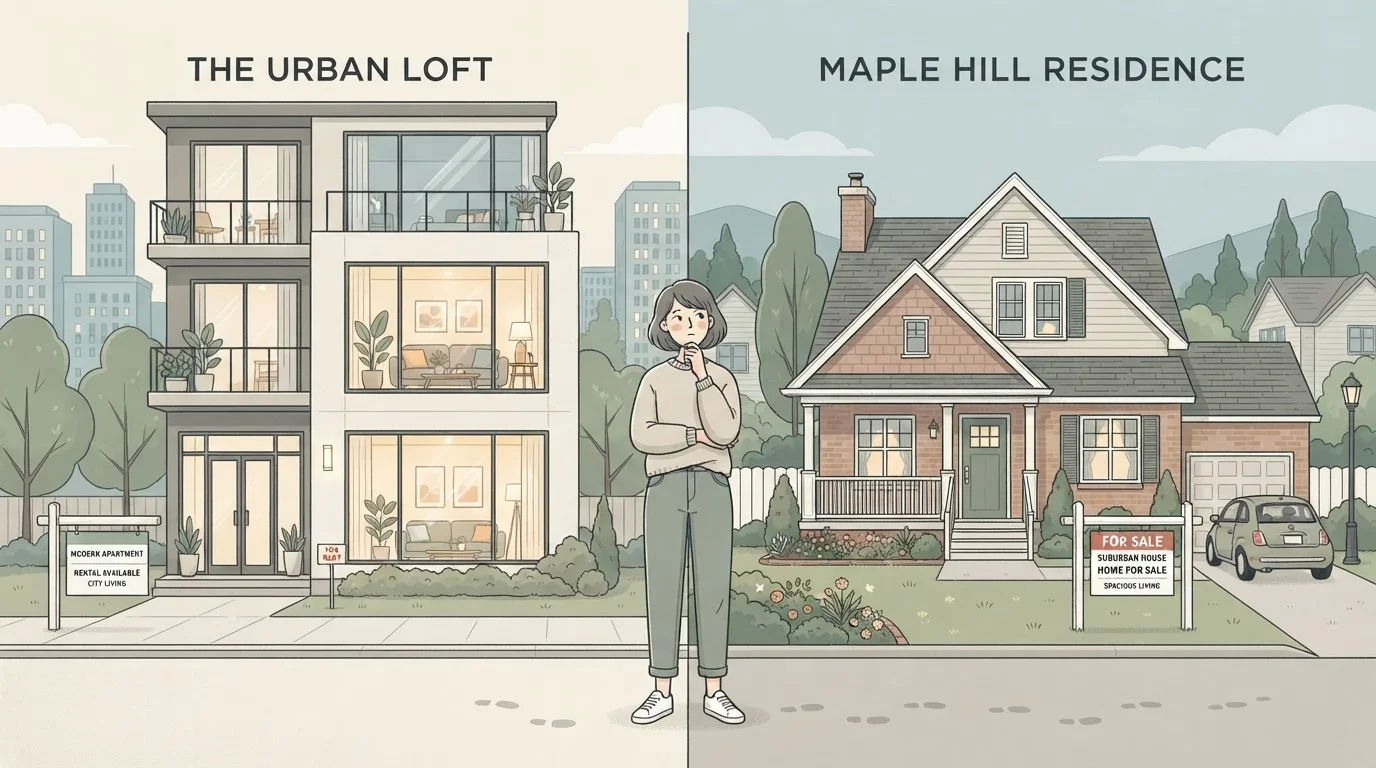
Our Verdict
Buying tends to make stronger financial sense for people with stable incomes, long-term plans in one location, and sufficient savings for a down payment and ongoing costs. Renting is often the smarter move for those prioritizing flexibility, facing uncertain job or life circumstances, or living in high-cost markets where the math doesn't favor ownership. Neither path is inherently right or wrong - the decision depends on your financial picture and life stage.
Buying is best suited for financially stable individuals planning to stay in one location for at least five to seven years; renting suits those who value flexibility or are not yet ready for the full financial commitment of homeownership.
Why This Decision Is More Complicated Than It Looks
The renting-versus-buying debate has long been framed as a simple financial calculation - but that framing misses most of what actually matters. Whether buying a home is smarter than renting depends on your timeline, your local housing market, your savings, your income stability, and what you want your daily life to look like. No single rule applies to everyone.
For renters especially, understanding how ownership actually works - and what it costs - is essential for making a genuinely informed comparison. For a deeper look at how to frame this comparison around your own circumstances, see a clear framework for weighing your financial situation and life goals.
This article lays out the concrete advantages and disadvantages of each path so you can evaluate them against your actual situation.
The Case for Buying: Genuine Advantages
Homeownership carries real financial and personal benefits - but they are conditional, not guaranteed.
Builds equity and long-term wealth potential
Monthly mortgage payments reduce your loan balance and increase your ownership stake. Over time, home appreciation can compound this into significant net worth.
Payment stability with a fixed-rate mortgage
Unlike rent, a fixed-rate mortgage's principal and interest stay constant for the loan term, making long-term budgeting more predictable.
Freedom to customize and renovate
Owners can modify their home - renovate kitchens, paint walls, add landscaping - without seeking a landlord's permission, allowing genuine personalization.
Potential tax considerations
Mortgage interest and property taxes may offer certain tax deductions depending on individual circumstances, though tax situations vary and professional guidance is recommended.
Stability for families and long-term planning
Ownership provides a sense of permanence and community ties that can be especially valuable for families with school-age children or strong local roots.
The most significant advantage of buying is the potential to build equity. As you pay down your mortgage and - ideally - as your home appreciates in value, you accumulate an asset. Over a long enough horizon, that equity can represent substantial wealth. Renters, by contrast, make monthly payments without gaining ownership stake.
Buyers also gain stability. With a fixed-rate mortgage, your principal and interest payment doesn't change over the life of the loan, unlike rent, which landlords can raise at lease renewal. That predictability has real value, particularly for families wanting to stay rooted in a community or school district.
If you're considering what buying actually involves, a practical guide to navigating the home purchase process covers the full range of steps involved.
The Case for Renting: Real Benefits Worth Taking Seriously
Renting is often dismissed as "throwing money away" - a characterization that doesn't hold up to scrutiny. Rent pays for housing, just as a mortgage payment does, and it comes with distinct advantages that ownership does not.
High upfront and ongoing costs
Down payments, closing costs, property taxes, insurance, and maintenance can add tens of thousands of dollars beyond the purchase price - costs renters don't bear directly.
Limited flexibility to relocate
Selling a home involves time, transaction costs, and market risk. Owners who need to move quickly - for a job or personal reasons - face real financial exposure.
Full responsibility for maintenance and repairs
When something breaks, the cost and coordination fall entirely on the homeowner. Major repairs like a new roof or HVAC system can run well into the thousands.
Market risk can erode value
Home values can decline, and owners who sell during a downturn may recover less than they paid - a risk renters are not exposed to directly.
Requires substantial capital to start
Most conventional mortgages require a down payment of at least 3-20% of the purchase price, plus reserves - a significant barrier for many households.
The most underappreciated benefit of renting is flexibility. Renters can relocate for jobs, relationships, or lifestyle changes without the financial and logistical burden of selling a home. In volatile job markets or early career stages, this matters enormously.
Renters are also insulated from many of the costs that quietly erode homeownership's financial appeal: property taxes, homeowners insurance, HOA fees, and maintenance and repair expenses. A roof replacement, HVAC failure, or foundation issue can cost tens of thousands of dollars - costs a renter never faces directly.
If you're new to renting and want to understand the process from start to finish, a complete walkthrough for first-time tenants offers step-by-step guidance. And if you're weighing lease types, comparing month-to-month and fixed-term leases can help you choose the right contract structure.
Renting Isn't Always a Stepping Stone
Cultural narratives often frame renting as a temporary phase before "real" homeownership - but for many Americans, renting is a deliberate, long-term choice. High-cost cities, career mobility, and personal preference all make renting a rational strategy for financially sophisticated households. The goal is housing that fits your life, not meeting a social milestone.
The Financial Math: What the Numbers Actually Require
The financial comparison between renting and buying is real but nuanced. Buying generally becomes more financially advantageous the longer you stay in a home. Most analyses suggest a break-even horizon of roughly five to seven years - before that point, transaction costs (down payment, closing costs, agent commissions when selling) often outweigh the equity gains.
5-7 years
Typical break-even horizon for buying vs. renting
Most real estate analysts estimate buyers need to stay in a home at least five to seven years before purchase costs are offset by equity gains and appreciation.
~6%
Typical total transaction cost when selling a home
Agent commissions and closing costs when selling a home have historically averaged around 6% of the sale price, meaningfully affecting the net financial outcome of short-term ownership.
65%
US homeownership rate (approximate)
The US Census Bureau has consistently tracked homeownership rates in the mid-60% range, reflecting that a significant share of American households rent by choice or necessity.
In high-cost metros, where home prices are elevated relative to local rents, the monthly cost of owning can substantially exceed renting - even after accounting for equity building. In lower-cost markets, the reverse is often true. Local market conditions are impossible to ignore in this calculation.
For a more detailed look at how these market dynamics play out, a balanced look at the financial and lifestyle factors offers additional context on both sides of the ledger.
This article is for general informational purposes only and does not constitute personalized financial, legal, or investment advice. Readers should consult a qualified financial adviser or real estate professional before making housing decisions.
The content on this site is provided for informational purposes only and should not be considered a substitute for professional advice. While we strive to provide accurate and up-to-date information, we make no guarantees regarding its completeness or accuracy. Always consult a qualified professional for advice specific to your circumstances before making any decisions.