

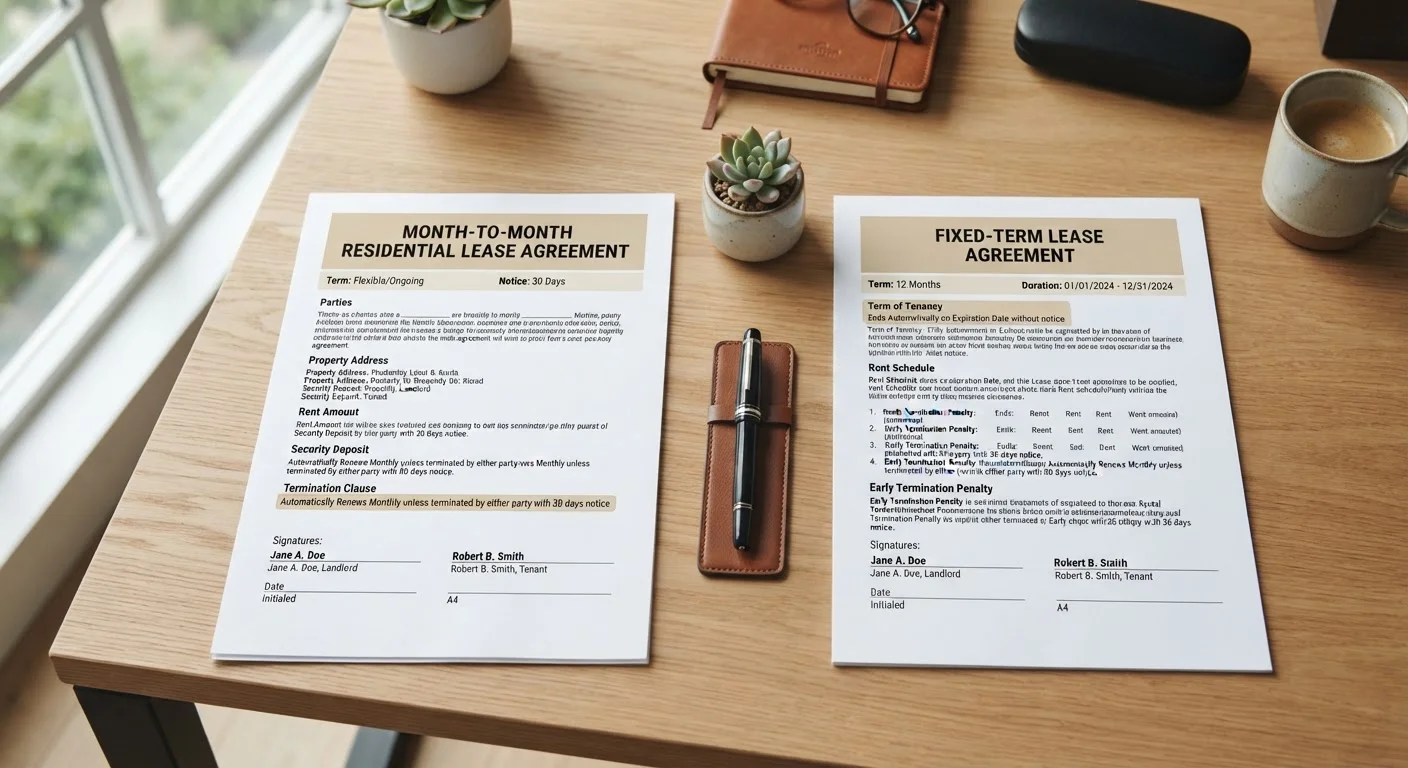
Option A
Month-to-Month Lease
The flexible, rolling rental agreement.
Best for: Renters who need short-term housing, anticipate a move soon, or want freedom to relocate without penalty.
Option B
Fixed-Term Lease
The stable, locked-in rental commitment.
Best for: Renters who plan to stay put for at least a year and want rent certainty and landlord stability.
How Each Lease Type Actually Works
At its core, a lease is a legal contract between a landlord and tenant that defines the terms of occupancy. The key difference between a month-to-month and a fixed-term lease is duration - and the legal protections that flow from it.
A month-to-month lease (sometimes called a tenancy at will) automatically renews each month unless either party gives notice to terminate. In most states, landlords and tenants must provide 30 days' written notice to end the arrangement, though some states require longer. Rent can typically be changed with each renewal cycle, subject to local notice requirements. For tenants, this means significant flexibility - but also real exposure to sudden rent hikes or non-renewals.
A fixed-term lease - most commonly 12 months, though 6-month and 18-month options exist - sets the rent, occupancy terms, and end date at signing. The landlord generally cannot raise rent or terminate the tenancy early without cause during the lease period. At the end of the term, the lease may convert to a month-to-month arrangement, renew automatically, or require a new agreement depending on its language. For an overview of the terminology you'll encounter in either document, see our tenant glossary.
| Criterion | Month-to-Month Lease | Fixed-Term Lease |
|---|---|---|
| Lease duration | Renews monthly automatically | Set period (typically 12 months) |
| Rent stability | Can change with each cycle | Locked for lease term |
| Tenant flexibility | High - exit with ~30 days notice | Low - early exit may incur penalties |
| Typical rent premium | Often 10-20% above market | Standard market rate |
| Landlord termination notice | As little as 30 days in most states | Cannot terminate without cause mid-term |
| Best market conditions | Soft or transitional rental markets | Competitive, high-demand markets |
| Negotiating leverage | Lower - landlord holds more flexibility | Higher - tenant commitment has value |
The Real Tradeoffs: Flexibility vs. Stability
The choice between these two arrangements almost always comes down to a fundamental tension: flexibility versus stability. Neither is objectively superior - the right fit depends heavily on where you are in life.
Month-to-month pros: You can relocate quickly if a job offer, family situation, or personal circumstance demands it. You aren't locked into an apartment that may disappoint you. If you're also weighing whether renting makes more sense than buying at all, understanding the full renting vs. buying tradeoff can provide helpful context before you commit to either lease type.
Month-to-month cons: Landlords often charge a premium - sometimes 10-20% above standard market rent - for the added flexibility. You also have less security: a landlord can decide not to renew with as little as 30 days' notice in many jurisdictions.
Fixed-term pros: Your rent is contractually locked, which helps with budgeting. If you face a sudden rent spike in your area, existing tenants with active leases are insulated. And if you need to break a fixed lease unexpectedly, understanding your options in advance matters - breaking a lease early explores the legal exposure and mitigation strategies in detail.
Fixed-term cons: Life is unpredictable. Early termination clauses vary widely, and in many states you may owe rent through the end of the lease period if you leave early, unless the landlord successfully re-rents the unit. Most states do require landlords to make reasonable efforts to re-rent, which can limit your liability - but the specifics are state-dependent.
State Law Governs Key Protections
Notice periods, allowable rent increase timing, and early termination rights differ meaningfully from state to state - and sometimes by city. For example, some cities with rent stabilization ordinances limit how much and how often a landlord can raise rent even on month-to-month tenancies. Before signing either type of lease, review your state's tenant rights statutes or consult a local tenant advocacy organization to understand exactly what protections apply to you.
What Landlords Prefer - and How That Affects You
Understanding a landlord's perspective helps renters negotiate better. Most landlords prefer fixed-term leases because they reduce vacancy risk and provide predictable cash flow. This preference gives tenants leverage: if you're willing to sign a 12-month lease, you may be able to negotiate a lower starting rent, a waived security deposit fee, or other concessions that a month-to-month applicant wouldn't receive.
Month-to-month arrangements are more common in specific situations: when a tenant is finishing out a lease and hasn't yet decided to renew, when a landlord wants to eventually sell or renovate the property and needs flexibility to give notice, or in markets with lower rental demand where landlords can't hold out for long-term tenants.
If you're budgeting carefully, it's also worth recognizing that rent is a fixed expense in your monthly budget - regardless of which lease type you sign. The distinction between fixed and variable expenses becomes especially relevant when a month-to-month arrangement introduces the possibility of rent changes mid-year. Locking in a fixed-term lease converts that uncertainty into a predictable line item.
Prospective tenants should also be aware that landlords evaluate applicants using income benchmarks. Rent-to-income ratios - typically 2.5x to 3x monthly rent - apply equally regardless of lease type, and meeting them is a baseline requirement for most landlords.
This article is for general informational purposes only and does not constitute legal or financial advice. Lease laws vary significantly by state and locality. Consult a qualified attorney or tenant advocacy organization for guidance specific to your situation.
The content on this site is provided for informational purposes only and should not be considered a substitute for professional advice. While we strive to provide accurate and up-to-date information, we make no guarantees regarding its completeness or accuracy. Always consult a qualified professional for advice specific to your circumstances before making any decisions.