

Fiber Optic Internet: The Gold Standard
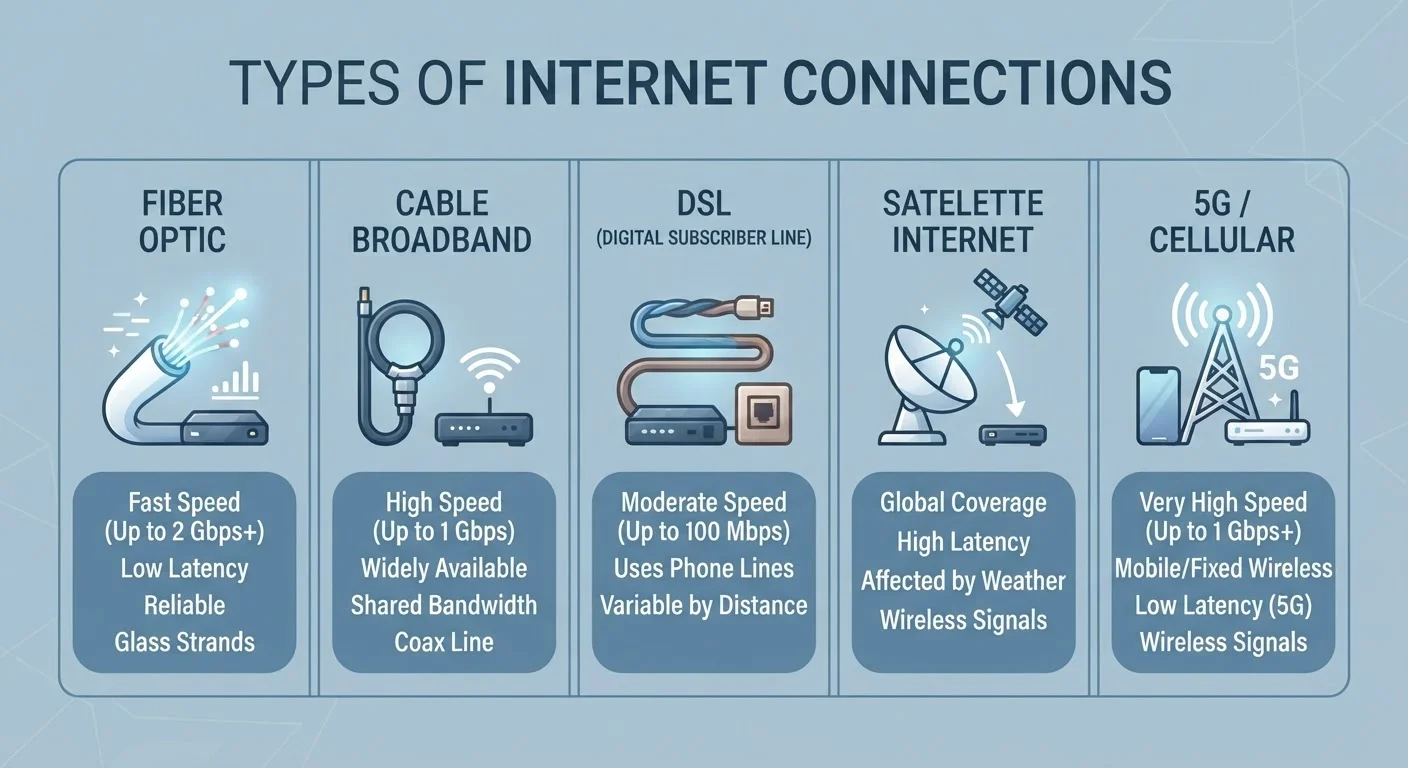
Fiber optic internet transmits data as pulses of light through thin strands of glass or plastic. This approach eliminates much of the signal degradation that affects copper-based technologies, resulting in faster speeds, lower latency, and a more stable connection even during peak usage hours.
One of fiber's most distinctive traits is symmetrical speeds - meaning upload speeds match download speeds. That matters for video conferencing, cloud backups, and remote work. Fiber plans are commonly available at 300 Mbps, 500 Mbps, 1 Gbps, and even higher tiers in some markets.
The main limitation is physical infrastructure. Laying fiber-optic cable is expensive and time-consuming, so availability is concentrated in urban and suburban areas. Rural coverage is growing, supported in part by federal funding initiatives, but it remains uneven. If fiber is available at your address, it is widely considered the most future-proof wired technology currently offered to consumers.
Before committing to any plan, see our guide to evaluating an internet plan to understand what questions to ask about contracts, equipment fees, and advertised versus real-world speeds.
Cable Internet: Widely Available and Generally Fast
Cable internet runs over the same coaxial cable infrastructure originally built to carry television signals. It is one of the most widely deployed broadband technologies in the United States, covering most suburban and many urban areas.
Speeds are competitive - many cable plans offer download rates between 200 Mbps and 1 Gbps. However, cable is typically asymmetrical: upload speeds are often a fraction of download speeds, which can be a drawback for users who regularly send large files or use cloud-based workflows. Cable networks are also shared among nearby households, meaning speeds can dip during high-demand periods in the evening.
Newer cable standards (sometimes marketed under names like DOCSIS 3.1) have reduced this congestion problem significantly, and some providers now offer "multi-gig" cable tiers. Understanding what terms like Mbps and bandwidth actually mean can help you decode advertised plan details - the internet terminology reference breaks these concepts down clearly.
~94%
U.S. households with access to fixed broadband
According to FCC broadband deployment data, the vast majority of Americans have access to at least one fixed broadband option, though speeds and technology types vary considerably.
25/3 Mbps
FCC's longstanding minimum broadband threshold
The FCC historically defined broadband as 25 Mbps download / 3 Mbps upload, though this benchmark has been under review as household data demands have grown.
~19 million
Americans lacking access to broadband
FCC and independent research estimates suggest millions of U.S. residents - disproportionately in rural areas - still lack access to reliable broadband service.
DSL, Satellite, and Fixed Wireless: The Remaining Landscape
DSL (Digital Subscriber Line) transmits broadband data over the copper telephone lines already present in most homes. Because telephone infrastructure is nearly universal, DSL reaches areas where cable and fiber don't exist. Speeds typically range from 5 Mbps to around 100 Mbps depending on distance from the provider's switching facility - the farther away, the slower the connection. DSL is a practical entry point for basic browsing and streaming but may struggle with bandwidth-intensive households.
Satellite internet uses orbiting satellites to send and receive data signals. Traditional geostationary satellites sit roughly 22,000 miles above Earth, producing latency of 500-700 milliseconds - noticeable in video calls and gaming. Low-earth orbit (LEO) satellite services orbit much closer (around 340-600 miles), reducing latency to 25-60 milliseconds in typical conditions. Satellite is often the only viable option in truly remote areas, though weather can affect signal quality.
Fixed wireless connects your home to the internet via radio signals from a local tower, with a small antenna mounted on your roof or exterior wall. It avoids the cable-laying costs of wired services and is expanding rapidly in rural and suburban areas. Performance depends heavily on proximity to the tower and physical obstructions like trees or hills.
How your connection type interacts with your in-home equipment matters too. See what your router actually does to understand how your home network affects the speeds you experience day to day. And if you've encountered confusing claims about speed tiers, common internet speed myths are worth reading before making any decisions.
Frequently Asked Questions
Fiber optic connections consistently deliver the highest speeds, often reaching 1 Gbps or more with symmetrical upload and download rates. Cable can also reach gigabit speeds in some markets, but upload speeds are usually significantly lower than download speeds.
Modern low-earth orbit satellite services have improved latency enough to support video calls and streaming for most users. Traditional geostationary satellite internet, however, has high latency that can make real-time activities feel sluggish.
DSL transmits data over copper telephone lines, while cable uses coaxial cable originally built for television. Cable generally offers faster speeds, but DSL is more widely available in rural and semi-rural areas that lack cable infrastructure.
Fiber availability in rural areas is expanding but remains limited compared to urban and suburban markets. Federal broadband expansion programs are funding rural fiber deployments, but coverage depends on your specific location.
Fixed wireless delivers internet via radio signals transmitted from a ground-based tower to an antenna installed at your home. It requires line-of-sight or near-line-of-sight to the tower and is increasingly available in areas underserved by wired broadband.
You can check availability through the FCC's National Broadband Map or by contacting providers that serve your zip code directly. Availability varies significantly even within the same city or town.
The content on this site is provided for informational purposes only and should not be considered a substitute for professional advice. While we strive to provide accurate and up-to-date information, we make no guarantees regarding its completeness or accuracy. Always consult a qualified professional for advice specific to your circumstances before making any decisions.