

Our Verdict
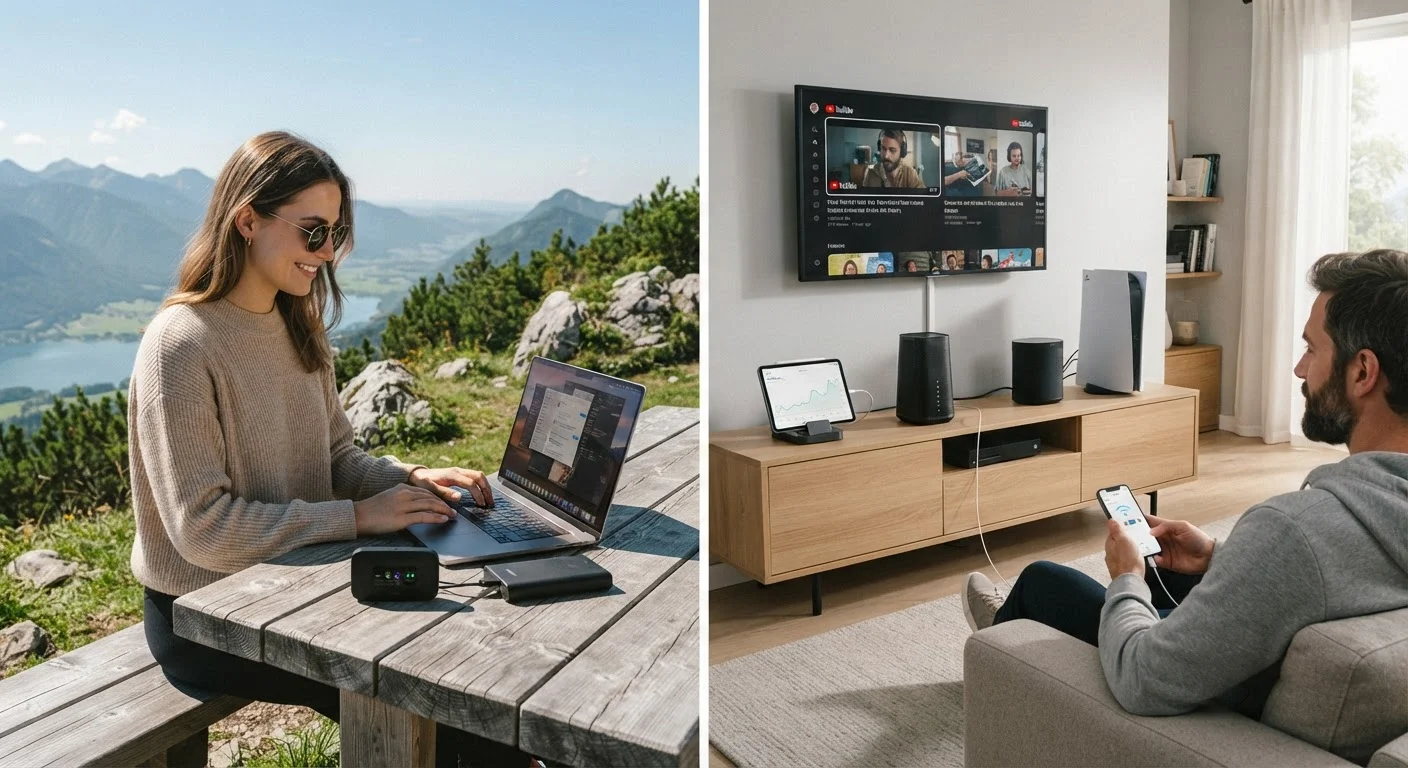
Home broadband remains the stronger choice for households with consistent, high-volume internet needs - streaming, gaming, video calls, and multiple simultaneous users. Mobile hotspots shine for people whose lives or work keep them moving, those bridging a gap between addresses, or anyone in an area where fixed-line service is unavailable or prohibitively priced. Understanding where your usage falls makes the decision straightforward.
| Best for | Recommended |
|---|---|
| Households with multiple users and heavy daily internet use | Home Broadband |
| Frequent travelers, remote workers, or people between residences | Mobile Hotspot |
| Rural locations where fixed-line options are limited | Mobile Hotspot (or satellite as an alternative) |
| Anyone needing a reliable primary connection for video conferencing and cloud work | Home Broadband |
How Each Technology Actually Works
Home broadband arrives at your address through a physical infrastructure - fiber-optic cable, coaxial cable, or DSL telephone lines. A modem translates the incoming signal, and a router distributes it wirelessly or via Ethernet throughout your home. For a closer look at how fiber and cable compare on speed and consistency, see this side-by-side breakdown.
A mobile hotspot works differently. It connects to a cellular network - typically 4G LTE or 5G - and converts that signal into a local Wi-Fi network that your devices can join. The hotspot device itself can be a dedicated gadget or simply your smartphone's built-in tethering feature. Because it relies on cell towers rather than fixed lines, it works anywhere your carrier has coverage, which is both its biggest strength and its biggest vulnerability.
Speed and Reliability: What to Realistically Expect
Fixed home broadband, especially fiber, typically delivers symmetrical or near-symmetrical upload and download speeds with low latency - the delay between sending a request and receiving a response. This consistency matters for video calls, online gaming, and large file transfers. For context on when physical connections give you a measurable edge, wired versus wireless home connections is worth reading.
Mobile hotspot speeds vary considerably based on network congestion, your distance from a cell tower, and whether you're on 4G or 5G. In ideal conditions, 5G hotspots can reach download speeds competitive with cable broadband. In practice - rush hour, crowded venues, rural areas with weaker signal - speeds can drop significantly. Latency on cellular is also generally higher than on fiber, which matters most for real-time applications.
| Mobile Hotspot | Home Broadband | |
|---|---|---|
| Typical speed range | 10-300 Mbps (variable) | 25-1,000+ Mbps (more consistent) |
| Data limits | Hard high-speed caps, then throttled | Large caps or unlimited on many plans |
| Latency | Higher (30-100ms typical) | Lower (5-20ms on fiber) |
| Portability | Works anywhere with cell signal | Fixed to one address |
| Setup complexity | Minimal - device or phone feature | Installation required |
| Multi-user performance | Degrades with many devices | Handles multiple users well |
| Contract requirements | Often month-to-month | Contracts common, some month-to-month |
Data Limits and Throttling: The Fine Print That Matters
Most home broadband plans in the U.S. either have no data cap or enforce a generous monthly threshold - often 1 TB or more - before any throttling occurs. Some providers offer truly unlimited plans at the residential level.
Mobile hotspot plans almost universally come with a high-speed data allotment - a set number of gigabytes at full speed, after which speeds are reduced to a much slower rate until the next billing cycle. This throttling can make video streaming or large downloads frustratingly slow. Standalone hotspot plans may offer 50-100 GB of high-speed data, but household-level usage can easily exceed that within two weeks. Before committing to any plan, evaluating the full terms of an internet plan helps you spot these limitations in advance.
Cost Structure and Who Each Option Serves Best
Home broadband involves a predictable monthly bill - typically including equipment rental fees - and sometimes a contract term. Installation may carry a one-time cost. The value proposition improves as more household members use the connection simultaneously.
Mobile hotspot costs vary. If you're adding hotspot data to an existing cell phone plan, the incremental expense may be modest. A dedicated hotspot device with its own data plan adds another monthly line but grants greater flexibility. For people between leases, traveling extensively for work, or living in locations where cable or fiber hasn't reached, the hotspot model can represent real savings - or the only viable option. In areas where fixed lines genuinely don't reach, satellite internet is another alternative worth considering alongside mobile options.
One often-overlooked factor is security. Using a personal hotspot is meaningfully safer than joining public Wi-Fi networks - but it's still worth understanding what happens to your data on shared networks and applying good practices on any connection type. For broader guidance, the Online Safety hub covers practical steps for staying secure.
The content on this site is provided for informational purposes only and should not be considered a substitute for professional advice. While we strive to provide accurate and up-to-date information, we make no guarantees regarding its completeness or accuracy. Always consult a qualified professional for advice specific to your circumstances before making any decisions.