

How Currency Exchange Actually Works
When you convert U.S. dollars into another currency, you're working with two numbers: the mid-market rate (sometimes called the interbank rate) and the rate you're actually offered. The mid-market rate is the midpoint between global buy and sell prices - it's what you see on Google or financial sites. The rate a currency counter or bank charges you will differ from this, and that gap is how the exchanger earns its margin.
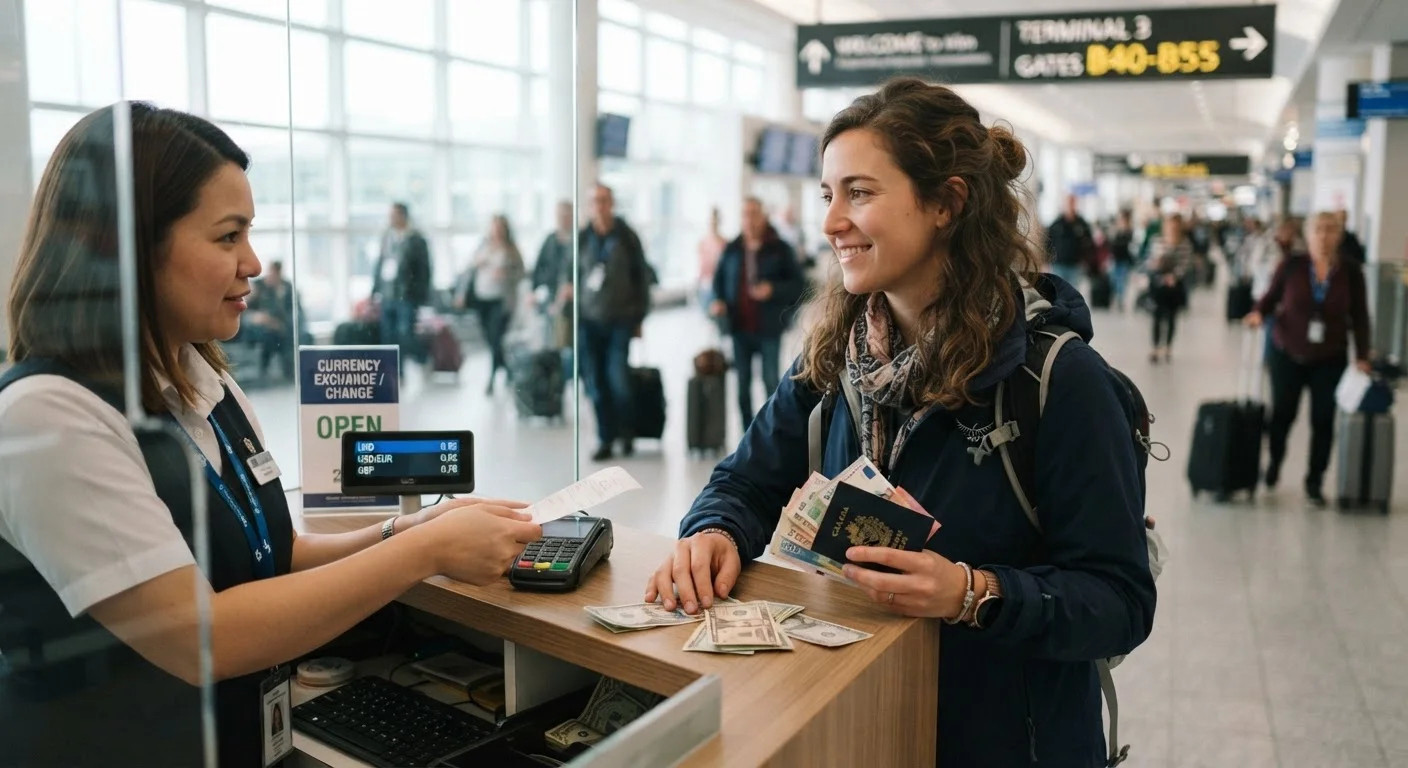
Airport currency exchange desks are convenient but consistently offer rates further from the mid-market than other options. Hotel desks tend to be similar. A more cost-effective approach for most travelers is withdrawing local currency from a bank-affiliated ATM at the destination, which typically applies a rate closer to the mid-market, though fees still apply.
If you want a small amount of foreign cash before you leave - useful for immediate transit costs upon arrival - check whether your home bank can order it in advance, as their rates are generally more competitive than airport counters. For broader trip budgeting context, see our guide to estimating real travel costs before committing to a destination.
Foreign Transaction Fees: What They Are and Where They Hide
A foreign transaction fee is a surcharge applied by your card issuer each time you make a purchase in a foreign currency or route a transaction through a non-U.S. bank. It typically ranges from 1% to 3% of each transaction. On a two-week trip with regular card use, these fees accumulate quickly.
These charges appear in two places travelers often overlook. First, on your credit or debit card's terms - review the fee schedule before packing your wallet. Second, within a practice called dynamic currency conversion (DCC): when a foreign merchant or ATM offers to charge you in U.S. dollars instead of local currency, their conversion rate is almost always worse than what your card issuer would apply. The correct response is to always choose the local currency.
Before any international trip, call your bank to confirm both your daily ATM withdrawal limit and your PIN's compatibility with the destination country's ATM network - don't assume either will work seamlessly.
ATM access failures are one of the most common - and most preventable - financial emergencies travelers encounter abroad. A five-minute call before departure eliminates the risk entirely.
Always decline dynamic currency conversion (DCC) when a card terminal abroad offers to charge you in U.S. dollars. Choose the local currency every time.
DCC rates are set by the merchant, not your card issuer, and consistently result in a less favorable conversion - sometimes 3-7% worse than the interbank rate your card would otherwise apply.
Some checking accounts and travel-oriented cards waive foreign transaction fees entirely and reimburse ATM fees up to a monthly cap. If you travel more than once a year internationally, reviewing whether your current card offers this before your trip is worthwhile. This is general information - consult your bank's current terms for specifics applicable to your account.
Using ATMs Abroad Safely
Bank ATMs affiliated with major international networks (such as Visa Plus or Mastercard Cirrus) are widely available in most countries and generally provide reliable access to local currency. Standalone ATMs in tourist areas - particularly inside convenience stores or nightlife districts - often charge higher fees and may be targeted by card skimmers.
To reduce risk, use ATMs attached to physical bank branches during business hours when possible. Inspect the card slot and keypad before use; if anything looks loose or overlaid, choose a different machine. Shield the keypad when entering your PIN regardless of who is nearby.
Be aware that many U.S. debit cards use a four-digit PIN by default, but some countries' ATMs may prompt for a different format. Verify your PIN works internationally with your bank before departure. Also confirm your daily withdrawal limit - it may be lower abroad than at home, which can affect planning in cash-reliant destinations. Protecting your financial data while traveling connects closely to broader digital security; our guide to keeping your devices and data safe covers related risks including phone theft.
How Much Cash to Carry - and How to Carry It
The right amount of cash depends on your destination. Some countries and regions - particularly in parts of Southeast Asia, Central America, and rural Europe - remain heavily cash-dependent. Others, such as much of Scandinavia, are nearly card-only. Research your specific destination in advance rather than assuming a universal standard applies.
A practical rule: carry enough local cash to cover one to two days of expenses, plus a buffer for transit and tips. Avoid carrying your entire travel budget in cash at once. Split funds between a wallet you access daily and a secondary amount kept separately - in a different bag or a concealed travel wallet - in case of theft or loss.
For rail-heavy itineraries, note that some ticket counters and smaller stations in Europe only accept cash or local payment methods; our overview of European train travel addresses these regional payment quirks in more detail.
Avoid Money Exchange at Unofficial Vendors
Street-level currency exchangers operating outside regulated businesses may offer attractive rates but carry real risks: counterfeit notes, shortchanging, and no recourse if something goes wrong. Use regulated bank counters, ATMs, or licensed exchange offices, and always count your money before walking away.
Notifying Your Bank and Planning for Emergencies
Most U.S. banks and card issuers flag unusual foreign transactions as potential fraud and may freeze your card without warning. Notifying your bank of your travel dates and destinations before departure is a simple step that prevents a common and stressful disruption. Many banks allow you to set travel notices through their mobile app.
Carry at least two payment methods - ideally from different networks (e.g., Visa and Mastercard) - so that if one card is compromised or declined, you're not stranded. Keep a record of your card's international customer service number stored separately from the card itself, so you can report a lost or stolen card promptly.
For emergencies that exhaust your available funds, some bank networks and wire services allow emergency transfers internationally, though these carry fees and take time to process. Knowing the process in advance is better than discovering it during a crisis. Before any international trip, review the full pre-departure checklist in our pre-departure verification guide - financial preparedness is one part of a broader set of steps worth confirming.
This article provides general financial information for travel planning purposes only. It is not personalized financial, banking, or legal advice. Consult your bank or a qualified financial professional for guidance specific to your accounts and circumstances.
The content on this site is provided for informational purposes only and should not be considered a substitute for professional advice. While we strive to provide accurate and up-to-date information, we make no guarantees regarding its completeness or accuracy. Always consult a qualified professional for advice specific to your circumstances before making any decisions.