

Our Verdict
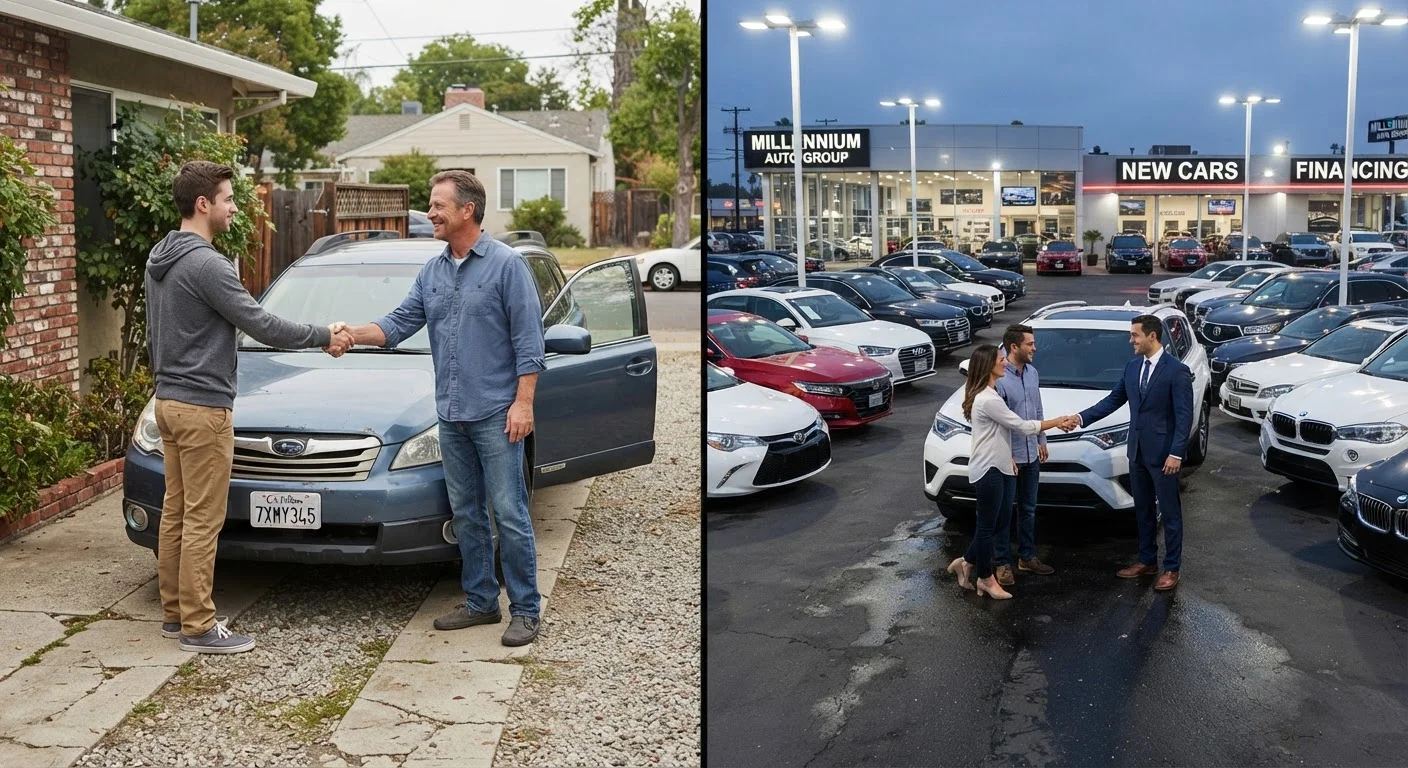
Neither channel is universally better - the right choice depends on your risk tolerance, financing needs, and how much due diligence you're prepared to do. Private sales can deliver real savings for buyers who know what to look for, while dealerships provide structured protections that justify their typically higher prices for buyers who want more certainty.
| Best for | Recommended |
|---|---|
| Buyers comfortable doing independent research and inspections | Private Seller |
| Buyers who want financing options and consumer protections in one place | Dealership |
| First-time used car buyers with limited mechanical knowledge | Dealership |
| Buyers seeking the lowest possible out-of-pocket price on a specific vehicle | Private Seller |
The Core Difference: Who You're Buying From
When you buy a used car from a private seller, you're dealing with an individual - often the vehicle's previous owner - who has no ongoing business relationship with you after the transaction closes. When you buy from a dealership, you're dealing with a licensed, regulated business entity subject to state and federal consumer protection laws.
That distinction shapes almost everything else: pricing, paperwork, recourse if something goes wrong, and the overall experience of the transaction. Neither route is inherently safer or smarter - they involve genuinely different trade-offs worth understanding before you commit.
Before you get behind the wheel of any candidate vehicle, asking the right questions upfront can reveal red flags that no test drive alone will surface.
Price and Negotiation
Private sellers generally list vehicles closer to their actual market value or below, because they have no overhead costs to recoup - no lot, no staff, no advertising budget. This creates a real opportunity for buyers to pay less for the same car compared to a dealership asking price.
However, negotiating with a private seller is a personal interaction, and emotion can complicate the process on both sides. The seller may be attached to their vehicle and resistant to offers they perceive as low. Unlike dealerships, there's no standard process for back-and-forth, and sellers are under no obligation to disclose what comparable vehicles sell for.
Dealerships carry more layers of margin, including reconditioning costs, documentation fees, and sometimes add-ons bundled into the price. Common negotiation assumptions can quietly work against buyers at the dealership, particularly when monthly payment framing obscures the total cost of the vehicle. If you're also trading in a car, be aware that trade-in valuations vary considerably from one dealership to the next.
| Private Seller | Dealership | |
|---|---|---|
| Typical Price | Often lower, less overhead | Higher, includes reconditioning and fees |
| Consumer Protections | Minimal; usually sold as-is | FTC Buyers Guide required; state laws may apply |
| Financing Options | Buyer must arrange independently | In-house financing available on the spot |
| Warranty | Rarely offered | Implied or limited warranty often included |
| Title and Paperwork | Buyer handles DMV process directly | Dealer typically manages transfer |
| Negotiation Dynamic | Personal, informal, variable | Structured, business process |
| Vehicle Inspection Access | Depends on seller's cooperation | Standard practice; may require seller approval |
Consumer Protections and Legal Recourse
This is where the gap between private and dealer purchases becomes most significant. Licensed dealerships in the United States are regulated at the state level and must comply with the Federal Trade Commission's Used Car Rule, which requires a Buyers Guide disclosing warranty terms on every vehicle. Many states also impose implied warranty protections on dealer-sold vehicles, meaning a car must be fit for its basic purpose for a period of time after sale - even without an explicit written warranty.
Private sales are almost universally conducted as-is. Once the title transfers and the money changes hands, the buyer has little legal standing if undisclosed problems emerge. Fraud claims are possible in theory if a seller knowingly concealed a major defect, but pursuing them through small claims court is time-consuming and uncertain.
As-Is Sales Offer No Automatic Recourse
When a private sale is completed as-is, discovering a major mechanical problem the next day generally leaves you with no legal remedy unless you can prove the seller deliberately concealed it. Even then, pursuing a claim is often more costly than the repair itself. Never skip an independent pre-purchase inspection, and pull a vehicle history report before any money changes hands.
For buyers considering certified pre-owned options through a dealership, it's worth understanding exactly what CPO certification covers - the protections vary meaningfully by automaker program.
Financing, Paperwork, and the Path to Registration
Dealerships are set up to handle financing in-house, often offering multiple lender options on the spot. This convenience comes at a potential cost - dealer-arranged financing doesn't always carry the most competitive interest rates. Comparing dealer offers against your own bank or credit union before signing is a sound practice. A detailed look at financing through a dealer versus your own bank can help clarify what you'd actually pay over the life of a loan.
Private sales require buyers to arrange their own financing independently and handle title transfer paperwork directly with their state's DMV. If the seller still has a lien on the vehicle - meaning they owe money on it - the transaction becomes more complicated, requiring lender coordination before the title can transfer cleanly. Buyers who are considering a vehicle from out of state should also account for the registration and tax implications of an out-of-state purchase.
Due Diligence: What You Should Do Either Way
Regardless of where you buy, certain steps are non-negotiable. A vehicle history report - run on the VIN (Vehicle Identification Number) - will flag prior accidents, title issues such as salvage or flood designations, and odometer discrepancies. These reports don't catch everything, but they reveal information the seller may not volunteer.
More important is a pre-purchase inspection by an independent mechanic of your choosing. Dealerships may push back on this, and private sellers vary in their willingness to accommodate it. Any hesitation from a seller - private or dealer - about an independent inspection should be treated as a warning sign. For ongoing service after purchase, weighing a dealer service center against an independent mechanic is a separate but related decision worth making intentionally.
Finally, understanding how depreciation affects a vehicle's value helps you assess whether the asking price - private or dealer - reflects what the car is actually worth in today's market.
The content on this site is provided for informational purposes only and should not be considered a substitute for professional advice. While we strive to provide accurate and up-to-date information, we make no guarantees regarding its completeness or accuracy. Always consult a qualified professional for advice specific to your circumstances before making any decisions.