

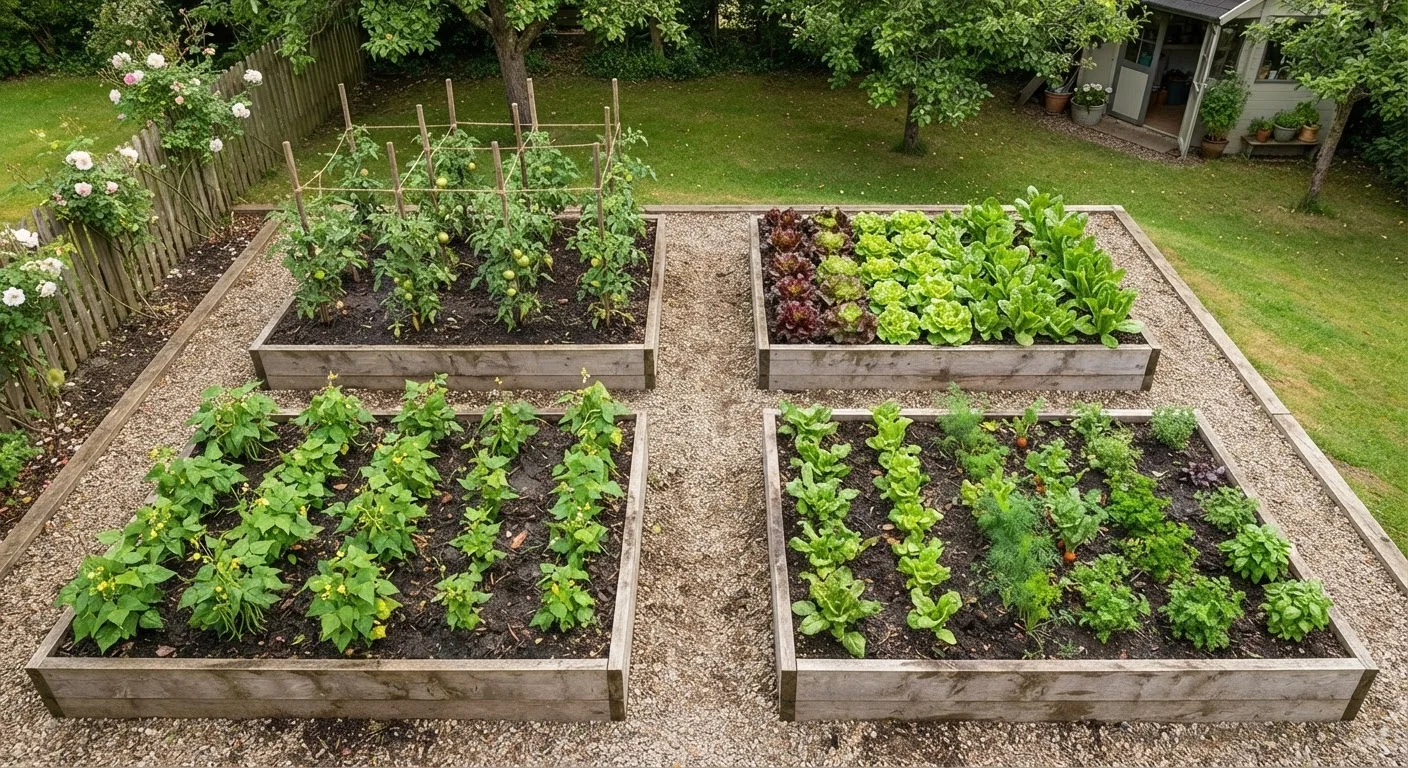
Why Planning Matters Before You Plant
A vegetable garden that's thought through before the first seed goes in almost always outperforms one that's improvised row by row. Good planning isn't complicated - it's mostly about understanding how plants compete for resources and how repeating the same crops in the same spot year after year invites trouble.
If you're new to growing food, it helps to start with the basics. Our guide to soil, sunlight, and water walks through the three fundamentals every beginner should understand before putting anything in the ground. Once those are solid, spacing, rotation, and companion planting become much easier to apply.
This guide covers each of those three planning principles clearly, separating what's well-supported from what's garden myth, so you can make decisions that actually move the needle.
Spacing: How Far Apart Should Vegetables Go?
Spacing affects airflow, root competition, light access, and how easy a bed is to maintain. Crowd plants too tightly and you invite fungal disease and stunted growth. Space them too generously and you waste productive ground.
Seed packets and transplant tags list recommended spacing for good reason - those numbers reflect the mature size of the plant, not its seedling size. Here are reliable guidelines for common vegetables:
- Tomatoes: 18-24 inches apart in rows spaced 36-48 inches apart (indeterminate varieties need more room).
- Lettuce and salad greens: 6-10 inches apart; they tolerate closer spacing when harvested young.
- Zucchini and summer squash: 24-36 inches per plant - they spread aggressively.
- Beans (bush type): 4-6 inches apart in rows 18 inches apart.
- Carrots: Thin to 2-3 inches apart after germination for full-sized roots.
- Peppers: 18 inches apart in rows 24-36 inches apart.
Raised beds allow slightly tighter block planting (spacing equally in all directions) rather than traditional rows, which can increase yield per square foot. Our comparison of raised beds and in-ground planting explains how the setup you choose affects spacing decisions.
When in doubt on spacing, always err on the wider side for your first season. You can always fill gaps with quick-maturing crops like radishes or lettuce while your main plants establish.
Overcrowding is one of the most common first-year mistakes and is much harder to correct mid-season than under-planting.
Label your beds with the plant family name, not just the crop name. When you rotate next season, you're moving families - not individual vegetables - so thinking in families from the start saves confusion.
Many gardeners accidentally replant the same family by switching from tomatoes to peppers, not realizing both are nightshades. Family-level labeling prevents this.
Crop Rotation: Protecting Your Soil Year After Year
Crop rotation means moving plant families to different areas of your garden each season rather than planting the same crops in the same spots repeatedly. The core benefit is interrupting the life cycles of soil-borne pathogens and pests that target specific plant families.
The four major vegetable families used in rotation planning are:
- Solanaceae (nightshades): Tomatoes, peppers, eggplant, potatoes. Heavy feeders; prone to blight and nematodes.
- Brassicaceae (brassicas): Cabbage, broccoli, kale, turnips. Clubroot and cabbage worms build up in static soil.
- Fabaceae (legumes): Beans, peas. Fix atmospheric nitrogen, leaving soil enriched for the following season's heavy feeders.
- Apiaceae and others (roots/alliums): Carrots, parsnips, onions, garlic. Lighter feeders; good at following legumes or heavy feeders.
A simple four-year rotation cycles each family through each bed position so no family returns to the same spot for at least three years. Even a two-year rotation - just avoiding the same family in the same spot back-to-back - offers meaningful protection.
Pairing rotation with good composting habits amplifies the benefit. Our guide to composting from scratch covers how to build and maintain a compost pile that keeps your rotated beds healthy.
Companion Planting: What the Evidence Actually Shows
Companion planting - growing certain plants near each other to achieve mutual benefits - has a long history in gardening culture. Some combinations are well-supported; others are repeated as folklore without meaningful evidence. Here's an honest breakdown:
Combinations with solid support
- Basil near tomatoes: Some research suggests basil may deter thrips on tomatoes, and the pairing makes practical use of space. The claim that it improves tomato flavor is anecdotal.
- Nasturtiums as trap crops: Nasturtiums genuinely attract aphids away from vegetables. Plant them at bed edges, then remove or discard infested plants.
- The Three Sisters (corn, beans, squash): A traditional Indigenous polyculture with practical logic - corn provides a trellis for beans, beans fix nitrogen, squash leaves shade the soil and suppress weeds. This works in larger garden spaces.
- Marigolds near susceptible crops: French marigolds (Tagetes patula) have demonstrated nematode-suppressing properties in research when planted densely for a full season, not just tucked in corners.
Combinations that are largely mythologized
- Carrots and onions: The idea that they repel each other's pests is not well-supported by controlled studies.
- Most aromatic herbs as universal pest repellents: The effect is inconsistent in garden-scale conditions.
Don't Rely Solely on Companion Planting for Pest Control
Companion planting is a useful supplementary tool, not a standalone pest management system. Relying on it exclusively - while skipping rotation, sanitation, or other integrated pest management practices - can leave crops vulnerable. Use companions as one layer of a broader strategy, not a replacement for fundamentals.
For beginners, focusing on a few evidence-backed companions is more productive than restructuring an entire garden around companion planting charts. Check our list of easy vegetables for first-time growers for crops that pair well with beginner-friendly companions.
Putting It All Together: A Simple Planning Framework
You don't need special software to plan a productive garden. A pencil sketch and a list of plant families will do the job. Here's a practical approach:
- Divide your space into zones. Whether you're working with raised beds or in-ground rows, designate four roughly equal areas for the four plant families described above.
- Note what grew where last year. Even rough memory helps. If you grew tomatoes in zone A, move the nightshade family to zone B this season.
- Apply spacing before you transplant. Mark out spacing with stakes or a measuring tape before plants go in - it's much harder to rearrange after the fact.
- Choose one or two evidence-backed companion pairings. Add nasturtiums at bed edges, or plant a dense border of French marigolds the season before a heavy-feeding crop.
- Record it. A simple notebook entry noting what you planted where, and when, pays off enormously next season.
Timing your planting within a seasonal calendar makes this framework even more effective. Our seasonal gardening calendar matches these planning principles to the right time of year for each region. And if you're working with limited outdoor space, container gardening on a patio or balcony adapts spacing and companion planting ideas for smaller setups.
Good planning doesn't require perfection - it just requires a little forethought before the season begins. That investment, made once, pays dividends all growing season long.
The content on this site is provided for informational purposes only and should not be considered a substitute for professional advice. While we strive to provide accurate and up-to-date information, we make no guarantees regarding its completeness or accuracy. Always consult a qualified professional for advice specific to your circumstances before making any decisions.